Flag

We stand with Ukraine and our team members from Ukraine. Here are ways you can help

Get exclusive access to thought-provoking articles, bonus podcast content, and cutting-edge whitepapers. Become a member of the UX Magazine community today!

Home ›› Design ›› A Six-Minute Breakdown of Gartner’s Top Conversational AI Platforms

Member-only story

A Six-Minute Breakdown of Gartner’s Top Conversational AI Platforms

by UX Magazine Staff
11 min read
Share this post on
Tweet
Share
Post
Share
Email
Print

Save

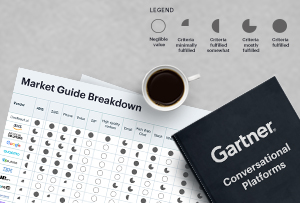
There’s a ton of noise, promises and exaggerations flying around. Here’s a breakdown of the sixteen conversational AI platforms in Gartner’s 2019 Market Guide.

With so much noise and hyperbole surrounding today’s race for AI and hyper-automation, choosing a conversational AI platform is a daunting task.

You might be a problem solver at an enterprise aiming to accelerate adoption of AI and conversational technology, a designer looking to create more useful chatbot experiences, or analyst researching tools for iterative, rapid hyper-automation of workflows and business processes. No matter your level of experience or technical background, tools for designing and deploying conversational AI applications are getting easier and better, and some have focused their design around user experience. We took our best shot at evaluating and summarizing the list of top platforms that Gartner Research included in their 2019 Market Guide for Conversational Platforms. 

Become a member to read the whole content.

Become a member
post authorUX Magazine Staff

UX Magazine Staff
UX Magazine was created to be a central, one-stop resource for everything related to user experience. Our primary goal is to provide a steady stream of current, informative, and credible information about UX and related fields to enhance the professional and creative lives of UX practitioners and those exploring the field. Our content is driven and created by an impressive roster of experienced professionals who work in all areas of UX and cover the field from diverse angles and perspectives.

Tweet
Share
Post
Share
Email
Print

Related Articles

What if your productivity app could keep you as focused as your favorite game? This article explores how game design psychology can transform everyday tools into experiences that spark flow, focus, and real engagement.

Article by Montgomery Singman
Flow State Design: Applying Game Psychology to Productivity Apps
  • The article shows how principles from game design can help productivity tools create and sustain a flow state.
  • It explains that games succeed by balancing challenge and skill, providing clear goals, and offering immediate feedback — elements most productivity apps lack.
  • The piece argues that applying these psychological insights could make work tools more engaging, adaptive, and motivating.
Share:Flow State Design: Applying Game Psychology to Productivity Apps
12 min read

Learn how understanding user emotions can create intuitive, supportive designs that build trust and loyalty.

Article by Pavel Bukengolts
The Role of Emotion in UX: Embracing Emotionally Intelligent Design
  • The article emphasizes that emotionally intelligent design is key to creating meaningful UX that satisfies users and drives business success.
  • It shows how understanding users’ emotions — through research, empathy mapping, journey mapping, and service blueprinting — can reveal hidden needs and shape more intuitive, reassuring digital experiences.
  • The piece argues that embedding empathy and emotional insights into design strengthens user engagement, loyalty, and overall satisfaction.
Share:The Role of Emotion in UX: Embracing Emotionally Intelligent Design
5 min read

As AI takes on more of the solution work, the real craft of design shifts to how we frame the problem. This piece explores why staying with uncertainty and resisting the urge to rush to answers may be a designer’s most powerful skill.

Article by Morteza Pourmohamadi
The Frame, the Illusion, and the Brief
  • The article highlights that as AI takes over more of the solution work, the designer’s true craft lies in framing the problem rather than rushing to solve it.
  • It shows how cognitive biases like the need for closure or action bias can distort our perception, making careful problem framing essential for clarity and creativity.
  • The piece argues that framing is itself a design act — a practice of staying with uncertainty long enough to cultivate shared understanding and more meaningful outcomes.
Share:The Frame, the Illusion, and the Brief
3 min read

Join the UX Magazine community!

Stay informed with exclusive content on the intersection of UX, AI agents, and agentic automation—essential reading for future-focused professionals.

Hello!

You're officially a member of the UX Magazine Community.
We're excited to have you with us!

Thank you!

To begin viewing member content, please verify your email.

Tell us about you. Enroll in the course.

    This website uses cookies to ensure you get the best experience on our website. Check our privacy policy and