Genre matters: the missing framework
Here’s the most important thing most gamification designers miss: there is no single “game psychology.”
When a product team says, “Let’s add gamification,” they’re making the same mistake as saying, “Let’s add music,” without specifying what kind of music. Jazz? Heavy metal? Classical? Each attracts different audiences through completely different emotional mechanisms. Games work the same way.
Different genres attract different players through fundamentally different psychological hooks. An RPG player seeks narrative meaning and character growth. A puzzle player wants elegant problem-solving. A strategy player craves long-term planning and mastery of systems. These aren’t superficial preferences—they’re different motivational structures.
The framework for Gamification 2.0 is this: you must choose your genre intentionally.
Don’t grab random mechanics from different game types and mash them together. Understand what genre your app naturally aligns with, study what makes that genre work, and design accordingly.
Let me break down the major genres and what gamification designers can learn from each.
A. Narrative-driven games/RPGs
Examples: The Last of Us, Final Fantasy, Mass Effect
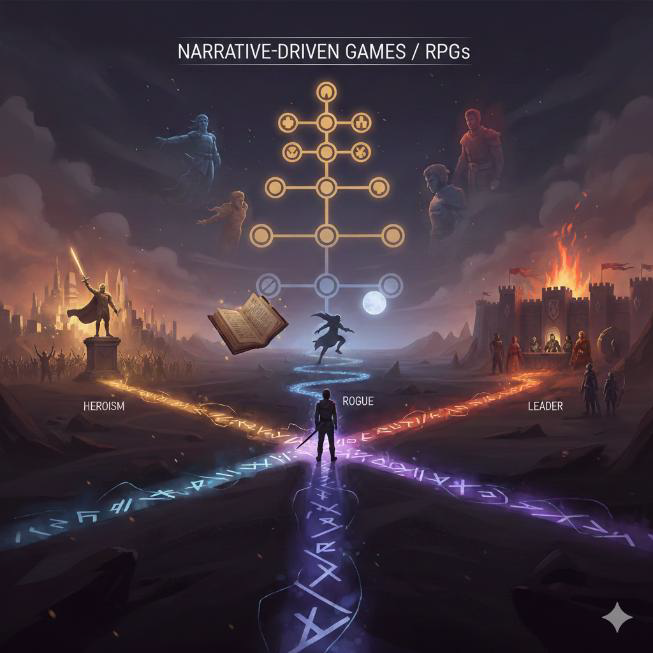
Who they attract:
Story-seekers. People who want experiences with emotional weight and meaning. Players who care deeply about character development, plot arcs, and world-building. These are the players who remember specific dialogue from games they played a decade ago, who write fan fiction about characters, and who replay games to see different story branches.
The core hook:
- Anticipation: “What happens next?” RPGs master the cliffhanger. Every quest completion opens new questions. Every character interaction hints at a deeper backstory. Players stay engaged because they’re invested in seeing how the story resolves.
- Identity: “Who am I in this world?” RPGs let players inhabit a role. Not just controlling a character, but becoming someone. You’re not just playing Geralt in The Witcher—you’re deciding what kind of Witcher he is. Ruthless or compassionate? Cynical or idealistic?
- Investment: “I’ve spent 40 hours with these characters.” The time commitment itself creates emotional attachment. When a beloved character dies in an RPG, players feel genuine grief. That’s not manipulation—that’s successful storytelling creating real emotional investment.
What gamification can learn:
Stop treating your user journey as a feature checklist. Give users a story arc, not just a progress bar.
Duolingo could frame language learning as chapters in a journey: “You’re not just earning XP—you’re unlocking the ability to navigate a Spanish-speaking country, read García Márquez in the original, and connect with 500 million new people.” That’s narrative framing. That’s the meaning.
Frame each milestone as a narrative beat: “You’ve mastered the present tense—you can now describe your daily life in Spanish.” Not “You reached Level 5.” One creates identity and capability. The other creates arbitrary numbers.
Build emotional investment over time. Show users how far they’ve come, not just where they’re going. Let them look back at their early work and see growth. That’s the RPG’s trick: making a time investment feel meaningful.
Actionable for developers:
If your app helps users build something over time—skills, projects, knowledge, health—consider RPG mechanics. Create a narrative arc around their journey. Show them becoming someone new. Give them identity markers that reflect real capability development, not arbitrary levels.
B. Action/Twitch-based games
Examples: DOOM, Call of Duty, Street Fighter, Mortal Kombat, Guitar Hero
Who they attract:
Skill-focused players who want immediate feedback on their performance. People who enjoy motor mastery and physical precision. Competitive players who want to prove they’re better than others at execution. These are players who practice the same move thousands of times to shave off a tenth of a second.
The fighting game community represents some of gaming’s most dedicated practitioners. Street Fighter players spend years mastering frame-perfect combos, learning matchups, and studying tournament footage. This isn’t casual entertainment—it’s deliberate practice toward measurable mastery.
The core hook:
- Feel: Action games live or die on “game feel”—the immediate responsiveness of controls, the feedback of impact, and the satisfying weight of every action. When you fire a gun in DOOM, it feels powerful. When you land a combo in Street Fighter, the visual and audio feedback create visceral satisfaction. This is often called “juice” in game design—the sensory polish that makes every action feel good.
- Flow State: Complete absorption in high-intensity action. Your conscious mind disappears. You’re just reacting, executing, performing. Time distorts. This is the feeling Guitar Hero players chase—being so locked into the rhythm that you forget you’re playing a game.
- Mastery: Visible improvement in execution. Fighting game players can see their skill progression clearly: combos they couldn’t land last month are now muscle memory. Speedrunners shave seconds off their times through better execution. The skill curve is steep, but the feedback is immediate and honest.
What gamification can learn:
Instant feedback matters more than delayed rewards. When a user completes an action in your app, they should immediately know if they did it well. Not a notification three hours later—immediate sensory feedback.
Make the core interaction feel good. This is where most productivity apps fail catastrophically. They treat every action as a chore to get through to earn a reward. Action games teach us: the action itself should be satisfying.
Duolingo actually gets this partly right with its pronunciation exercises. When you nail a pronunciation, you get immediate audio and visual feedback. That moment feels good regardless of the XP awarded. More apps should study this.
Focus on how the task feels, not just what users get for doing it. If logging a workout feels tedious, no amount of badges will make users want to do it. If the act of logging itself is smooth, quick, and satisfying—with nice animations, clear feedback, maybe a bit of haptic response—users will do it for its own sake.
Actionable for developers:
If your app requires users to repeatedly perform the same core actions—logging data, creating entries, completing tasks—study action games’ “juice.” Add satisfying animations. Include audio feedback. Make the action itself pleasurable through sensory design. Test whether the core loop feels good even with all rewards removed.
Fitness apps should make logging feel as responsive as landing a combo in Street Fighter. Note-taking apps should make capturing thoughts feel as smooth as executing a speedrun trick. The interaction itself should be rewarding.
C. Strategy & 4X games
Examples: Civilization, StarCraft, Whiteout Survival, Evony: The King’s Return, Last War: Survival
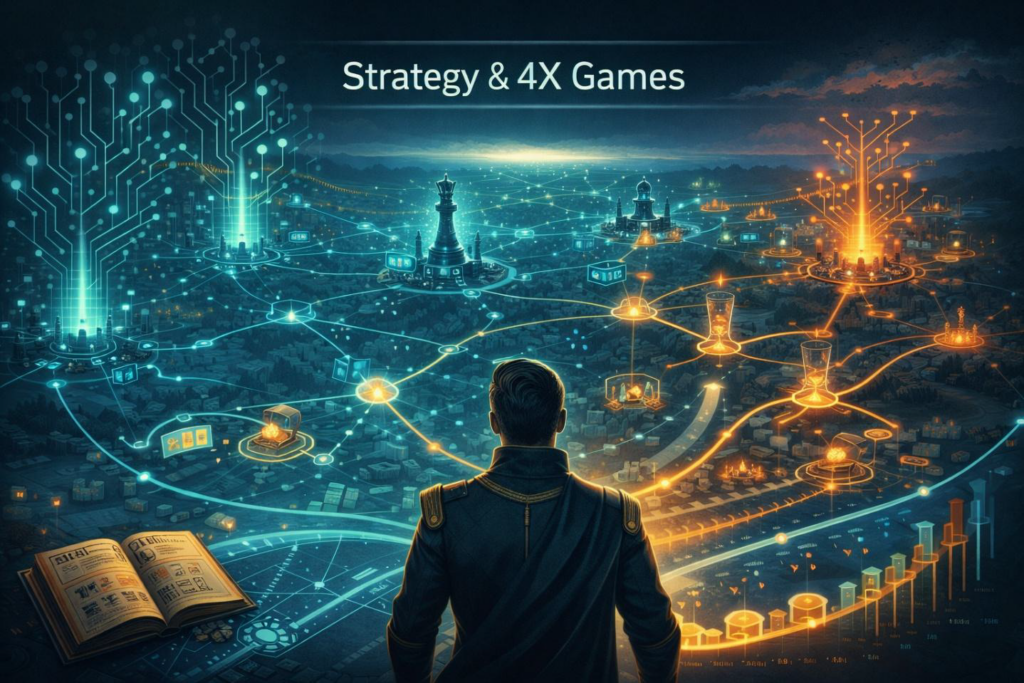
Who they attract:
Long-term planners. Optimizers. People who enjoy complex systems and want to feel in control of outcomes. Players who think several moves ahead, who enjoy discovering how different systems interact, and who spend hours theorycrafting optimal builds.
Alliance-oriented players. These mobile strategy games generate billions partly through social commitment structures. You’re not just building your own empire—you’re coordinating with dozens of allies in real-time events.
The mid-core mobile audience willing to invest significant time and money in strategic depth. Whiteout Survival and Last War: Survival players often spend months or years in a single game, building not just bases but relationships and reputations.
The core hook:
- Strategic Depth: Decisions have cascading consequences. In Civilization, choosing to research “Writing” instead of “Bronze Working” shapes your next hundred turns. You’re not just making one choice—you’re making a choice that opens certain paths and closes others. Every decision creates opportunity costs.
- Exploration: Discovering how systems interact. The “X” in 4X stands for eXplore, eXpand, eXploit, and eXterminate, but the deepest exploration is mechanical, not spatial. Learning that military tech synergizes with diplomatic policies, that certain hero combinations create devastating effects, and that resource management connects to alliance coordination.
- Optimization: Finding the “perfect” strategy. Strategy gamers are spreadsheet enthusiasts. They calculate cost-per-turn efficiency. They test different build orders. They optimize everything that can be optimized, then share their findings with other players.
- Long-Term Investment: Building empires over weeks or months, not hours. These games respect players who invest time. Your early decisions compound into visible power months later. This creates sunk cost attachment, but done well, it’s also a genuine accomplishment—you built something substantial.
- Social Obligation: Alliance commitments create retention that no solo game can match. When your alliance is planning a coordinated attack on Saturday at 8 PM, you show up. Not because the game bribed you, but because 50 real humans are counting on you. This is cooperative accountability—possibly the strongest engagement mechanism in gaming.
- Survival Pressure: Games like Whiteout Survival and Last War add urgency through environmental or apocalyptic threats. Your base has a “freeze timer”—let it run out, and you face consequences. This creates natural urgency without artificial daily streaks. The pressure comes from the game world, not from guilt-tripping notifications.
What gamification can learn:
Let users plan and see long-term payoff. Most apps are immediate-gratification focused. Strategy games teach us that many users will engage more deeply if they can make plans that take weeks to come to fruition.
Reveal system depth gradually. Don’t overwhelm users with complexity upfront. Civilization doesn’t teach you every game system in the tutorial. You discover trade routes, then diplomacy, then religion, each when it becomes relevant. Complexity reveals itself through play.
Reward thoughtful choices, not just activity. Stop measuring engagement by DAU alone. Strategy games show that some players will engage weekly for years rather than daily for weeks, and they’ll spend more money and refer more users.
Create meaningful trade-offs. Every decision should foreclose some options while opening others. If every path leads to the same outcome, there’s no strategy—just the illusion of choice.
Leverage social commitment. Whiteout Survival keeps players engaged through alliance wars, coordinated events, and mutual aid systems. People stay not just for personal progress but also because others depend on them. That’s infinitely more powerful than leaderboards.
Show compound growth. These games excel at making players feel their early investments paying off months later. A building you upgraded in week one makes week twelve more powerful. That’s satisfying in a way no streak counter ever will be.
Actionable for developers:
Project management tools could let users experiment with different approaches and see projected outcomes, not just follow linear task lists. Show them: “If you prioritize these three tasks, here’s your likely project timeline. If you prioritize these other three, here’s the alternative path.” That’s strategic thinking.
Financial planning apps could adopt the “tech tree” model. Show how small decisions compound into different futures. “Saving $200/month now unlocks these options in five years. Saving $400/month unlocks these different options.” Make financial planning feel like Civilization’s research trees.
Team productivity tools should create interdependencies that make individuals feel accountable to the group. Not competition—cooperation. Alliance mechanics, not leaderboards. People should feel they’re letting down teammates, not just themselves, if they don’t contribute.
Revenue insight:
Whiteout Survival and Last War: Survival each generates hundreds of millions annually, not through shallow daily login rewards, but through creating systems where players feel genuine ownership, strategic agency, and social responsibility. Players spend money not to skip gameplay but to accelerate meaningful strategic choices. That’s the strategy genre’s real lesson for gamification: invest in feeling strategic, not compulsive.
D. Puzzle games
Examples: Portal, Baba Is You, Wordle, Royal Match, Toy Blast, EverMerge
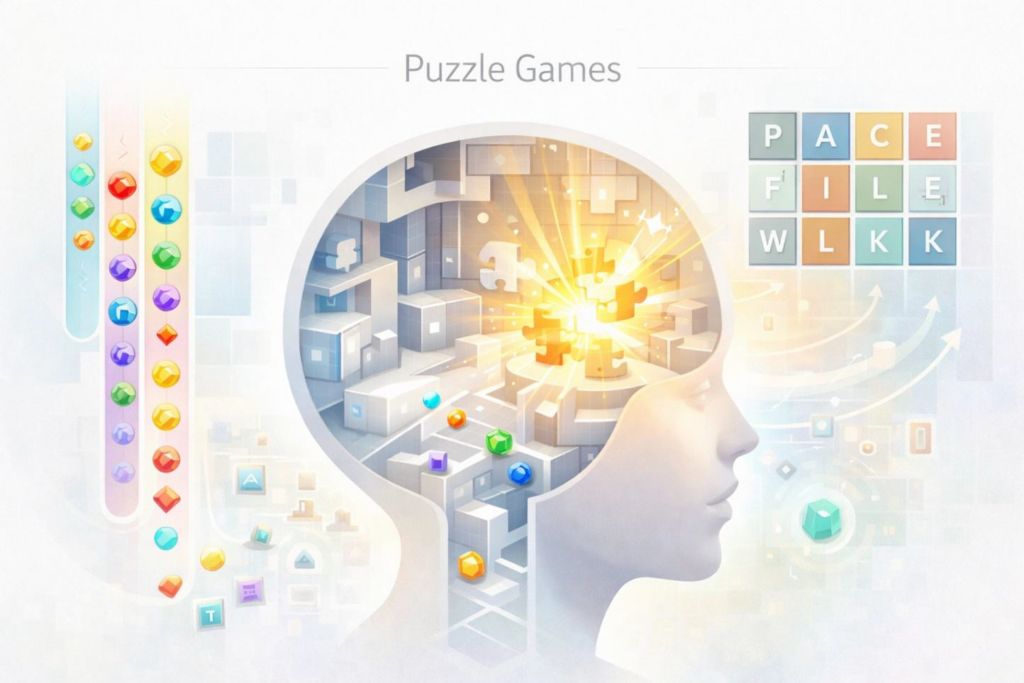
Who they attract:
Problem-solvers. People who enjoy “aha!” moments—the sudden flash of insight when a solution becomes clear. Players who appreciate elegant solutions, not grinding. People who want to feel smart, not just busy.
The casual mobile audience represents billions in revenue here. Royal Match and Toy Blast keep hundreds of millions engaged through precisely calibrated challenges that feel accessible yet satisfying. These aren’t “hardcore gamers”—they’re people who want 5-10 minutes of engaging problem-solving while waiting for coffee.
The core hook:
- Insight: The satisfaction of figuring something out. Puzzle games create a specific pleasure: being stuck, trying different approaches, then suddenly seeing the solution. That moment—“Oh! THAT’s how it works!”—releases dopamine more effectively than any badge. Portal is the masterclass here. Each test chamber presents what seems like an impossible problem. You experiment. You fail. You try new approaches. Then you see it—that specific portal placement that makes everything work. The satisfaction isn’t from completing the level. It’s from understanding how to complete it.
- Elegance: Clean, simple rules that create complex challenges. The best puzzle games have mechanics you can explain in 30 seconds, but strategies that take hours to master. Wordle is six guesses, five letters, and color-coded feedback. That’s it. Yet it has generated millions of daily players. Match-3 games like Royal Match operate on rules a toddler can grasp: connect three identical items. But level 2,847 requires spatial planning, combo anticipation, and resource management. Simple rules, emergent complexity.
- Self-Paced: No time pressure in most puzzle games. You can take five minutes or five hours to solve a level. This respects different user contexts. Portal doesn’t punish you for thinking. Wordle gives you all day. This is crucial for casual audiences who play in stolen moments between other activities.
- Tactile Satisfaction: Match-3 games excel at making the act of solving feel physically pleasurable. Explosive animations. Cascading combos. Satisfying sounds. The sensory feedback of matching gems feels good, independent of progression. This is why people can play hundreds of levels—the core loop itself is pleasurable.
- “One More Level” Design: Puzzle games master the art of leaving players wanting just one more attempt. You were close on that last try. You see how you could optimize. Just one more. This isn’t manipulation through FOMO—it’s confidence that you can solve it with one more attempt.
What gamification can learn:
Sometimes less is more. Don’t overwhelm users with features, options, and complexity. Give them one clear problem to solve. Make the rules simple and the mastery deep.
Create “aha!” moments of understanding. Don’t just teach users through tutorials—let them discover insights. Duolingo’s grammar lessons work better when they let you figure out the pattern from examples rather than explaining the rule first.
Let users solve problems, not just follow instructions. Most app onboarding is step-by-step instructions. Puzzle games teach through play. They present challenges and let you figure out solutions.
Make success feel good. EverMerge’s merge mechanics are satisfying in themselves, not just for rewards earned. When you merge five items into a higher-tier item, the animation, sound, and visual feedback feel rewarding. Many productivity apps could learn from this: make task completion visually and audibly satisfying.
Perfect your difficulty curve. Royal Match keeps hundreds of millions engaged through precisely calibrated challenge escalation. It’s too easy, and users quit from boredom. Too hard and they quit from frustration. The game adjusts difficulty dynamically based on user performance—something more apps should study.
Actionable for developers:
Learning apps should present concepts as puzzles to solve, not facts to memorize. Instead of “Here’s the past tense rule,” give examples and let users deduce the pattern. The insight moment creates deeper learning than explicit instruction.
Onboarding should feel like tutorial levels that teach through play, not through walls of text. Show, don’t tell. Let users learn by doing, by succeeding, and by occasionally failing and trying again.
Make the core interaction loop as satisfying as matching three gems—even without rewards. If the act of using your app feels tedious when you remove all the badges and points, you have a puzzle design problem. The action itself should feel good.
Financial apps could present budget challenges as puzzles: “Here are your income and expenses—find three ways to save $200/month.” Make it a problem to solve, not a lecture to endure.
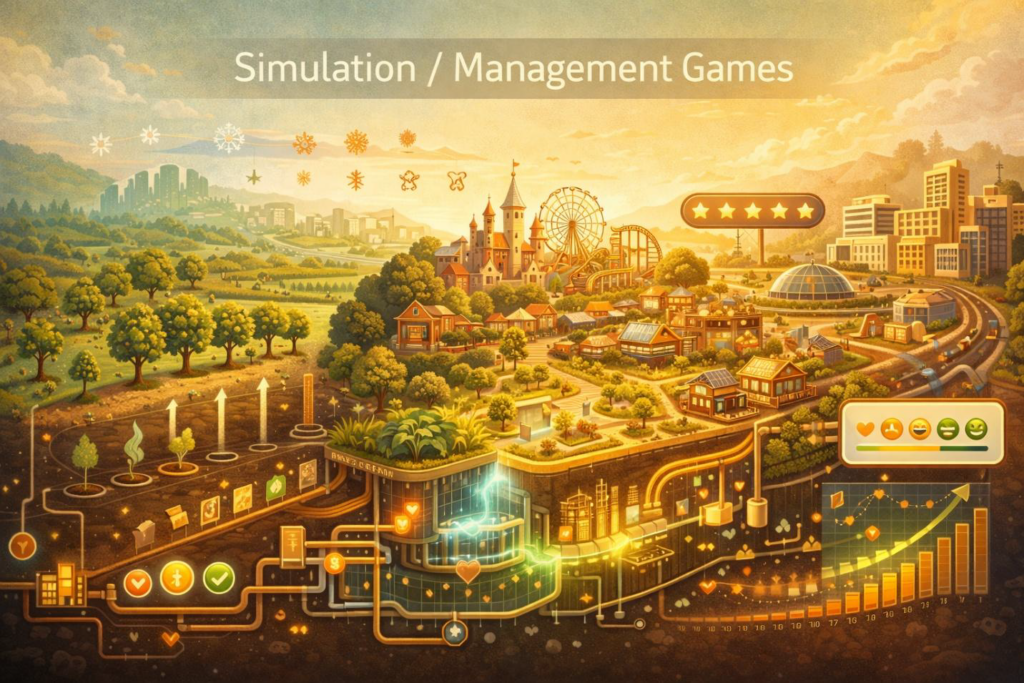
E. Simulation/Management games
Examples: The Sims, Cities: Skylines, RollerCoaster Tycoon, Stardew Valley
Who they attract:
Systems thinkers. Organizers. People who enjoy optimization and watching things grow over time. Players who want to build something that reflects their decisions and personality.
RollerCoaster Tycoon players obsess over guest satisfaction metrics, park layout efficiency, and ride throughput optimization. They’re not just playing—they’re managing complex systems with multiple interdependent variables.
The core hook:
- Ownership: “This is mine.” Simulation games create profound attachment through personal investment. Your theme park. Your city. Your farm. Your family of Sims. You built it. Every detail reflects your choices. This ownership drives engagement far more than any external reward.
- Incremental Growth: Watching something evolve. Cities: Skylines starts with a highway entrance and a patch of land. Hundreds of hours later, you’ve built a metropolis with distinct neighborhoods, transit systems, and industry zones. The progression is visible, tangible, and earned. Stardew Valley masters this. Spring year one: you’re clearing rocks and planting parsnips. Spring, year three: you have automated sprinklers, diverse crops, animals, relationships, and a community center completion. You built this farm from nothing.
- Experimentation: “What if I try this?” Simulation games encourage tinkering. What happens if I zone residential next to industry? What if I build a log flume that’s twice as long as recommended? What if I plant all blueberries this season? The best part: failure is informative, not punitive. Your experiment failed? Now you understand the system better. Try something else.
- Complex Systems Mastery: Understanding how multiple variables interact. RollerCoaster Tycoon teaches operations management: guest happiness depends on ride variety, wait times, park cleanliness, food prices, bathroom availability, and more. Changing one variable cascades through the system. This is deeply satisfying for a certain kind of mind—discovering the hidden connections, optimizing the inefficiencies, and mastering the system.
What gamification can learn:
Give users something to build, not just consume. Most apps are consumption experiences. Simulation games teach us that many users want to create, construct, and grow something that’s theirs.
Show visible progress that compounds. Every action should contribute to something that persists and grows. Not “You completed 10 tasks today” but “Your project dashboard is now 60% complete, and here’s what that looks like.”
Allow personalization and experimentation. Let users customize their experience, try different approaches, and see what works for them. Don’t force a single workflow on everyone.
Reveal system depth gradually. RollerCoaster Tycoon doesn’t teach spreadsheet optimization upfront. You start simple: build some rides, charge admission. Gradually, you discover you can customize ride settings, set different prices for different guest types, and optimize staff patrol routes. The depth reveals itself through play.
Support multiple valid strategies. There’s no single “correct” way to build a successful park, city, or farm. Different approaches all work. This respects user diversity and encourages personal investment in their chosen strategy.
Actionable for developers:
Productivity apps could let users “build” their own systems, not just follow templates. Give them building blocks—task types, views, and automations—and let them construct workflows that match how they think.
Budget apps could show financial decisions as building a structure. You’re not just tracking numbers—you’re constructing financial stability, building toward specific goals. Visualize net worth as a building growing taller, and debt as foundation problems to fix.
CRM tools could visualize relationship-building like growing a garden. Plant seeds (initial contacts), water them (regular touchpoints), and watch them grow into productive relationships. Some connections need daily attention; others thrive with weekly check-ins. Let users see their relationship network as a living system they’re cultivating.
Project management tools could adopt simulation mechanics: show the ripple effects of decisions. “If you delay this task, here’s how it affects downstream timelines.” Let users experiment with different resource allocations before committing.
Revenue insight:
Simulation games generate substantial revenue not from consumables but from expansion content that lets users build more. The Sims’ success comes from expansion packs that add building options. This teaches us: users will pay for tools that let them create and express themselves more richly.
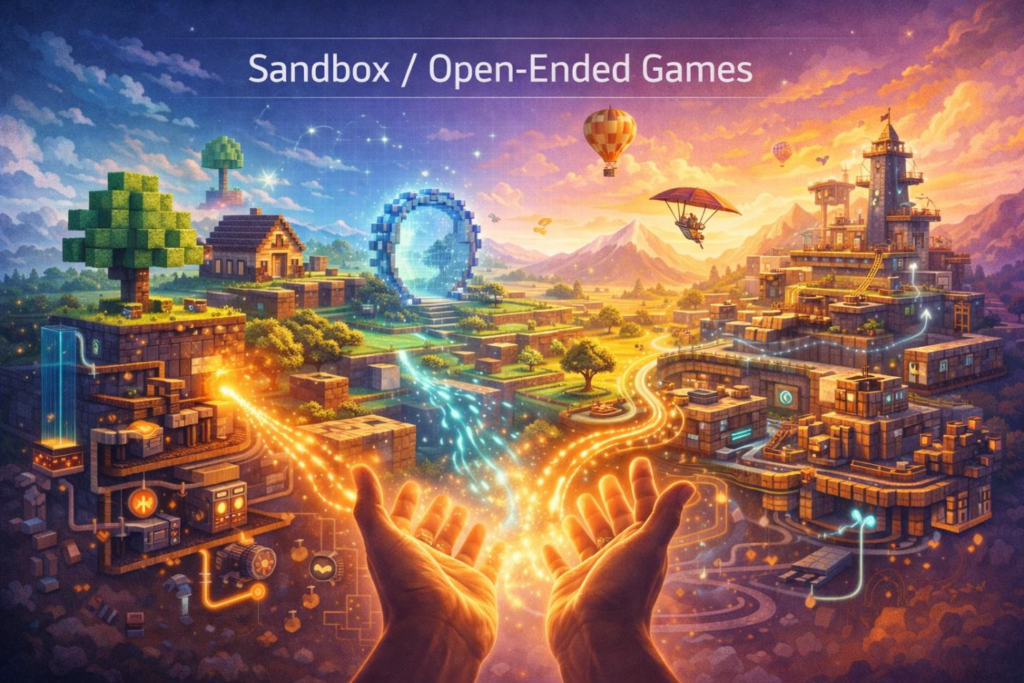
F. Sandbox/Open-ended games
Examples: Minecraft, Terraria, Breath of the Wild
Who they attract:
Creative players. Explorers. People who resist being told what to do. Players who want agency above all else—the freedom to pursue their own goals in their own way.
These are players who might spend 100 hours in Minecraft without ever fighting the Ender Dragon because they’re too busy building a replica of Hogwarts. They define success on their own terms.
The core hook:
- Freedom: “I can do anything.” Sandbox games present tools and possibilities, not objectives. Minecraft gives you blocks and says, “Build whatever.” No quest markers. No correct path. Pure agency. This freedom is terrifying for some players and liberating for others. The players it attracts are those who don’t need external goals—they generate their own.
- Creativity: Self-expression through gameplay. Sandbox games are digital canvases. Some players build massive architectural projects. Others create elaborate redstone circuits. Others tell stories through their builds. The game accommodates all of it. Breath of the Wild takes this further: Most puzzles have multiple solutions. The game’s physics systems allow emergent problem-solving. Need to reach that tower? Climb it. Paraglide from a mountain. Build a flying machine. The game doesn’t care how you solve problems—it just gives you tools and says, “Figure it out.”
- Emergent Goals: Players set their own objectives. Minecraft doesn’t tell you to build a castle—you decide that’s your goal. Terraria doesn’t require you to fight bosses, but you might choose to because you want their loot for your next project. This self-directed goal-setting creates profound engagement. Players aren’t chasing your objectives; they’re pursuing their own dreams using your tools.
What gamification can learn:
Stop forcing linear paths. Many users don’t want to follow your carefully designed user journey. They want to explore, experiment, and use your app in ways you didn’t anticipate.
Let users define their own success. Not everyone wants the same outcome. Some want mastery. Some want creation. Some want exploration. Your app should accommodate different definitions of progress.
Provide tools, not just tasks. Instead of a checklist of things to do, give users capabilities and let them decide how to use them.
Support emergent use cases. The best apps enable workflows their designers never imagined. Notion succeeds partly because users can bend it to their needs. Spreadsheets became business infrastructure because they’re infinitely flexible.
Actionable for developers:
Note-taking apps like Notion and Obsidian succeed because they’re sandboxes, not rigid templates. They give users building blocks and say, “Organize your knowledge however makes sense to you.” This attracts power users willing to invest time in building their own systems.
Design tools should provide capabilities, not workflows. Don’t force users through your ideal process—give them tools and let them develop their own approaches.
Productivity apps could adopt sandbox principles: instead of prescriptive workflows, provide flexible building blocks. Let users construct their own productivity systems. Some will build simple task lists. Others will build elaborate project management frameworks. Both are valid.
Learning platforms could let advanced students create their own learning paths. Not everyone wants to go lesson 1 → 2 → 3. Some want to jump to advanced topics and backfill prerequisites as needed. Let them.
Critical insight:
Sandbox games teach us that for certain users, agency is more engaging than any progression system. These users will invest thousands of hours if you give them creative freedom, but they’ll abandon your app immediately if you force them down a linear path.
Know your audience. If they value freedom and self-expression, design sandbox experiences. If they prefer structure and guidance, design a more linear progression. Don’t try to serve both audiences with the same mechanics.
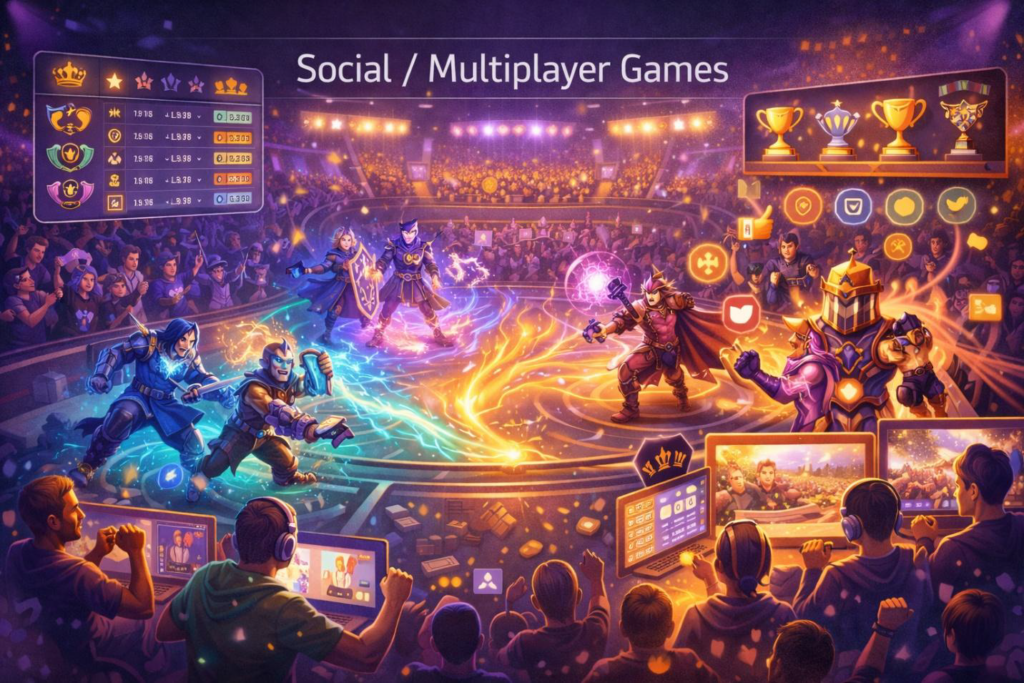
G. Social/Multiplayer games
Examples: Fortnite, Among Us, League of Legends, Roblox
Who they attract:
Socially-motivated players. Status-seekers. Competitive players who want to prove superiority. Cooperative players who enjoy teamwork. People who play because their friends play—the social network is the value, not just the game.
Creators and collaborators. Roblox’s 70+ million daily active users include millions who build games for others to play. They’re not just consumers—they’re architects of shared experiences.
The core hook:
- Social Proof: “Everyone’s playing this.” Network effects create momentum. Fortnite became a cultural phenomenon partly because everyone’s friends were playing. The game was the venue for social interaction—what you did while hanging out online with friends.
- Status: Showing off skill, cosmetics, or rank. Competitive games create status hierarchies based on skill. League of Legends players display their rank. Fortnite players show off rare skins. This status signaling drives both engagement and monetization.
- Teamwork or Rivalry: Shared experiences create bonds. Among Us sessions become stories you retell: “Remember when Dave was the impostor and convinced everyone it was Sarah?” Shared gaming experiences become shared memories. League of Legends teamwork—coordinating five players in real-time, combining abilities, and executing complex strategies—creates flow states that solo games can’t match.
- User-Generated Content: Roblox succeeded by making players into creators. The ultimate social engagement: building something others use. Top Roblox developers earn millions creating games within Roblox. They’re not just players—they’re entrepreneurs, designers, and community leaders.
- Persistent Identity: Your avatar, achievements, and creations follow you across experiences. Your Roblox character isn’t trapped in one game—it’s your identity across thousands of experiences. This creates investment in the platform, not just individual games.
What gamification can learn:
Social features must be core, not bolted on. You can’t add social as a feature layer. It needs to be fundamental to how the app works. World of Warcraft’s guilds weren’t added later—they were central to the design.
Competition works only if it’s fair and contextual. League of Legends has sophisticated matchmaking to ensure competitive balance. Random leaderboards comparing users with wildly different contexts don’t create fair competition—they create resentment from everyone except the top 1%.
Cooperation often beats competition for retention. Guild mechanics, alliance systems, and cooperative challenges create stronger engagement than competition because they build relationships, not just rivalries.
Enable creation, not just consumption. Roblox proves people will invest thousands of hours if they can build something others use. User-generated content transforms consumers into invested stakeholders.
Status through contribution. Recognize and reward community contributors, not just individual achievement. Stack Overflow’s reputation system creates status through helping others. That’s more sustainable than status through consumption.
Cross-context identity. Let users build a persistent profile that matters across different parts of your app. Their reputation, their style, and their contributions should travel with them.
Actionable for developers:
Fitness apps should enable real social features—workout buddies who coordinate sessions, teams that train together, and accountability partnerships. Not just leaderboards comparing strangers’ step counts. Real social connection means users show up for each other, not for badges.
Learning platforms should let advanced users create content for beginners. Like Roblox developers creating games, your power users could create lessons, templates, or resources for newcomers. This keeps experts engaged while providing value to beginners.
Professional tools should recognize and reward community contributors. Those who answer questions in forums, create helpful templates, or mentor new users should gain visible status. Contribute a path to prominence.
Productivity apps could adopt guild mechanics. Project teams become guilds. Shared goals create interdependence. Status comes from helping the team succeed, not just personal metrics.
Design platforms, not just apps. Let users create within your environment. The platform that enables creation will always beat the app that delivers content.
Revenue insight:
Roblox generates $3+ billion annually, not from forcing engagement but from giving players genuine creative agency and social connection. Top creators earn millions. Millions more earn smaller amounts. The platform succeeds because it transformed consumers into stakeholders.
The Lesson: The best gamification makes users into creators and community members, not just consumers. Status, meaning, and social connection drive far more revenue than badges and streaks ever will.
Up next in the “Gamification” series: “Gamification 2.0. Beyond Points and Badges: Designing for Players, Not Metrics. Chapter 4: Special Considerations.”
Featured image courtesy: Cash Macanaya.