
Every organization has its own goals, processes, techniques, and teams—each with special characteristics. They are all important to consider when incorporating user experience, but it’s also crucial to gauge the maturity level of an organization.
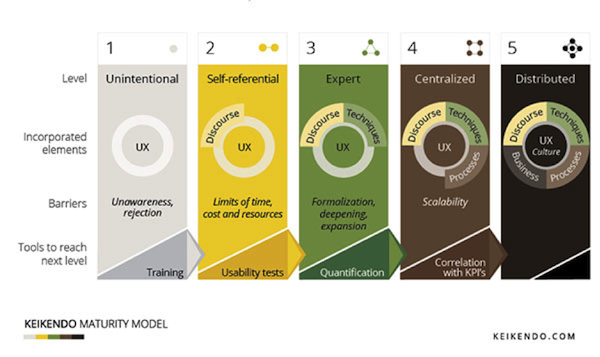
Last year my company, Keikendo, presented a model to identify the maturity level of user experience within an organization. The product of over 10 years of shared experience in organizations of different sizes and types across markets, we call it the Keikendo Maturity Model.
What we’re looking for are barriers to the adoption of user experience within an organization, and the model describes 20 barriers clustered on five levels:
- Unintentional
- Self-Referential
- Expert
- Centralized
- Distributed
It is possible that the 20 barriers do not cover all situations in all organizations, but they do address the most common barriers that occur at each level. Let’s have a look at the five levels and the best tools for working through them.
1. Unintentional
For organizations at this level, user experience isn´t treated proactively but emerges as a consequence of certain business goals and IT constraints. The most common barriers here are ignorance and rejection: there are no resources with knowledge of user experience or they do not have intentions of incorporating it because they think it isn´t worth it.
Tools for advancement: Training, formal (courses, events, etc.) or informal (internal presentations, lectures, etc.).
2. Self-Referencial
At this level, organizations design products as if their users think and act just like they do. Users are fictional and often idealized, and they don´t really participate in the design process. UX can begin to be part of the organization´s public communications but, in general, it’s no more than a slogan. The common barriers at this level are budget, time, and resource constraints.
Tools for advancement: User testing is the most powerful tool for overcoming resistance at this level. While observing real people using a product or interface, preconceptions begin to crumble and it’s possible to discover where and why they are failing.
3. Expert
At this level there emerges one person or a small team within the organization focused on user experience. It’s possible that some user tests have been done but they are rare and not methodologically strict.
The common barriers at this level are formalization, expansion, and deepening of the process. The UX technique that has been implemented can not be a consistent part of the design process. On the other hand, it is difficult to replicate it in other projects and even incorporate other complementary techniques.
Tools for advancement: Quantification of user testing to measure results and compare projects where UX techniques were applied to those where they were not.
4. Centralized
Organizations that are at this level have a user experience team consisting of at least three roles: interaction design, information architecture, and usability. Several UX techniques are applied and user testing is a consistent part of the design process.
The common barriers are issues are related to UX team scalability. The value of UX has increased and different departments within the organization ask for more resources and better skills, but it is difficult for the UX team to meet these demands; generally because UX is still an internal service instead of a strategic area with its own budget.
Tools for advancement: At this level is very important that UX metrics are linked to KPIs (Key Performance Indicators) to expose the impact that UX provides.
5. Distributed
User Experience is at the same level as Marketing or Finance. UX is part of the organizational culture and participates in the phases of discovery, design, and development for products and services.
The common barriers here usually show up in the consolidation phase of UX as a strategic area within the organization. In general, barriers arise due to generational issues and the ignorance of senior executives, including the CEO.
Tools for advancement: Show how User Experience improves ROI (Return On Investment).
Gaining Maturity
Maturity progresses one level at a time. If an organization has a UX environment that is Self-Referential, they won’t be able to skip ahead to the Distributed level without moving through the levels in between, gaining skills and overcoming barriers. Because each level requires the integration of knowledge, skills, specific profiles, and changes to internal processes, the process can last for years.
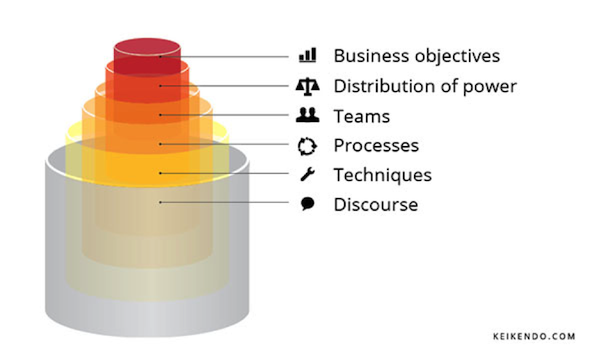
To achieve higher levels of maturity two important things must change within an organization:
-
- Organization goals
- Power balance
Changing organizational goals involves incorporating new variables into the economic and financial business equation by putting the focus on users. As the product and service development cycle changes, an organization begins to think about the design of products with users in the center of the process, actively involving them from discovery and research phases, through design, development, and support. The organization understands that users are the most important variable to achieving their business goals.
The organization understands that users are the most important variable to achieving business goals
Altering the balance of power requires changes that affect all organization levels, particularly middle management and directors including the CEO. These changes also require the participation of users in the decision-making process, which can limit management’s control. In organizations that are strongly self-centered in the CEO, CTO, or any other person this can be difficult and will require gradual changes that need to be consistently supported by positive results.
The Keikendo Maturity Model provides a way to map an organization’s maturity level and to build an action plan to better incorporate user experience in order to improve business results. You can find out where your company or organization sits on the spectrum by taking the test online.
Image of nesting doll courtesy Shutterstock.