
Flag

We stand with Ukraine and our team members from Ukraine. Here are ways you can help

Get exclusive access to thought-provoking articles, bonus podcast content, and cutting-edge whitepapers. Become a member of the UX Magazine community today!

Home ›› Business Value and ROI ›› 6 Key Questions to Guide International UX Research ›› Announcing the Drawing Ideas Contest Winners

Announcing the Drawing Ideas Contest Winners

by UX Magazine Staff, Mark Baskinger
1 min read
Share this post on
Tweet
Share
Post
Share
Email
Print

Save

Two sketches and a video for the winners of our Drawing Ideas book contest.

In December, we announced a contest to win a copy of Drawing Ideas: A hand-drawn approach for better design, the new book by Mark Baskinger and William Bardel. Entries were requested in the form of design drawing challenges. Along with a copy of the book and a UI Stencil, two winners were also promised some sketches of their entries.

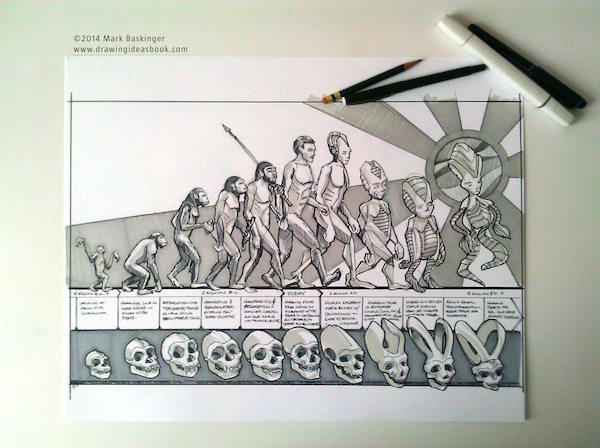
The first winning entry came from Paul Brooks, a UX designer in the United Kingdom, who posed this challenge on Twitter: “Continue the ‘Evolution of Man’ image, looking forward one million years.”
parallax scrolling

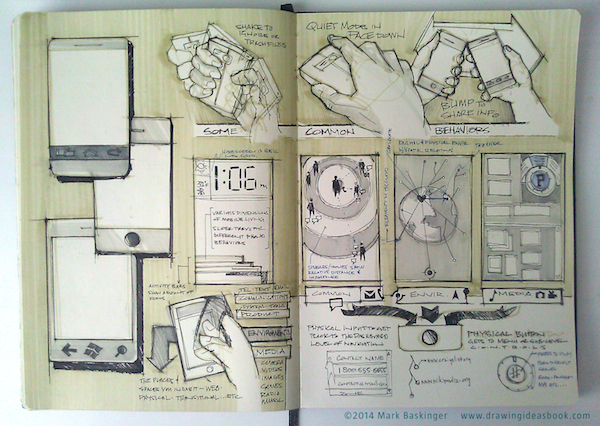
The other winning challenge came from Rebecca R who requested, “A responsive, graphic centered design that’s intuitive across mobile devices—Apple, Android, and Windows.”
parallax scrolling

“This rough sketch captures my initial thinking on the fly as I try to figure out what a cross-platform, graphic-centered phone UI might be,” Baskinger says. “Whenever I sketch digital interfaces, I try to connect them to both physical hardware and behaviors to think through the user experience more holistically. To keep the mobile experience simple, this concept focuses on four key platform-independent attributes: communications (telephone, text, email), product/system (controls, tools, setup, etc), environments (physical places, GPS, bookmarked web pages, browser, social media, etc), and digital media (photos, videos, music, radio, etc).”

Here’s a video of Baskinger completing the sketch:

Last but not least, check out our video flip-though of Drawing Ideas:

post authorUX Magazine Staff

UX Magazine Staff
UX Magazine was created to be a central, one-stop resource for everything related to user experience. Our primary goal is to provide a steady stream of current, informative, and credible information about UX and related fields to enhance the professional and creative lives of UX practitioners and those exploring the field. Our content is driven and created by an impressive roster of experienced professionals who work in all areas of UX and cover the field from diverse angles and perspectives.

post authorMark Baskinger

Mark Baskinger

Mark Baskinger is an associate professor in the School of Design at Carnegie Mellon University who teaches courses in industrial design with an emphasis on form & interaction. His interests include exploring new paradigms for interactive objects and interpretive environments, and methodologies of design drawing and visual thinking to promote collaboration. He has published papers and articles on the language of designed artifacts, inclusive/universal design, visual “noise” in product design, tangible interaction, and methodologies of visualization.

Baskinger currently serves as a researcher with the Quality of Life Technology Engineering Research Center through Carnegie Mellon University and the University of Pittsburgh; he is a core faculty member in the Master of Tangible Interaction Design program through Carnegie Mellon’s School of Architecture (mTID), is an affiliate faculty member of the Human-Computer Interaction Institute (HCII) at Carnegie Mellon and collaborates with the /d.search-labs at the Technische Universiteit Eindhoven, The Netherlands (TU/e).

An international speaker and workshop leader, Mark also conducts Drawing Ideas®: A Field Guide to Visual Thinking courses in conference and business contexts where he makes design drawing methods and visual thinking techniques accessible to a broader audience and demonstrates strategies for using sketching to foster collaboration in design processes. His work has been featured in design publications and international magazines, and has been exhibited in numerous galleries and museums, including the Museum of Modern Art (New York), I-Space Gallery (Chicago), the Krannert Museum (Illinois) and the Regina Gouger Miller Gallery (Pittsburgh). His work is also included in the permanent art collection of the University of Illinois.

He has won numerous design awards from ID Magazine and the Industrial Designers Society of America (IDEA) and personally holds multiple product patents. Prior to joining Carnegie Mellon, Baskinger was creative director at Corchia Woliner Rhoda in New York City, and was the lead designer at the Central Park Zoo - Exhibits and Graphic Arts Dept. He also held a visiting faculty position in the School of Art and Design (https://art.uiuc.edu) at the University of Illinois (UIUC). Parallel to his appointment at Carnegie Mellon, he co-directs The Letter Thirteen Design Agency, and is a founding member of the EcoDesigners Guild of Pittsburgh.

Tweet
Share
Post
Share
Email
Print

Related Articles

Find out how design leaders can build a more inclusive digital world from the ground up.

Article by Pavel Bukengolts
Championing Accessibility: a Path to Inclusive Design Leadership
  • The article highlights that designing for accessibility isn’t about following rules. It’s about making sure no one gets left out of the digital world.
  • The piece explores how building accessibility from the start, with the help of AI and the right mindset, makes the result better for everybody.
Share:Championing Accessibility: a Path to Inclusive Design Leadership
4 min read

Discover how a simple comprehension test reveals if mobile content is too hard to read.

Article by Paivi Salminen
Why Reading on Mobile Is Uniquely Challenging
  • The article explains why mobile reading is harder: small screens and distractions make people miss information even when it’s there.
  • It introduces the cloze test, which removes words to measure real understanding: comprehension drops from 39% on desktop to 19% on mobile.
  • The piece argues that mobile content needs simpler language because the real question is: Does this make sense when life gets in the way?
Share:Why Reading on Mobile Is Uniquely Challenging
4 min read

Learn how to build systems where design explicitly models development, handoff is automatic, and AI can extend your work reliably.

Article by Jim Gulsen
Your Design System Works in Figma. Does It Work in Code?
  • The article explains why many design systems don’t work well: designs made in Figma don’t translate well into code.
  • It introduces five practices: structure frames like code, use fewer components with more variants, organize by how both designers and developers actually work, let AI check your naming, and build documentation into your daily workflow.
  • The piece says that good design systems are the same in design and development, and when they match, everything just works.
Share:Your Design System Works in Figma. Does It Work in Code?
6 min read

Join the UX Magazine community!

Stay informed with exclusive content on the intersection of UX, AI agents, and agentic automation—essential reading for future-focused professionals.

Hello!

You're officially a member of the UX Magazine Community.
We're excited to have you with us!

Thank you!

To begin viewing member content, please verify your email.

Get Paid to Test AI Products

Earn an average of $100 per test by reviewing AI-first product experiences and sharing your feedback.

    Tell us about you. Enroll in the course.

      This website uses cookies to ensure you get the best experience on our website. Check our privacy policy and