History doesn’t loop; it climbs the same corners to a higher floor.
- Late ’90s: Function first. Ship it; paint it later.
- 2010s: Design first. Cheaper dev, better tooling, and design ran the room.
- 2025: Systems everywhere. Patterns are cheap, judgment is not, and speed finally has a brain.
The spine stayed the same: Critical thinking, research, communication, empathy. What changed is the distance. The idea of coding is now a short walk. Live artifacts beat static decks, agents sit inside our tools, feedback lands faster, and excuses don’t.
What actually changed
Design isn’t dead; it moved to systems, tokens, and code. You still need taste and story, but you don’t need to redraw the same control for the hundredth time. Handoffs got shorter, prototypes run in the real stack, and decisions now link to artifacts and metrics, so nothing floats alone.
The modern stack I run (and how it’s all connected)
It’s a connected surface, not a pile of apps; each step hands context to the next.
- Miro to frame the bet, flows, and risks. One board. One narrative. It takes the hit: Tons of drafts, sketches, ideas, docs, and charts, all parked there. Organized, productive chaos.
- Figma, when I need to teach AI how to build it: States, constraints, edge cases. Pictures as instructions.
- VS Code + AI (Codex as my “dev team”) to scaffold, refactor, and test. AI is my pair, not my boss.
- GitHub for PRs and a clean decision log. Every change has a why.
- Jira for small, measurable bets. Throughput you can’t fake.
- Assistants embedded in the flow: Design Thinking Facilitator (personas/methods for bets), Systems Thinking Coach (loops, dependencies, and second‑order effects), and Meeting Minutes Facilitator (decisions, talk‑time analysis, and auto‑actions into Jira).
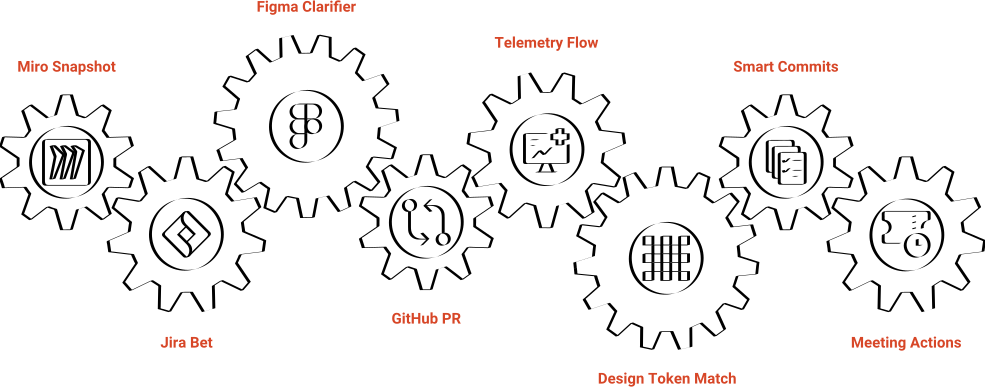
Everything is connected
Miro snapshot links to a Jira bet (goal, metric, exit). Jira links to the Figma clarifier and the GitHub PR. The PR holds the decision log and a preview. Telemetry flows back into Jira, and my debrief notes. Design tokens match IDs in Figma Dev Mode and in code. Smart commits update Jira. Meeting actions open tickets automatically. One chain of truth from idea through shipping to learning.
TCE: The wipeout and the rebuild
We lost the plot. Wrong bet. Slow signals. It hurts fast. We lost all app data and connections. We decided to start over from zero. We chose zero. That made every step simpler to judge: Does it get us learning by Friday or not? I cut the ceremony. Kept the spine. Short interviews, plus a bot trained on our past data that interviewed me for about four hours and surfaced gaps we’d missed. We pulled the data we already had and tightened the hypothesis. Miro framed the new bet. Figma clarified the states so the agent wouldn’t hallucinate. In VS Code, the AI laid out scaffolds and tests. I edited. I owned it. PRs landed early. Jira tracked the bet, the metric, and the exit condition. We shipped behind a flag, watched the dials, and adjusted. We got back to market. Not because research vanished. Because waste did.
From UX to product
Titles follow the work. When UI is commoditized, advantage moves upstream: Framing the problem, sequencing bets, and owning outcomes.
“Product Designer” fits.
Not just “make it pretty.” Own the value. Own the risk. Design closer to code. Engineers closer to users. Fewer handoffs. Cleaner bets.
0 to 1: what AI is good for (and what it isn’t)
AI gets me from zero to one, fast. Scaffolds, test shells, variant ideas, quick refactors. I’m not saying we don’t need developers; I was one. Code is messy. Edge cases bite. Architecture matters. Performance isn’t free. Security is a profession. After we hit one, professionals take over the code to harden, scale, and secure it. Use AI to explore and draft. Use people to harden and scale. That balance is the job.
The 48-hour operating loop
This cadence is simple on purpose; it keeps the room aligned and the work honest.
Observe
Support logs. Analytics. Sales notes. Meeting Minutes Facilitator pulls the last decisions and open risks and flags who’s blocked.
Orient
One Miro snapshot: Goal, constraints, success metric, edges to test. Systems Thinking Coach maps loops and second‑order effects so we don’t fix one metric and break another.
Decide
Write a small bet. Define the minimum test. Design Thinking Facilitator runs JTBD/HMW to shape the bet and the test plan.
Act
Use Figma for AI clarity, create an agent plan, scaffold in VS Code, open a PR early, and run a 30-minute usability pass.
Review
Ship behind a flag. Watch metrics. Log decisions in the PR and Jira. Meeting Minutes Facilitator scores the debrief (talk time, sentiment, decision clarity), opens follow-ups in Jira; the Systems Thinking Coach flags second‑order effects before we scale. Fidelity ladder: Sketch, prompt, runnable prototype, then production. If it isn’t linked, it isn’t real.
Guardrails so speed doesn’t lie
- Agent RACI: Who proposes, who approves, and who owns failure.
- Tests and telemetry are non-negotiable.
- System sameness check: Break patterns when user value demands it.
- Weekly research touchpoints: Light. Consistent.
- Privacy and ethics: Opt-in recording. Off-the-record flags. Redaction by default. Clear retention.
Metrics that keep you honest
- Lead: time to first PR, time to usable prototype, review latency, and preview coverage.
- Quality: escaped defects, task success rate, and decision-log completeness.
- Outcome: one north-star metric per bet.
- Collaboration/meeting health (auto‑scored by the Meeting Minutes Facilitator): Hygiene score, talk-time fairness, sentiment, decision clarity, % of meetings with actions, and SLA on follow-ups.
- Connection health: % PRs linked to bets, % bets with telemetry, and design-token drift rate.
My thinking stack: custom assistants I use every week
They don’t replace people. They sharpen me.
Design Thinking Facilitator
Spins working personas on demand. Rotates methods (JTBD, “How Might We,” 2x2s, assumption maps) so I don’t tunnel. Outputs crisp prompts, concept boards, and test plans.
Systems Thinking Coach
Maps feedback loops and dependencies. Flags second-order effects before we commit. Gives me a one-page global picture.
Meeting Minutes Facilitator
Turns meetings into decisions: Agenda, outcomes, owners, deadlines. And it doesn’t stop at notes. It analyzes dynamics: Talk-time distribution, interruptions, sentiment, quote capture, question-to-statement ratio, and decision clarity. It pulls risks and open questions into Jira. Tracks follow-ups.
Private coaching notes for me. Redacted summaries for the team.
Use them like teammates. I still make the call.
Start/Stop/Keep
Start
- Writing measurable bets in Jira with an exit condition.
- Opening a PR within 24 hours of deciding.
- Running a 30-minute usability pass before polish.
Stop
- Treating Figma as the source of truth for everything.
- Shipping without a hypothesis and a metric.
- Letting agents merge code.
Keep
- Real people. Real empathy. Real collaboration. Real interviews. Real data. Real stories that move stakeholders.
Close
The tools got loud. Judgment still wins. Patterns are cheap. Ideas are expensive. If you can frame a problem, test it fast, and keep a clean trail of why, you can rebuild anything.
Your move. How does your team’s 48-hour loop look today? What breaks first? Send it. Let’s compare notes.
“Plans are worthless, but planning is everything.”—Dwight D. Eisenhower
The article originally appeared on UX Design Lab.