
By their very nature, heuristics offer a hands-on approach to discovery, where knowledge is culled through trial and error. They are rules of thumb that give us a framework as we move through the research and design process.
In service design, this kind of framework is also valuable for assessing completed projects to find the weak links. A heuristic can apply to a single interaction as well as to the overall service eco-system. Heuristics can be applied to a single moment in time or to a user’s entire long-term relationship with a service.
This conceptual approach to design recognizes that experiences are coproduced, and that human interaction is a key component of many, if not all, services. As systems grow ever more sophisticated and interconnected, designers will continue to face new challenges. Service design heuristics can help us to frame and think about these complex experiences on a new level.
Creating a Service Design Framework
Inspired by Jakob Nielsen’s 10 Usability Heuristics for User Interface Design we created a set of service design heuristics at Usability Matters that meet our need to review and analyze experience design.
These service design heuristics provide a hands on framework for evaluating and generating useful, valuable services. Much like a traditional heuristic review gauges the usability of an interface, our heuristics give us a way to review a service according to design principles. They were developed based on our experiences as design practitioners and service users and tested using peer reviews.
Taking Heuristics into the Real World
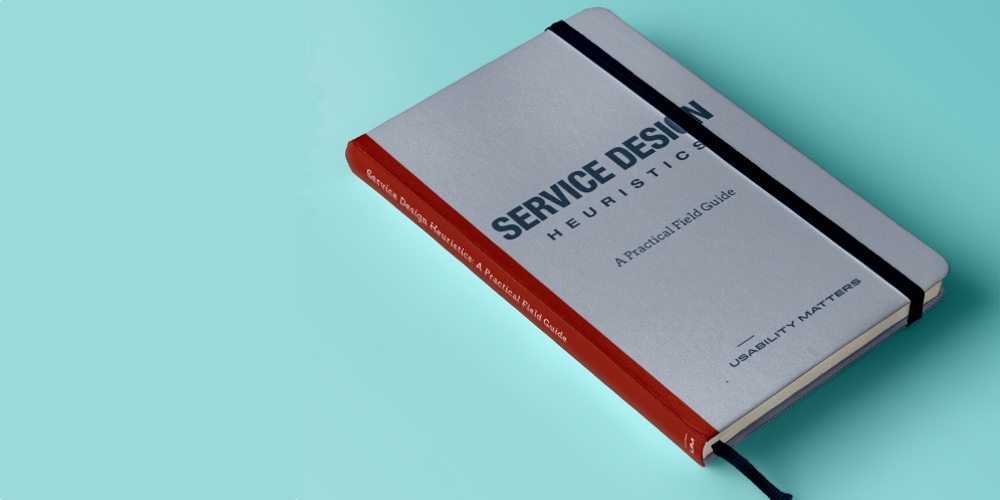
Services are often made up of many parts, with both tangible and intangible goods and value traded. To help apply heuristics to the service experiences that surround us, we created a workbook that can be used in the real world. This field guide makes it easy and enjoyable to try out service design heuristics and apply design thinking to your experiences.
We identified ten distinct heuristics that serve us well as we work through each new design challenge and have provided a workbook that lets you log your journeys in the real-world so you can bring them back to the design table and move forward with confidence and perspective.
Our Ten Service Design Heuristics
1. Address Real Need
Solve people’s problems while providing value that feels like it’s worth the effort. Base service models on needs identified from contextual research with people.
2. Clarity of Service Offering
Provide a clear service offering in familiar terms. Actors should easily grasp if a service is right for them and what they are trying to deliver.
3. Build Lasting Relationships
The service system should support appropriate interactions, allow for flexibility of use, and foster ongoing relationships. The right level of engagement supports an evolving service experience.
4. Leverage Existing Resources
Consider the whole system and what existing parts could be used to better deliver the service. Find opportunities to augment, repurpose, or redeploy resources.
5. Actor Autonomy and Freedom
The service ecosystem should fit around the habits of those involved. Do not expect people to adapt their life or work styles to suit the service model.
6. Graceful Entry and Exit
Provide flexible, natural entry and exit points to and from the service. Consider when it is appropriate for actors to jump in, or to achieve closure.
7. Set Expectations
Let actors know succinctly what to expect. Assist understanding of where they are in the system through the design of environments and information.
8. The Right Information at the Right Time
Tell the actors of the system what they need to know with the right level of detail at the right time. Weigh the costs and benefits of providing more or less precise information.
9. Consistency Across Channels at any Scale
Continuity of brand, experience, and information should exist across the entire service system. Actors should be able to seamlessly move across channels.
10. Appropriate Pace and Rhythm of Delivery
All actors should experience and provide the service at a suitable and sustainable pace.
We would love you for to test drive our service design heuristics. Download your free copy right here.We want the service design community to share and shape this tool, so let us know what you learned about your organization as you applied these activities to real-world situations. Were you surprised with any of the observations? What was your biggest take-away?