Home ›› Customer Experience ›› Meeting Design for Managers, Makers and Everyone: A Book Excerpt
Meeting Design for Managers, Makers and Everyone: A Book Excerpt
by Kevin M. Hoffman
7 min read
March 21, 2018
Share this post on
Tweet
Share
Post
Share
Email
Print
Save
Chapter 3 “Build Agendas Out of Ideas, People, and Time” dives into the intricacies of planning and executing a successful and productive meeting.
Dave is an independent consultant who helps organizations figure out the relationship between how they organize information in digital products (websites, apps) and the job those products are intended to do. As an independent contractor, he adapts to the working culture of each client. Dave’s latest client is a multinational insurance firm with inefficient design processes and an overworked in-house design team.
Dave scheduled a meeting to present six design principles he had developed to simplify the ongoing production work of the design team. The intention of the meeting was to build a shared understanding of these principles among the five members of the design team and the two senior stakeholders; he was not soliciting feedback for revisions. Dave restricted the agenda to around 10 minutes per principle. During each 10-minute session, he covered one or two examples of how each principle was applied. A brief period of time was reserved at the end of each 10-minute block for discussion. Here’s what Dave’s agenda looked like:
Dave’s Design Principle Agenda
Review a principle (8 minutes)
Discuss a principle (2 minutes)
(Repeat six times, once for each principle)
It was a lot to cover. He expected to orient the team just enough to begin applying the principles in their work. Once they began to do so, Dave was on-hand to answer more questions via email.
Dave felt confident as the meeting was started. However, two minutes into the meeting, the CEO of the company, James, interrupted Dave with a question that belied a fundamental misunderstanding of the meeting’s intent.
“On page 36 of the document, there’s a blue button in the example diagram. Can that button be green?”
Jan, the Chief Design Officer, intervened, trying to help Dave.
“I think we’re jumping ahead here, let’s try to stay on topic. My team needs to be able to start applying these principles this week.”
James replied:
“Well, I’m not sure I agree with the agenda of this meeting. I thought we were going to get a detailed review of the design of all of our different applications.”
Jan disagreed
“James, that would be a waste of time. We can read these documents on our own time. Let’s use this time to explore how we could apply these principles on our own.”
During the next 30 minutes, Dave was only able to get through a single design principle, due to continued interruptions from the two senior stakeholders. The remaining time was steamrolled by those stakeholders’ continued debate regarding differing expectations of agendas. Sadly, Dave only went through two of the six principles he had planned to cover in the hour. He was unable to convey the intended ideas in the time allotted.
The Illusion of the Agenda
It sucks when you lose control of a meeting. In Dave’s presentation, three different people had entered the meeting with three different agendas, and each agenda disrupted the other. Dave’s agenda fell victim to a power struggle. Jan lost the benefits she had hoped to get for her design team. James’ expectations were broken at the beginning, due to a lack of preparation on his part. Dave had distributed agendas in advance, and even personally emailed the “hippos” (HIghest Paid Person’s Opinion) in the office to give them the opportunity to express additional expectations. But like a lot of busy people, James didn’t have (or make) time to prepare. It’s an excuse, but it’s also a real design constraint that meetings face.
A well-designed agenda should work when it’s “mostly broken.” If unforeseen circumstances render an agenda impossible to execute, it was too brittle to begin with.
—James Macanufo
Creative Director, Pixel Press and Co-author, Gamesstorming
Meeting derailments happen despite good intentions and solid preparation. It’s frustrating when you put time and energy into preparing a plan that didn’t work out. It feels disrespectful to you and the attendees who came prepared.
But all is not lost. The basic components that make up a meeting agenda are still present. The duration is not unlimited: there is a beginning, middle, and end. There are a quantifiable number of people present. Those people carry a limited set of expectations — ideas in their brains about why they showed up in the first place. Dave could have designed a better situation by not being precious about his agenda and instead prioritizing three things:
What ideas did he intend to explore?
How did the people in the room expect to receive those ideas (or were they expecting entirely different ideas)?
How much time did he have to get through the material?
It’s good to stay flexible about agendas, but important to be crystal clear about the three core elements of agenda building: ideas, people, and time. Sticking to these three elements, while being flexible about how you get there, keeps an agenda from being too brittle.
Count Your Ideas, Then Count Your People
The hour-long business meeting often ends up on your calendar because calendaring software (and the clock) defaults to that length of time. An hour is longer than necessary for a quick check-in, but depending on the group, it might not be long enough to fully explore many ideas or “just-complex-enough concepts.” So, first, count how many of these you intend to address. That number gives you the ability to assess a meeting’s scale.
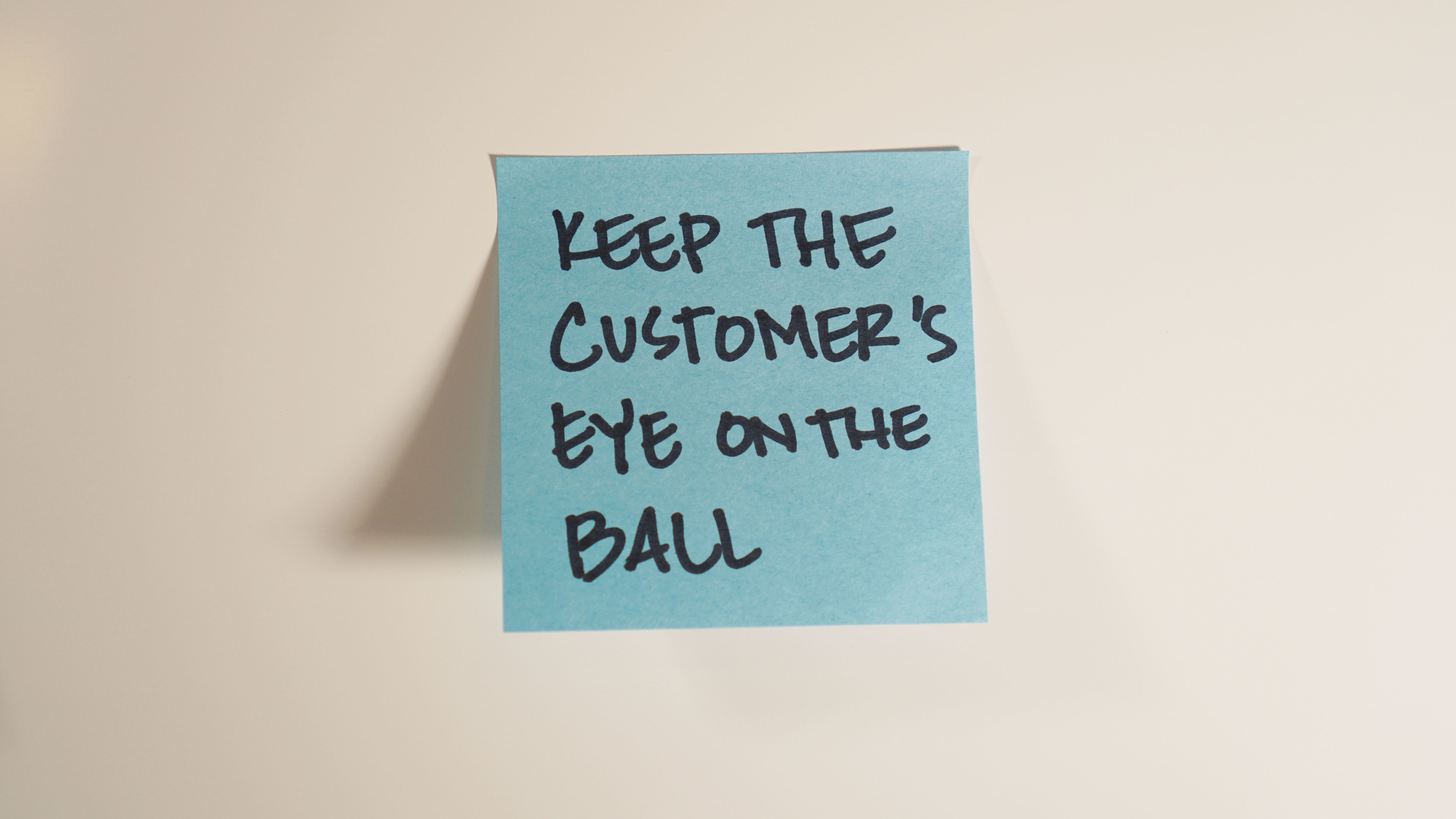
How much information comprises a “just-complex-enough” concept? Here’s an example — one of Dave’s six design principles was “to keep the customer’s eye on the ball.” It’s a common pitfall in software design to overwhelm users with too many options. To combat that tendency, Dave recommended that the most logical next step should be obvious on each screen. A single complex concept is simply a couple of sentences that describe a single piece of information — what you might fit on a sticky note (see Figure 3.1).
Figure 3.1 This much information is in a single, “just-complex-enough” concept.
It’s not too difficult to keep in mind what Dave means when he says “keep the customer’s eye on the ball.” Now to put that idea into the context of a meeting, two people need to reach an agreement on that idea — to have the same meaning in their minds on which to base further conversation. Simple math dictates that there is a single point of agreement between two people. You might assume that for each additional person added to a group, you would add one more point of agreement. Unfortunately, it’s not that simple.
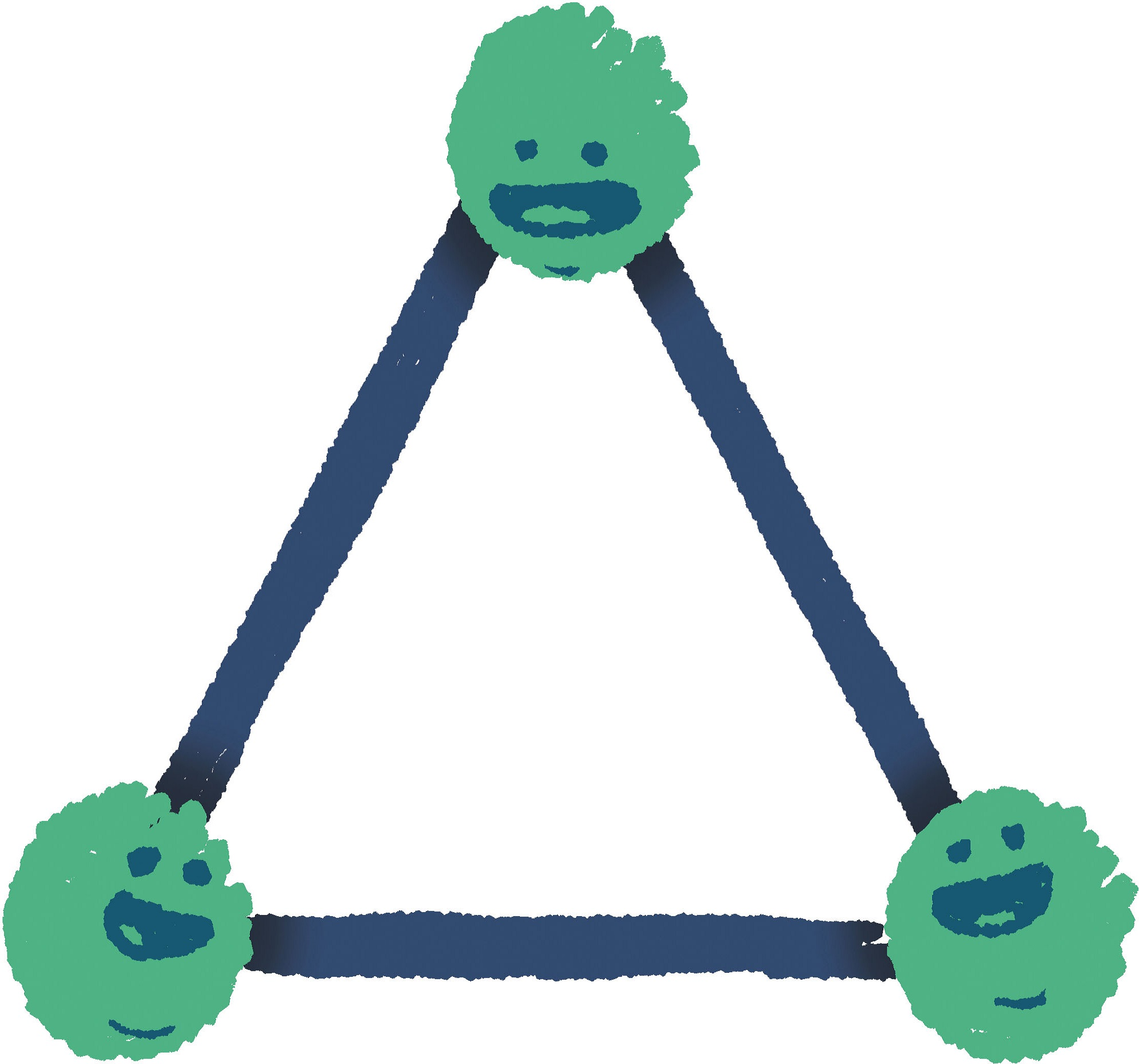
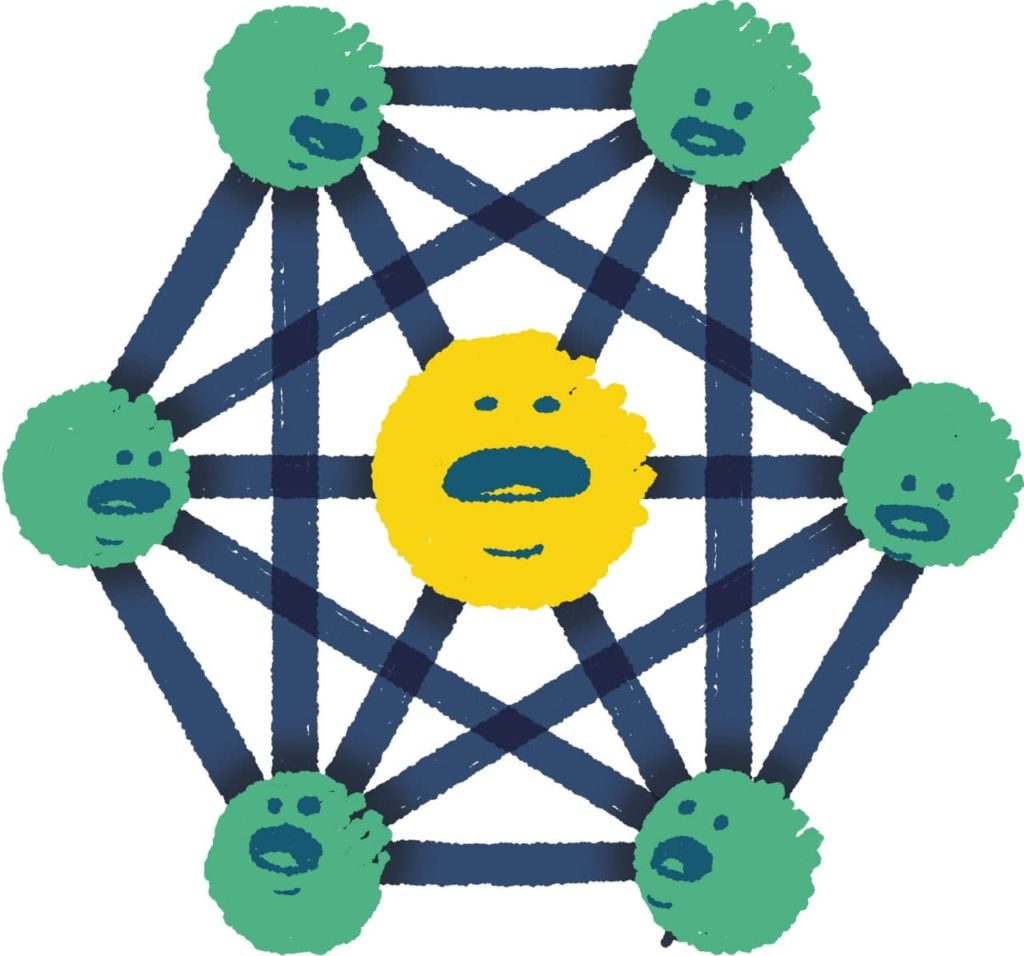
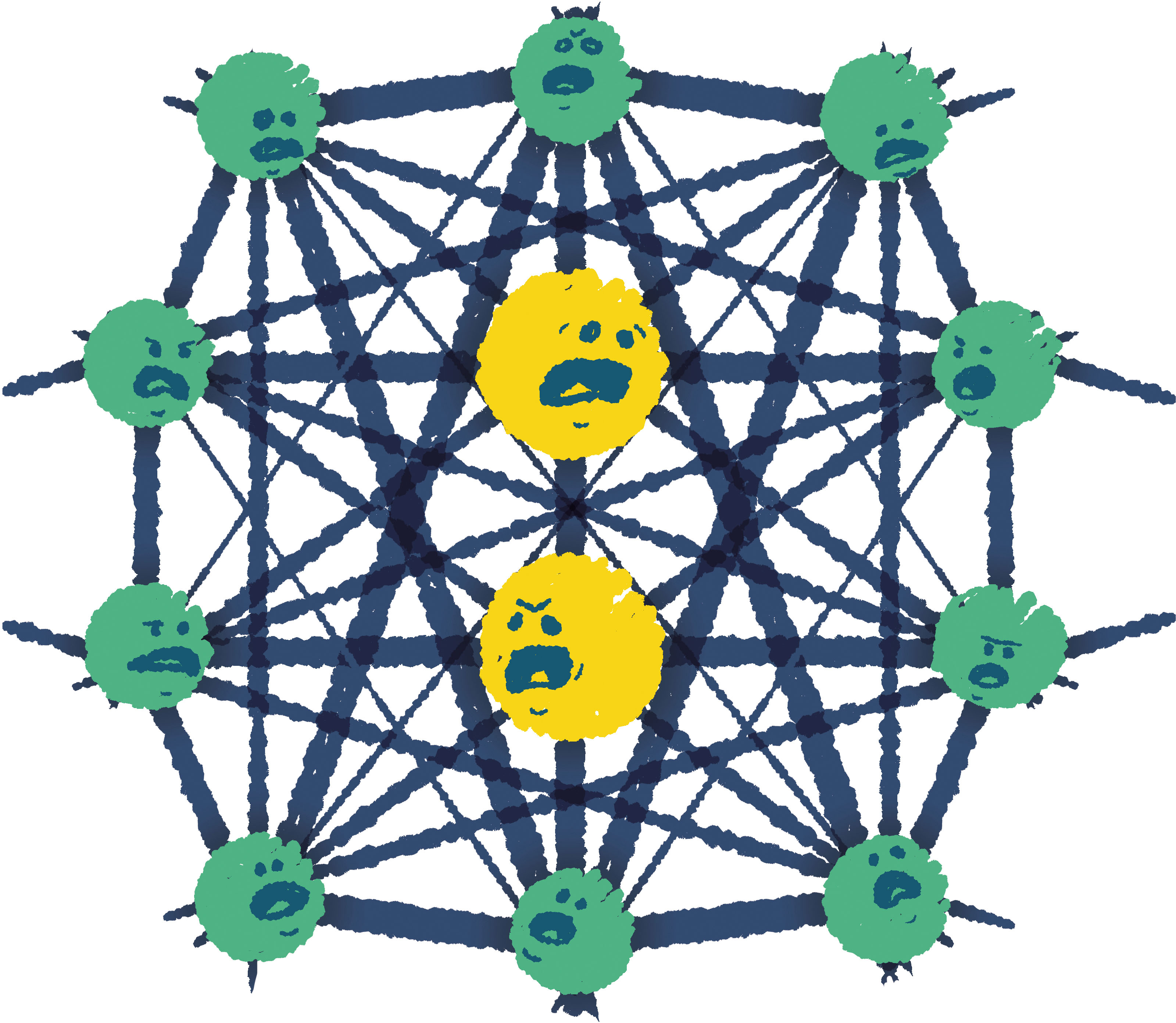
For three people, those points of agreement jump to three; for five, they elevate to 10; and seven, they leap all the way up to 21. Crowded conversations of 12 people make getting everyone on the same page painfully difficult, as you can see by just counting the lines in Figure 3.2, illustrating a points-of-agreement model.
Figure 3.2a 3 people: 3 points of agreement (Doable!)
Figure 3.2b 7 people: 21 points of agreement (Overwhelming.)
Figure 3.2c 12 people: 66 points of agreement (Nearly impossible!)
When you add one person to a meeting, you aren’t just seeking that one person’s new agreement. You are adding as many points of agreement as there are people who are already involved. Increasing the number of people in a meeting will scale up the complexity quickly. If you oversee a meeting’s planning and can control who is being invited, start by capping it at six or seven people.
If more than seven people cannot be avoided or it’s simply out of your hands, write down the reason that each person needs to be there in a simple statement. What is their anticipated goal? Make sure that each attendee knows your intention for inviting them. If you use calendaring software, include those intentions in the meeting invitation itself, or email each person what your take on their assumptions might be, just before the meeting, as a reminder. This will help them remember their role right before they join and get them in the correct frame of mind. You can revisit those expectations at the beginning of the conversation by writing them publicly before you get started.
The points-of-agreement model conveys the idea visually that adding more people makes the discussion more complex. This is one issue affecting Dave’s unsuccessful presentation. Dave has eight people to deal with (including himself), and as you saw, some of those people have different expectations about the intentions of the meeting. Here’s how Dave could have adjusted his agenda as soon as this became a problem: break into two smaller groups.
Dave’s Original Design Principle Agenda
Review a principle (8 minutes)
Discuss a principle (2 minutes)
(Repeat six times, once for each principle)
Dave’s Adjusted Design Principle Agenda
Identify two subgroups: a design group (design team) and a business outcomes group (leadership).
Review a principle (8 minutes).
Break into subgroups to discuss principle (2 minutes).
(Repeat six times.)
By breaking into two groups, Dave isolates different expectations of the agenda (in this case, business outcomes versus design application efforts) to keep them from becoming distracting tangents at best and a derailing debate at worst.
If you want to read the whole book, you may find it at Rosenfeld.
Kevin M. Hoffman Kevin M. Hoffman is an information architect and design strategist that has been building digital tools since 1995. He holds a deep belief that properly designed and executed time spent together, or a good meeting, is a core element of good design. It puts necessary shared understanding and trust in place, enabling teams to make better experiences real. Kevin is regularly hired to facilitate design meetings for web and application design projects. He also speaks and provides workshops on the design of meetings and collaboration all over the world.In 2012, Kevin founded the distributed design network Seven Heads Design, a network of highly experienced digital design thinkers who operate independently but love working together. Prior to that he served as Experience Director for the award-winning web design agency Happy Cog, where he lead he led user experience strategy and practice for Fortune 500 companies, non-profits, and start-ups. He spent the formative years of his career in-house at colleges and universities, bringing countless digital design and communications initiatives to life. During this time he also taught digital communications strategy and web design in graduate and undergraduate interaction and communications design programs. He always says yes to the first meeting.
Artificial Intelligence, Design Leadership, Future of Work, Human-AI Collaboration, Product Design, User Experience, UX × AI Series, UX Design
AI can create wireframes, synthesize research, and draft copy fast. What it can’t do: understand your users, carry context, or be accountable when something goes wrong. That’s still you.
The Agile Trap Designers Fall into: Feeding the Beast
Agile teams are fast, but designers get stuck in an infinite loop of visual work: redesigning the same components over and over instead of solving real UX problems.
Design systems break that cycle, defining the building blocks once, freeing designers to focus on how the product works, not how it looks.
When the basics are in place, teams can start working together sooner, prototype faster, and release incremental features without the interface falling apart.
Gamification 2.0. Beyond Points and Badges: Designing for Players, Not Metrics. Conclusion
Most apps use gamification as a manipulation layer to drive metrics, but people engage with things that are truly worthy of their time, not points or streak guilt.
Apps that people stick with do this by designing for intrinsic motivation, making the experience itself rewarding.
The true measure of success is whether users feel more capable, accomplished, and enriched for having used your app.