


“With the rapid adoption of synthetic data and persistent misconceptions about the importance of research, getting stakeholder buy-in is a critical first step.”
I’m optimistic about AI. It’s already changing how we analyze data, generate concepts, and even imagine new kinds of user insight. But while these tools are exciting, they don’t replace the messy, relational work of understanding people — they make that work even more important.
When product deadlines or team resources get tight, research with real users is often the first thing to go. Stakeholders are pressured to show “progress,” not pause for interviews or observations. Of course, if the end goal is to create products people can, need, or want to use, then any initiative that isn’t pointing to that end goal isn’t really progress at all.
“UX people” know that great research is about revealing truth, not making assumptions about it. But before you can do great research, you have to convince people to let you do it. And that’s getting harder as AI-powered research tools become more common. Many stakeholders now assume that, because we can fast-forward through certain steps in the research process, we must also be able to skip or rush the strategic planning, critical thinking, and synthesis that surround stages like data collection, analysis, and early solutioning.
AI can move faster than we can, but it can’t earn trust, hold multiple perspectives across user groups, or understand the nuances of feasibility and the interconnectedness of all the little parts of the systems we design for. And it can’t build relationships. That’s all of the stuff that we bring as practitioners.
And that’s why we have to start with gaining influence within organizations and earning buy-in for this work, piece by piece. I dig into the “how” more deeply in Chapter 2 of my book, Design Research Mastery, but I’m expanding on it here too, because I think it’s something we design and research practitioners can’t afford to ignore.
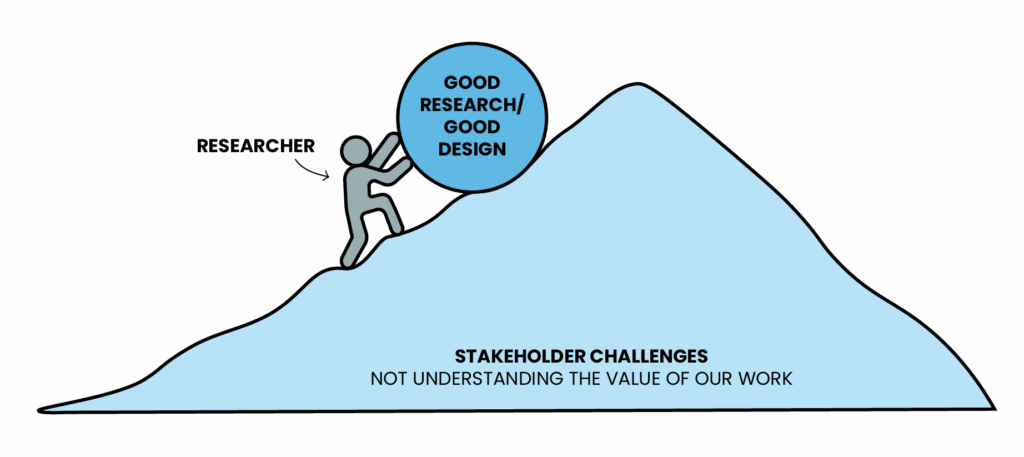
The alignment problem AI can’t solve
Remember when our main problem was getting stakeholders to understand that they’re not the user? Enter AI-generated profiles. The thing is, AI-driven tools might be making user data more “available” (read: easier to generate), and that might actually be getting more stakeholders interested in collecting that data… which, on the one hand, is great!
But whether that synthetic data is valuable or not, I can guarantee it will be useless without alignment around what kind of data is actually needed, what that data really means, and how it can or should be used. Is the proposed solution feasible? Is it solving for users’ actual problems? Have these problems been prioritized properly? Will solving these problems contribute meaningfully or profitably to the organization’s business goals?
The answers to these questions still depend on people — researchers, designers, product teams, product owners, and other stakeholders — developing a common understanding of what the business needs are, what the users’ needs are, and how research can inform design that bridges the two. We need two things before anything else: alignment and a plan that’s actionable. (That’s why “action” and “alignment” are major throughlines in my book, along with AI.)
In today’s landscape, you might be able to make a better case for research if you prove that AI is going to speed up your process. But even then, how will you get the budget approved for the AI subscription? And how will you ensure that the tool is modeling data accurately from real and reliable sources? You don’t just need your stakeholders to sign onto the idea of design research in general. You need them to collaborate with you on the research goals, the user groups you want to study, and the methods of data collection, so that you, the researcher, can understand what “progress” for the business means, and work to connect your research plan to those goals. In other words, you need your stakeholders to care about and be involved in the research in order for you to do your job well.
How do you do this? Well, first, you need to figure out how much they care now, and learn the landscape — who holds influence, where decisions live, what tensions already exist. Then you can slowly work toward influencing stakeholder sentiments surrounding your human-centered mission.
Acknowledging, then scaling your circle of influence
If you’ve ever poured hours into a research plan only to have it paused, re-scoped, or quietly ignored, you know how discouraging it can be. You share insights, build decks, make the case — and still nothing moves. Stakeholders nod, priorities shift, and projects move forward without you. It’s a frustrating feeling, putting effort into areas where you don’t actually have influence.
This is where many of us UX practitioners miss the mark: fueled by passion and good intent, we rush in ready to “fix” things — poking holes in existing processes and shattering egos like bulls in a china shop. To stakeholders, that enthusiasm can feel abrupt, even threatening, especially if they think the direction’s already set, or that they already have the knowledge they need to do their best work. Charging in too fast can make design research look like friction instead of support.
To deal with this, I often come back to a model from Stephen Covey’s 7 Habits of Highly Effective People. It wasn’t written for design research, but I’ve found that applying it to stakeholder buy-in can actually earn green lights on projects that no one ever thought would get off the ground. This model helps you focus on where your energy creates traction, and then grow outward, one circle at a time.
First, you need to take stock of your circle of control, your circle of influence, and your circle of concern in your current circumstances:
- Your circle of control includes the things directly in your hands: the quality of your work and deliverables, how you respond to others, your knowledge of human-centred design, and the professionalism you bring to relationships.
- Your circle of influence covers what you can affect indirectly — your team, the projects you work on, the organization’s pre-existing UX and research practices (or lack thereof), and your organization’s understanding of design. This is where buy-in starts to form!
- Your circle of concern includes the factors you can’t control: company strategy, leadership changes, budget shifts, and how others think or behave.
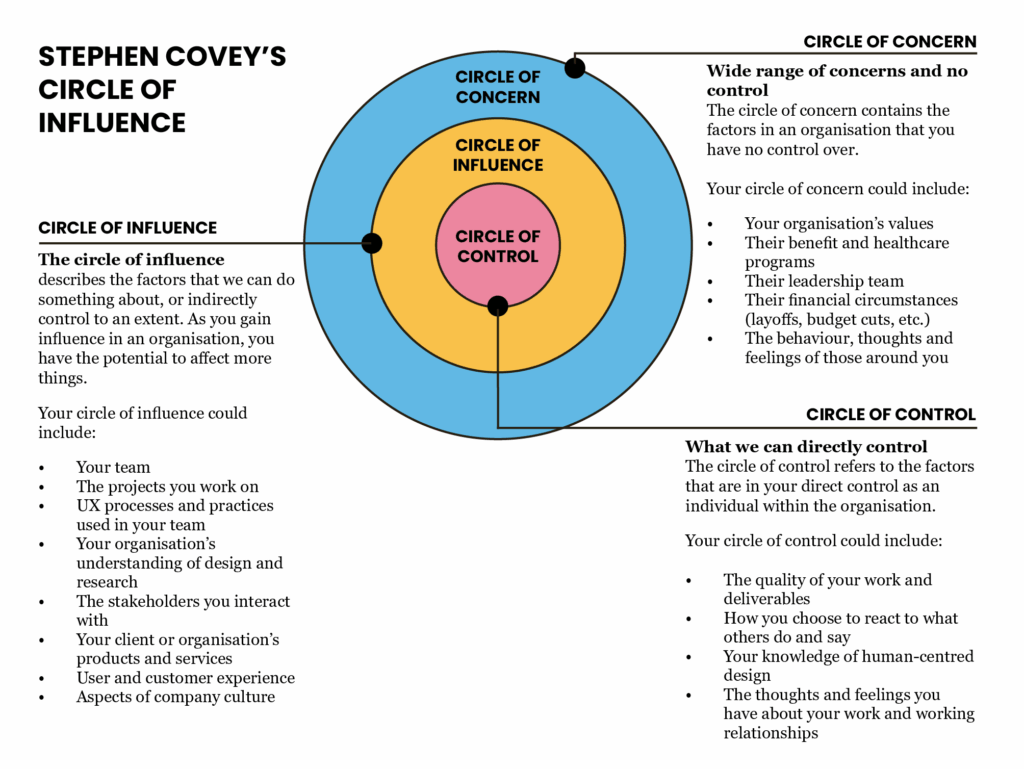
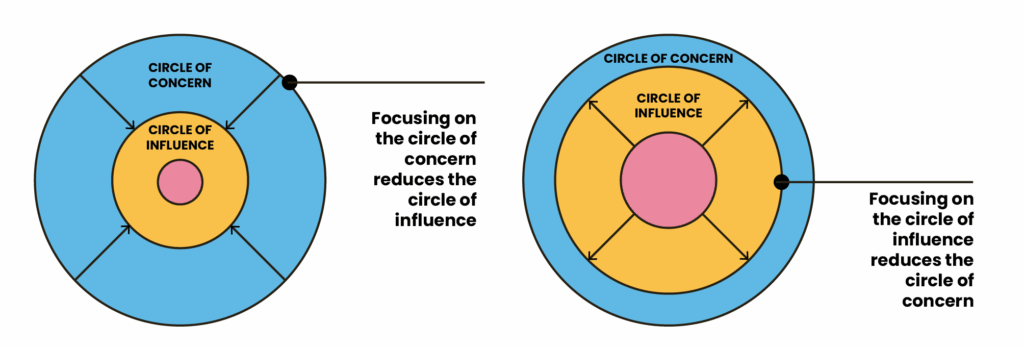
Influence grows from the inside out. When you try to sell research at the outer ring before building credibility within your team, it backfires.
Say you propose user interviews in a meeting, and a decision-maker shuts the idea down. It’s easy to react defensively, but that response can damage trust and shrink your influence. A better move is to pause, ask questions, and understand what’s behind their hesitation. Take the conversation offline, explore solutions together, and you might uncover an even stronger plan than the one you started with.
Start small, show value, and your influence expands naturally. Buy-in is earned gradually.
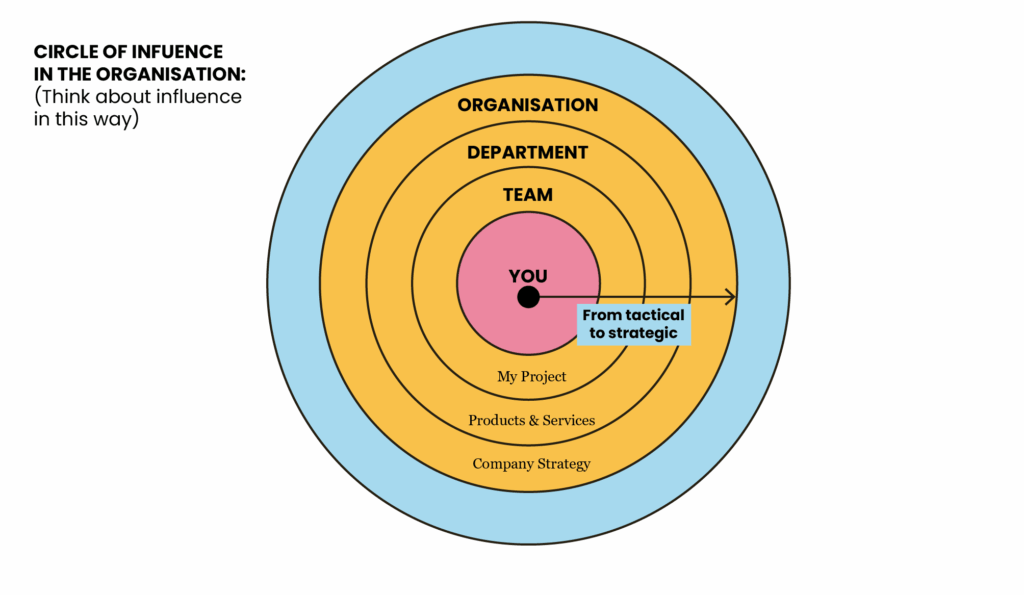
It can help to think about growing your influence by moving from tactical to strategic, as you begin to influence groups outside of your team and then outside of your department.
Three moves to grow influence fast
To build buy-in for design research inside an organization, you need to show them proof that you know what you’re talking about and that you hear their “side.” Then, you need to find ways to meet them where they are, because the only way forward is when you’re on the same side, working toward the same goals that will earn both stakeholders and users a “win-win.”
1. Be undeniably good
When I first started consulting, I thought influence meant convincing people through conversation, but it actually starts long before the meeting. Great work is persuasion. When your research is airtight, and your synthesis is sharp, people listen.
Be known for:
- Thorough research plans that show foresight and rigour.
- Clear synthesis that makes complexity understandable.
- Beautiful, compelling artefacts that speak for themselves — slides, summaries, or visuals that aren’t just pretty, but tell a strong story, and stay persuasive even when you’re not in the room.
2. Speak business first
I can’t count how many times I’ve seen brilliant research get dismissed simply because it was framed in “UX language.” The reality is that executives don’t wake up thinking about users — they wake up thinking about performance, risk, and growth. When we connect our work to those things, doors open fast.
Try this:
- Do a “sanity check” each time you plan or launch into a new task — is your work linked to a measurable business goal?
- Read annual reports and attend town halls to understand priorities and language.
- Mirror stakeholder language when you share insights. If they talk about “conversion” or “efficiency,” you should too.
3. Match to design maturity
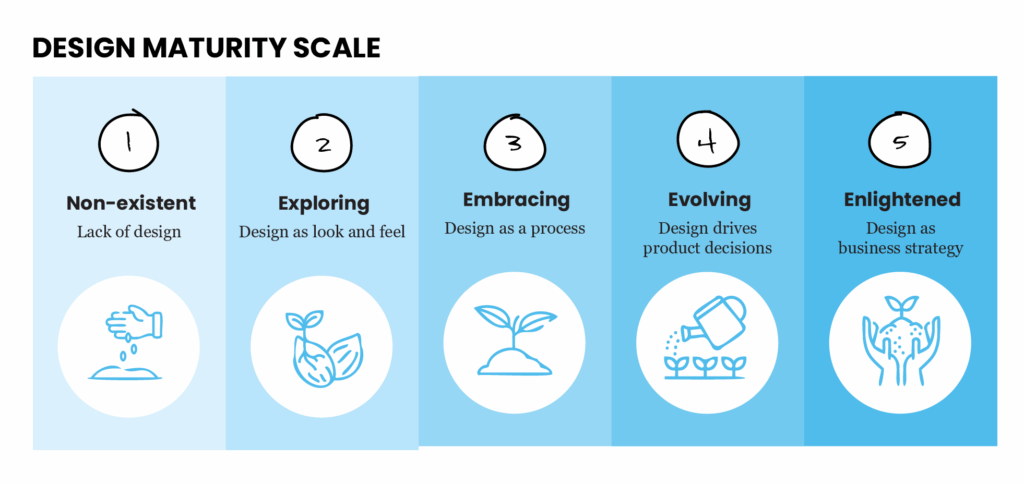
Before you push for big research initiatives, pause and take stock of your organization’s design maturity. Understanding where your company sits on the spectrum — from “look and feel” to fully integrated, human-centred practice — helps you shape realistic goals and avoid unnecessary friction.
You can use a simple design maturity assessment to guide your assessment. Look for cues across these areas:
- Understanding: Is UX seen as surface polish, a process, or a core business strategy?
- Resources: Are design and research roles defined and supported, or does one person wear all the hats?
- Research: Is it limited to usability testing, or are generative and evaluative studies built into planning cycles?
- Process: Are designers looped in at the end, or part of discovery and decision-making from the start?
- Governance: Who sponsors design? Is there executive-level ownership or just informal oversight?
Once you’ve mapped where things stand, adjust your approach accordingly:
- Low Maturity (Levels 1–2): Start small. Run quick usability tests or pilot interviews that show clear, measurable value.
- Medium Maturity (Levels 3–4): Expand. Connect research findings to product and business outcomes. Build rituals that bring cross-functional teams together.
- High Maturity (Level 5): Integrate. Align design research with strategic planning and governance. Help leadership connect human insights to long-term growth.
When you meet your organisation where it is, you build credibility that earns the right to take it further.
Navigating politics without losing your soul
As your circle of influence expands — from your immediate team, to your department, and eventually across the organization — the work changes. So do the politics. Every new layer comes with its own mix of priorities, personalities, and unspoken rules. And now with AI in the mix, those politics can become even more complicated. Some might be obsessed with AI, believing it will fix every problem, while others might be terrified that it will replace them completely.
Navigating this landscape means taking concrete steps toward winning over stakeholders, while staying true to your values and sense of integrity. As Niven Postma put it, “Office politics are about relationship currency and influence capital.” The goal isn’t manipulation; it’s awareness, and learning how to move through the system with empathy, transparency, and strategic intent.
Here are strategies you can apply at each level (team, department, or organization) as you gradually build your influence.
1. Seek to understand
Politics eases when you lead with empathy. Ask questions before you act, and spend time observing the dynamics around you.
- Team Level: Learn who naturally holds sway, who’s new, and who’s quietly holding the team together. Understand their working styles and what they need to succeed.
- Department Level: Get to know how teams depend on one another — where goals overlap, where tension builds, and where your work could help relieve pressure.
- Organization Level: Again, read annual reports, attend town halls, and notice which metrics or initiatives leaders talk about most. Knowing what matters to them helps you frame research in a way that resonates.
2. Seize opportunities
When you understand the landscape, you can start adding visible value.
- Team: Volunteer to facilitate a session, smooth a process, or help align next steps after a meeting.
- Department Level: Join cross-functional efforts where your research perspective clarifies direction.
- Organization Level: Share short, polished examples and case studies showing how research can create momentum.
3. Take initiative
When you’re proactive, you put yourself in a “helper” role, instead of positioning research buy-in as something that you’re asking for help with.
- Team Level: Identify process-related issues and offer to help with improving them. Be on the lookout for small ways to add value to your team.
- Department Level: Find ways to talk about your work and tie it back to strategic goals.
- Organization Level: Build business cases and use data to show how design research drives ROI and reduces risk.
Navigating politics well requires awareness and restraint — knowing when to adapt, when to push back, and how to stay anchored in what really serves the team and the work. When you lead with a genuine desire to help and to understand your stakeholders, you can build the kind of influence that lasts.
“Be so good they can’t ignore you.” — Steve Martin
Quick wins that build momentum
Research advocacy rarely starts with a big reveal. Instead, it starts with proof that feels practical. When stakeholders can see results quickly, they’re more likely to trust the process and give you space to go deeper next time. Small, well-chosen studies show that design research isn’t a pause in progress; it’s how progress starts.
Here are three ways to go for small, quick wins:
- Usability Testing: Examine an existing flow or feature. It’s fast, familiar, and immediately relevant to delivery teams.
- Pilot Study: Talk to 8–10 users (or credible stand-ins) and share a short insights summary. Tangible findings create curiosity and open doors.
- Stakeholder Workshop: Bring decision-makers together to clarify goals or interpret early results. Shared understanding builds advocacy faster than persuasion.
The trust toolkit (what to do every week)
We often talk about trust in big terms — alignment, influence, leadership — but it’s the small, routine actions that sustain it. The check-ins, the updates, the clear plans… they can feel mundane, even boring. But they’re also proof that you’re reliable. This is the quiet work that keeps collaboration steady and your influence growing.
- Collaboration: When you start a new initiative, bring people along from the start. Co-draft research goals and approaches, and review works-in-progress together instead of unveiling a “final” plan. When stakeholders see their input reflected, they feel more ownership. And advocacy follows.
- Expectation-setting: Be honest about risks, timelines, and possible risk mitigation for your projects. Clarify what you’ll need from others and what could derail progress. When surprises happen (and they will), preparation earns you patience and credibility.
- Planning: Keep one shared, living plan that everyone can see. Mark milestones, schedule check-ins, and track progress visibly. It keeps accountability mutual and reduces the nervous micromanagement that breaks trust.
- Communication: Stay responsive and clear. Share updates before you’re asked, raise red flags early, and make sure everyone knows where things stand. Silence breeds anxiety!
- Working in the open: Share process as well as outcomes. Make artefacts, notes, and decisions accessible in shared spaces so others can see how insights take shape. This will help with managing expectations, and it might even get them excited about the progress you make.
In a time when AI tools promise quick answers, it’s easy for stakeholders to lean on shortcuts or synthetic data that looks convincing, but isn’t grounded in authentic or relevant challenges and viewpoints. When you build trust, you can insert yourself into conversations about what’s actually useful — i.e., properly collected and synthesized data that reflects real users, and helps shape decisions that serve both them and the business.
From permission, to participation, to partnership
AI can get your work ramped up quickly, but before you come up with any research plan or collect any dataset, you need the trust and alignment that make a real inquiry possible. When that foundation is in place, AI tools become extensions of the system you’ve built (even possibly “synthetic data,” if it’s modeled after confirmed data that originally came from humans). But AI is not a substitute for planning research with your stakeholders, or thinking critically about design strategy, or any of the other context-processing we do in between research steps and stages of the design process.
No matter how advanced the tech, “progress” in design research depends on everyone understanding what they’re trying to achieve, how they’re achieving it, and ensuring that the resulting insights are sound enough for decision-makers to trust.
I’ll leave you with this thought: Design research hasn’t peaked; it’s still rising.
If we focus on what we can control, invite participation, and keep our practice human at its core, the rest will follow. With that mindset, AI becomes fuel for better questions and braver decisions… and the tide lifts all of us.
The excerpt has been exclusively created for UX Magazine by Sara Fortier.
The featured image, visuals, and concepts are taken from Design Research Mastery by Sara Fortier, BIS Publishers.