
Save
Part 4 of the “User Psychology Series.”
Before a user reads your copy, explores your features, or understands your value, their brain is already making judgments. These judgments are fast, instinctive, emotional, and sometimes brutally unfair. But they are real.
Onboarding is not “the start of the product experience.” Onboarding is the moment where the brain decides whether the product deserves attention, trust, and commitment.
Users don’t judge your UX first. They judge how the experience makes their mind feel.
“The confidence people have in their judgments is not a measure of accuracy.” — Daniel Kahneman
In onboarding, users are confident in their intuition — even when they barely understand the product.
This chapter explores the psychology behind those early decisions, how first impressions anchor long-term engagement, and why onboarding failures are rarely UI failures — they are cognitive and emotional failures.
The brain decides long before the user “understands”
Emotions process information 5× faster than conscious reasoning. That means the user “feels” the product before they “understand” it. Research shows:
- Emotional impression → 0.2 seconds.
- Cognitive impression → 3 seconds.
- Stay-or-leave decision → 10–30 seconds.
Users don’t pause to analyze your design. Their brain simply makes a snap judgment: “safe” or “difficult,” “comforting” or “uncertain,” “worth continuing” or “maybe later.”
“The brain’s emotional circuits act first. Reasoning is always late to the party.” — Joseph LeDoux
This is why onboarding is not just the beginning. It is the moment the brain forms the narrative of your product.
First impressions: the primacy effect in digital behavior
The primacy effect states that first experiences are disproportionately influential. In UX terms:
- A smooth first moment → “This app is simple.”
- One moment of uncertainty → “This is confusing.”
- One unexpected step → “This is risky.”
- One emotional friction → “Not for me.”
This effect is powerful and difficult to reverse.
A 2024 Forrester Study found:
- 84% of long-term dissatisfaction originates in the first session.
- A successful onboarding increases 30-day retention by 3.5×.
- Early friction decreases trust by 47% even when later steps improve.
“If the first impression fails, the rest of the experience becomes damage control.” — Jared Spool
The brain uses first impressions as shortcuts — and rarely revisits them.
Clarity: the brain rejects ambiguity instantly
Ambiguity doesn’t look like friction — but it feels like danger. When users can’t answer basic questions such as:
- What is this?
- What am I supposed to do next?
- Why is this permission needed?
- What is the expected outcome?
- Is this safe?
The brain immediately activates caution.
“Uncertainty magnifies perceived risk.” — Paul Slovic
Example: the permission shock
A cloud backup app asked for device-wide permissions upfront. The UI wasn’t wrong. But the psychology was. To the brain:
- No explanation → threat.
- Unknown consequences → danger.
- High stakes → avoidance.
Drop-off was 61%.
Only after adding a clear reassurance (“This helps us protect your photos. Nothing will be deleted.”) did the drop-offs fall dramatically.
Clarity reassures the brain. Ambiguity alarms it.
Cognitive load: the enemy of momentum
Cognitive load is the amount of mental effort required to proceed. High cognitive load = friction → hesitation → abandonment.
Harvard’s 2023 UX Psychology Review states:
- Mental fatigue begins after 2 consecutive decisions.
- Users abandon flows 27% faster when they cannot predict effort.
- Every additional field increases drop-off by 12–18%.
The brain is not resisting your onboarding. It is protecting its energy.
“If you want users to do something, make it effortless.” — Steve Krug
Example: the fitness app overload
A fitness app tried gathering all user data upfront. Users felt mentally burdened. Drop-offs surged.
After reducing it to a simple 3-step introduction, completion rose 44%.
Cognitive ease drives momentum. Cognitive strain kills it.
Emotional safety: the user’s first psychological need
Users are emotionally sensitive during onboarding. They don’t yet trust:
- The product
- The interface
- The outcome
- Themselves
Emotional friction — even a subtle one — triggers withdrawal.
“Losses loom larger than gains.” — Daniel Kahneman
Example: the fintech panic
A neobank asked users to “Connect bank account” as step one. Visually perfect. Psychologically terrifying.
78% abandoned.
Moving this step later — after building trust and demonstrating value — improved continuation by 40%.
Users aren’t afraid of your UI. They’re afraid of vulnerability.
Familiarity: the most underestimated UX superpower
Innovation is exciting — but not during onboarding.
When a user is new, familiarity acts as the brain’s stabilizer.
Familiarity reduces:
- Cognitive load
- Emotional tension
- Perceived risk
- Decision effort
“Familiarity breeds preference. Novelty breeds caution.” — Robert Zajonc
Example: the gesture-heavy social app
A new social platform introduced a gesture system unlike anything else. Users abandoned immediately.
The UI wasn’t wrong — it simply violated years of Instagram/TikTok/Snapchat mental models.
When the app reverted to standard navigation, engagement increased dramatically.
During onboarding, users don’t want innovation. They want orientation.
Onboarding is a promise, not a process
Onboarding is not where the user “learns.” It is where the product makes a psychological promise:
- “You will not be overwhelmed.”
- “You will not make mistakes.”
- “This will be predictable.”
- “This is worth your time.”
- “You can trust this.”
When users believe this promise, they continue. When they don’t, the journey ends silently.
“Design is really about communication and trust.” — Don Norman
Onboarding communicates whether the product is trustworthy.
First impressions rule the brain
The first moments of a product experience are not functional. They are emotional, instinctive, and deeply cognitive.
The mind does not wait to see your best features. It forms its judgment early — and rarely changes it.
After 25 years of studying user behavior inside digital systems, the conclusion is clear: Onboarding is not where users begin. Onboarding is where users decide.
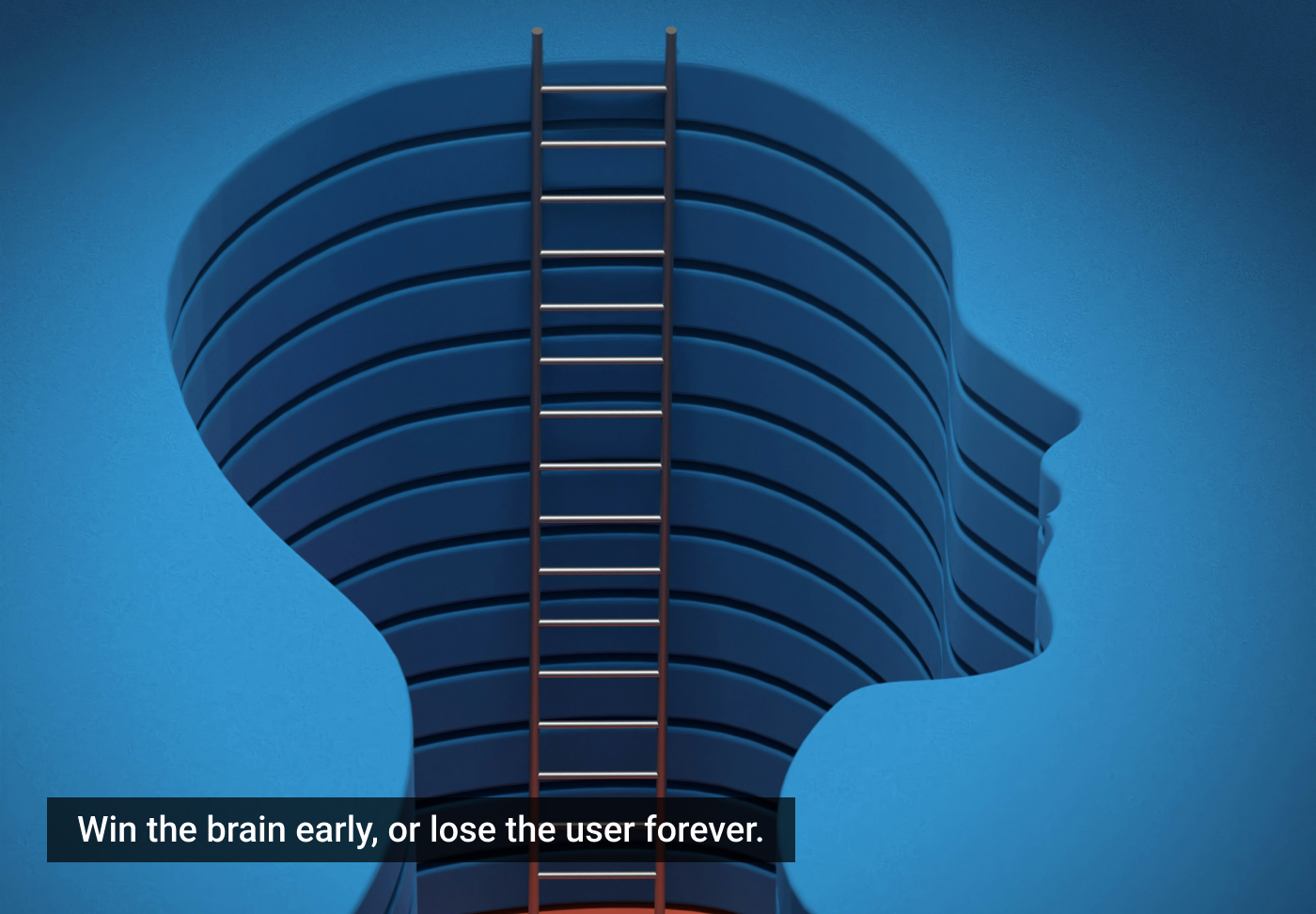
If you win the brain early, you win the user. If you lose the brain early, no amount of feature excellence can recover the relationship.
First impressions are not cosmetic. They are cognitive anchors.
Further reading:
- “Thinking, Fast and Slow,“ Daniel Kahneman.
- “Emotional Design,“ Don Norman.
- Mere Exposure Effect, Robert Zajonc.
- First-Use Behavior Studies, Nielsen Norman Group.
- Attention & Primacy Research, MIT Brain & Cognitive Lab.
- Cognitive Load in Onboarding, Stanford HCI Lab.
- Forrester Experience Trust Index (2024).
- LUCY UX.
The article originally appeared on LinkedIn.
Featured image courtesy: Yumu.


Tushar Deshmukh
Tushar A. Deshmukh is a seasoned UX leader, entrepreneur, and founder of UXExpert, UXUITrainingLab, UXUIHiring, UXTalks, and AethoSys — ventures dedicated to advancing human-centered and ethical design. With over 25 years of experience in design and development, he has mentored thousands of professionals and shaped digital transformation initiatives across industries. He now also serves as the Design Director at SportsFan360, where he brings his deep expertise in UX psychology, usability, and product strategy to craft next-generation fan engagement experiences.
- The article argues that onboarding is not where users begin; it is where they decide whether to stay or leave.
- It shows that most onboarding failures are not design problems; they are psychological ones.
- The piece challenges designers to recognize that first impressions are cognitive anchors and that the brain rarely revises its judgments.