
Design Research for Healthcare Services
Service design potentially represents a significant change and challenge to experience design and technology infrastructure design orientations.
A comprehensive presentation of service-oriented design methods would fill its own book.
Because the health sector is vast and by necessity conservative, a selection of methods for service innovation is meaningless without establishing a specific context.
The integrated service design framework in the table below identifies the contexts in which the participatory scenario design method stands.
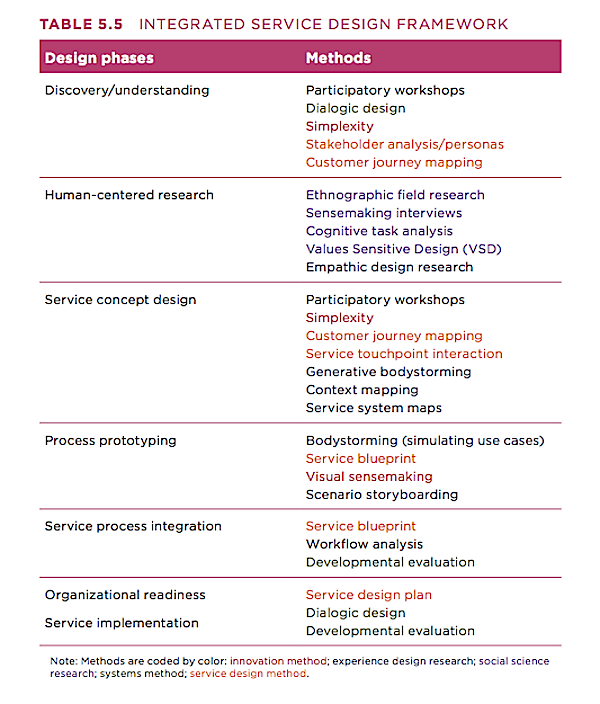
Participatory Scenario Design
The participatory scenario design process elicits multiple perspectives and experiential knowledge from people with a deep understanding of the field. Facilitating scenario development as a workshop process helps participants form shared mental models of user behavior associated with the product/service design context.
By formulating scenarios as a collaborative process, people get the chance to share their own stories, wisdom, experience, and details helpful to the group’s developing understanding. Such a shared understanding is more powerful than a set of storyboards developed in isolation by design researchers as a prepared deliverable.
As a group’s understanding evolves and their stories become embedded in scenarios, the resulting story lines of shared knowledge become a basis for future design decisions, many of which will occur as business or product development decisions well in the future. Scenario design can be viewed as an investment in the long-term process.
Guiding scenario design requires setting the context for the activity, typically as part of a series of design workshop processes. A sequence of activities may be structured along the following lines:
- Review and discuss user and market research.
- Articulate themes and priorities from research to carry forward into design.
- Identify stakeholders and users from research and requirements.
- Engage the team in defining personas as a small-group exercise.
- Review personas and list relevant activities for each.
- Identify common activities across personas, and cluster personas into sets where it makes sense.
- Generate and sketch activity scenarios for high-priority persona activities.
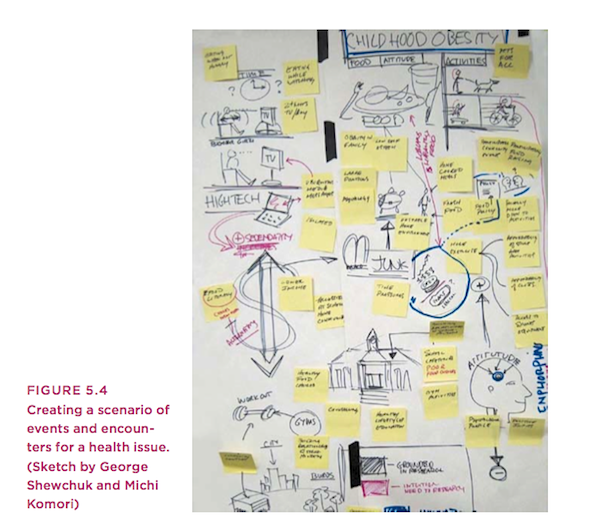
Scenario creation starts at step seven. Participants generally start either by posting anticipated actions and events on sticky notes to generate a series of touchpoints and potential encounters, or by creating a timeline for the period of engagement and associating events with time dependencies. The figure below illustrates the scenario construction of the former.
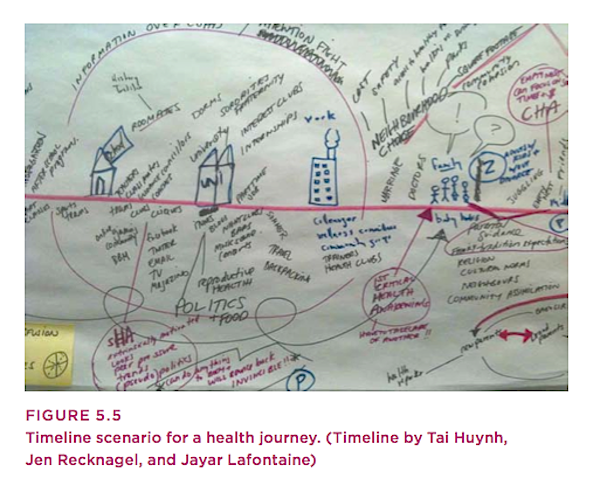
The outcome of a timeline scenario can be seen in the image below, which shows the envisioned sequence of life events—from college to first job to middle age— to identify the points of intervention for health conversations. Although this is a much longer timeframe than a typical customer journey, the scenario process benefits from leaving the timeframe, experiences, and ideation open to the experience of participants.
Scenarios are generated for a set period (30 minutes is typical). A variation that is done within informed groups of varied roles or disciplines is to hold charettes of the first scenarios: A narrator stays with each team’s scenario while all others circulate around the room and walk through and critique each of the scenarios.
New sticky notes (of another color) can be added to annotate the sketches with additional events, touchpoints, or suggestions. Following the development of rough sketch scenarios in the workshop setting, the narratives can be integrated into design artifacts and shared with management and the development team.
The Value in Design Research Methods
Design research methods can blur the boundaries and nudge practitioners into making proposals for which their experience is inapplicable. Service designers without clinical experience should avoid advising on clinical content. In the right context, any user-centered design method can be applied in healthcare service design. Sequence a series of research methods so they contribute significantly to each design decision.
You can read about Generative Bodystorming, another design research method for healthcare, in Design for Care: Innovating Healthcare Experience by Peter H. Jones. This new book from Rosenfeld Media, “fuses design practice, systems thinking, and practical healthcare research to help designers create innovative and effective responses to emerging and unforeseen problems,” covering design practices and methods for innovation in patient-centered healthcare services.