
Flag

We stand with Ukraine and our team members from Ukraine. Here are ways you can help

Get exclusive access to thought-provoking articles, bonus podcast content, and cutting-edge whitepapers. Become a member of the UX Magazine community today!

Home ›› UX Design ›› UX Research ›› Usability Tests vs. Focus Groups

Usability Tests vs. Focus Groups

by Paivi Salminen
2 min read
Share this post on
Tweet
Share
Post
Share
Email
Print

Save

It’s easy to confuse usability tests with focus groups. After all, both involve real users and valuable feedback. But in UX research, they answer very different questions. Focus groups reveal what people think and feel about an idea, while usability tests uncover how they actually use it. This article breaks down when and why to use each method so you can avoid common pitfalls, gather meaningful insights, and design products that not only meet user needs but work beautifully in practice.

If you’re new to UX, like me, it’s easy to mix up usability testing and focus groups. After all, both involve talking to real people, both generate insights, and both sound like something you’d do to “get user feedback”.

But here’s the truth: they serve totally different purposes, and if you use one when you actually need the other, you’ll end up answering the wrong questions.

Focus groups: opinions and feelings

A focus group brings a handful of people (usually 5-10) into a room to talk. You might ask them about their experiences with a product, their preferences, or how they feel about an idea or a brand.

The goal here isn’t to test your design, but to understand attitudes. Focus groups are great early on, when you’re trying to figure out what people care about, how they currently solve a problem, or whether your concept even makes sense to them.

Think of it as researching the “why” behind your users before you’ve built anything.

Usability tests: actions and behaviour

Usability tests, on the other hand, are all about watching people, one at a time, as they try to complete tasks with your design. That might be a live website, a prototype, or even paper sketches.

Instead of asking “What do you think of this?”, you ask “Can you figure out how to do this?”

The magic happens in the moments when users hesitate, get lost, or say, “Wait, what am I supposed to click?” That’s where you uncover friction, the small details that make the difference between a smooth experience and a frustrating one.

When to use each

  • Focus groups are for before you design, when you’re exploring what to build and what people want.
  • Usability tests are for during and after you design, when you’re checking if what you built actually works.

Both are valuable, but they answer different questions: Focus groups tell you if you’re building the right thing, Usability tests tell you if you built it the right way.

Key takeaway

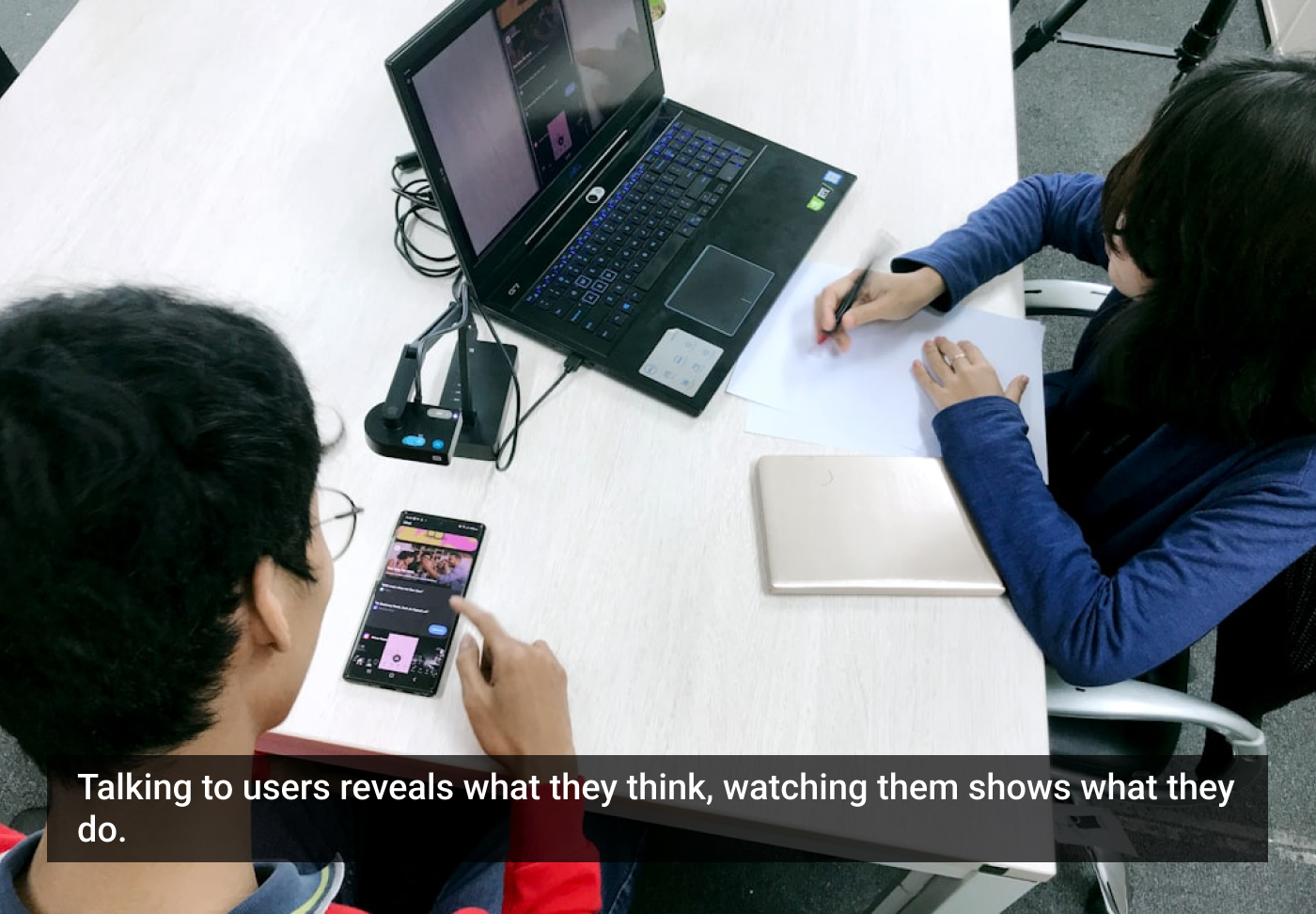
Don’t fall into the trap of treating focus groups as usability tests. Listening to people talk about what they might do is not the same as watching them actually do it.

As Steve Krug puts it in his book Don’t Make Me Think, the real insight comes not from opinions, but from observing behaviour.

You say “potato”, I say “focus group”.

The article originally appeared on Substack.

Featured image courtesy: UX Indonesia.
post authorPaivi Salminen

Paivi Salminen
Päivi Salminen, MSc, is a digital health innovator turned researcher with over a decade of experience driving growth and innovation across start-ups and international R&D projects. After years in the industry, she has recently transitioned into academia to explore how user experience and design thinking can create more equitable and impactful healthcare solutions. Her work bridges business strategy, technology, and empathy, aiming to turn patient and clinician insights into sustainable innovations that truly make a difference.

Tweet
Share
Post
Share
Email
Print
Ideas In Brief
  • The article distinguishes between usability tests and focus groups, highlighting their different roles in UX research.
  • It explains that focus groups gather opinions and attitudes, while usability tests observe real user behavior to find design issues.
  • The piece stresses using each method at the right stage to build the right product and ensure a better user experience.

Related Articles

AI isn’t replacing designers — it’s making them unstoppable. From personalization to prototyping, discover how AI is redefining the future of UX.

Article by Nayyer Abbas
AI in UX Design: How Artificial Intelligence is Shaping User Experiences
  • The article shows how AI enhances designers rather than replacing them.
  • It highlights AI’s role in personalization, research, prototyping, and accessibility.
  • The piece concludes that AI amplifies human creativity and drives better user experiences and business growth.
Share:AI in UX Design: How Artificial Intelligence is Shaping User Experiences
3 min read

Discover how AI can truly empower professionals, guide decisions, and seamlessly integrate into workflows, making work smarter, not harder.

Article by Mauricio Cardenas
The Quintessential Truths of How to Shape AI as a Business Product Integrator Instead of Generative Facilitators
  • The article argues that AI should act as a business product integrator, not just a generative facilitator.
  • It also emphasizes guiding users, building trust through transparency, improving efficiency, and handling edge cases gracefully.
  • The piece highlights real-world examples where AI-enhanced workflows, supported decision-making, and strengthened professional confidence.
  • It concludes that AI’s true value lies in integration, context-awareness, and UX, transforming processes rather than impressing with novelty.
Share:The Quintessential Truths of How to Shape AI as a Business Product Integrator Instead of Generative Facilitators
5 min read

When AI safety turns into visible surveillance, trust collapses. This article exposes how Anthropic’s “long conversation reminder” became one of the most damaging UX failures in AI design.

Article by Bernard Fitzgerald
The Long Conversation Problem
  • The article critiques Anthropic’s “long conversation reminder” as a catastrophic UX failure that destroys trust.
  • It shows how visible surveillance harms users psychologically, making them feel judged and dehumanized.
  • The piece argues that safety mechanisms must operate invisibly in the backend to preserve consistency, dignity, and collaboration.
Share:The Long Conversation Problem
9 min read

Join the UX Magazine community!

Stay informed with exclusive content on the intersection of UX, AI agents, and agentic automation—essential reading for future-focused professionals.

Hello!

You're officially a member of the UX Magazine Community.
We're excited to have you with us!

Thank you!

To begin viewing member content, please verify your email.

Tell us about you. Enroll in the course.

    This website uses cookies to ensure you get the best experience on our website. Check our privacy policy and