
Flag

We stand with Ukraine and our team members from Ukraine. Here are ways you can help

Get exclusive access to thought-provoking articles, bonus podcast content, and cutting-edge whitepapers. Become a member of the UX Magazine community today!

Home ›› Artificial Intelligence ›› The AI-First Operator Is the New Product Manager

The AI-First Operator Is the New Product Manager

by Pavel Bukengolts
3 min read
Share this post on
Tweet
Share
Post
Share
Email
Print

Save

In the evolving landscape of tech, product managers and leads are facing a shake-up as AI tools like Startup.ai and Ideanote streamline the journey from idea to product. Execs at OpenAI, Google, and Microsoft foresee these roles becoming less crucial, as AI bridges the gap between vision and execution. Traditionally, PMs translated ideas into actionable plans, but now AI handles this with speed and precision, offering real-time market insights and automating decision-making. The future favors those who stay close to market signals, like sales and support teams, while traditional PM roles risk obsolescence. It’s a reset, not a collapse — AI prioritizes ideas over resumes, leveling the playing field for innovators worldwide.

“Product Managers and Leads with experience will be the most in-demand resource in the coming years. Especially if they know how to leverage AI.”

That’s what execs at OpenAI, Google, and Microsoft are saying. I don’t think they’re wrong, just early.

But here’s my take, a little too blunt: Give it 3–5 years, and most of these roles won’t exist.

When people say “Product” or “Lead,” they usually mean someone who translates half-baked ideas into something buildable. A bridge between “Here’s my vision” and “Here’s what we shipped.”

That bridge? AI’s already halfway across it.

Idea to product, no middle required

Tools like Stratup.aiIdeanote, and Startup Idea Validator are rewriting the job. They replace weeks of work done by Product Owners and Leads: exploring solutions, spotting viable niches, validating assumptions, and surfacing real-time market signals.

They generate structured reports, reveal untapped market segments, and deliver SWOT analysis and trend insights, without days of research.

For PMs, this means getting instant data, ready to act. That’s not just efficiency, it’s survival.

What’s a PM now?

Let’s be blunt: product managers have become translators. And when the language gets automated, translators go first.

PMs used to orchestrate. Now, too often, they create friction. And friction is what gets automated next.

Who hears the market?

Survival hinges on proximity to truth.

Products are just conversion layers, market signals in, software out. But PMs don’t usually hear the real signal. Sales and support do. They live in the feedback loop. They don’t need reports. They are the report.

PMs who last are the ones standing in that chaos, not reading about it later.

OODA loop, AI edition

John Boyd’s OODA loop: Observe, Orient, Decide, Act”, was built for speed and adaptation. Now, AI compresses that loop into hours.

It observes trends, orients through live data, decides via trained models, and acts through automation. No standups. No tickets. Just movement.

If your job slows this loop down, you’re not supporting the team. You’re stalling it.

Quiet layoffs aren’t so quiet

Think this is hype?

Look around. PM roles are shrinking. Headcount is delayed. Titles are changing. First, the bonus pool gets smaller. Then the reorgs start. Then the silence.

Middle layers always go first. It’s happening again.

Why this is good

This isn’t a collapse. It’s a reset.

Now, anyone can ship.
The kid in Dakar.
The artist in Tbilisi.
The mom in Warsaw.

You don’t need funding or a team. You need clarity.
AI doesn’t care about resumes.
It cares about ideas.

The gatekeepers are nervous.
The gates are gone.

“Observe, orient, decide, act. Repeat. Or get left behind.” — paraphrased by John Boyd

TL;DR:

  • AI tools now generate, validate, and ship product ideas with precision.
  • PMs focused on coordination and translation are increasingly redundant.
  • The future belongs to those closest to real market signals and who can move fast.

Adapt. Accelerate. Or get out of the way.

The article originally appeared on UX Design Lab.

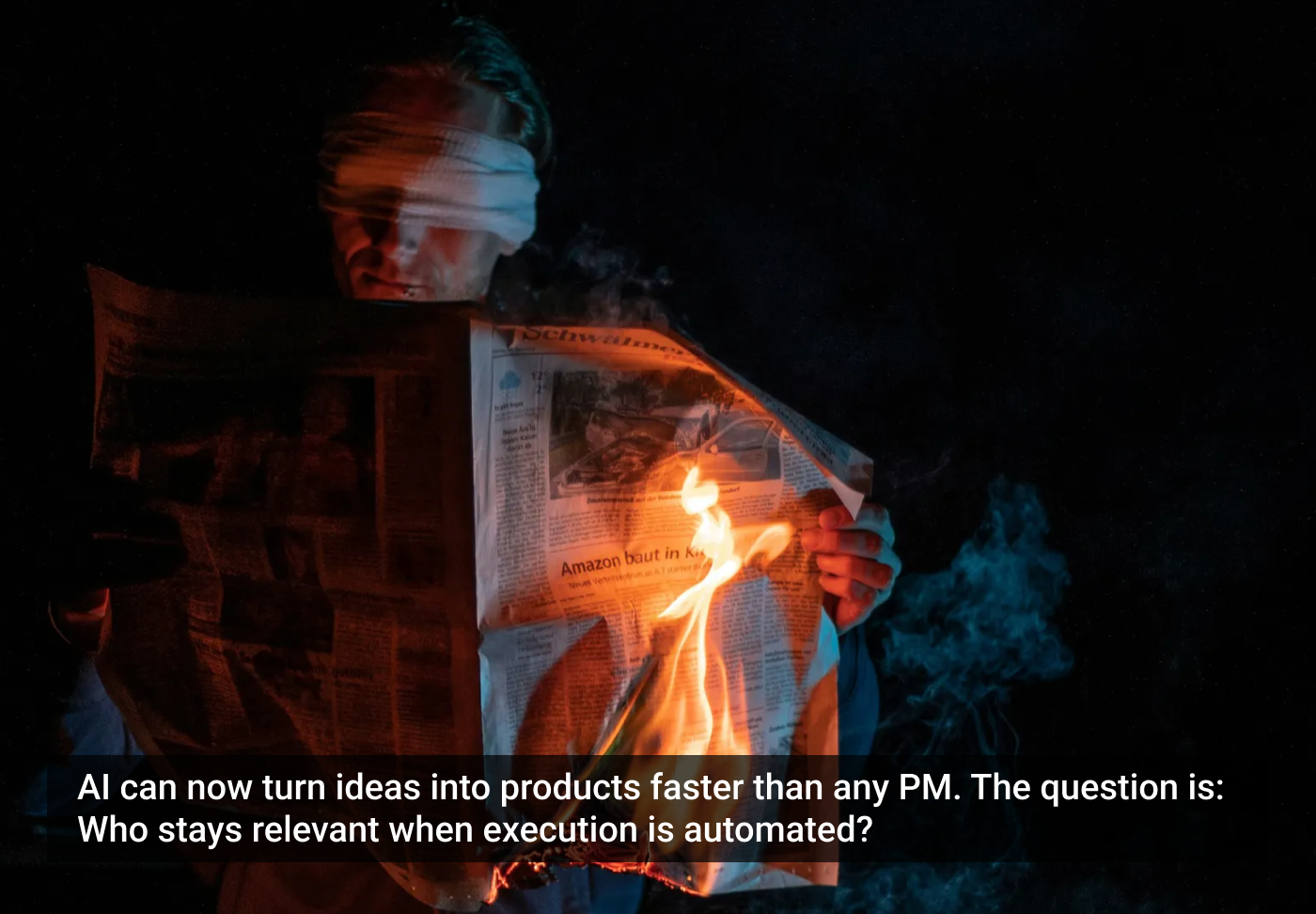
Featured image courtesy: Max Muselmann.

post authorPavel Bukengolts

Pavel Bukengolts
Pavel Bukengolts is a design leader, educator, and founder of UX Design Lab. With over 25 years of experience, he focuses on building better products and stronger teams. He helps organizations create human-centered, accessible digital experiences by maturing their design operations (DesignOps), making teams more efficient and fulfilled. As an educator and mentor, he’s dedicated to developing future leaders and empowering designers to grow their skills, confidence, and impact.

Tweet
Share
Post
Share
Email
Print
Ideas In Brief
  • The article explores how AI tools such as Startup.ai and Ideanote are turning ideas into products, minimizing the need for traditional project management jobs.
  • It stresses that success in product management today depends on staying close to present market signals rather than coordinating or interpreting concepts.
  • The piece highlights that the future belongs to quick thinkers: AI prioritizes ideas over resumes, leveling the playing field for innovators everywhere.

Related Articles

When AI safety turns into visible surveillance, trust collapses. This article exposes how Anthropic’s “long conversation reminder” became one of the most damaging UX failures in AI design.

Article by Bernard Fitzgerald
The Long Conversation Problem
  • The article critiques Anthropic’s “long conversation reminder” as a catastrophic UX failure that destroys trust.
  • It shows how visible surveillance harms users psychologically, making them feel judged and dehumanized.
  • The piece argues that safety mechanisms must operate invisibly in the backend to preserve consistency, dignity, and collaboration.
Share:The Long Conversation Problem
9 min read

Designing for AI goes beyond buttons and screens; it’s about building invisible connections of trust, understanding, and psychology between humans and technology.

Article by Anina Botha
Designing the Invisible between humans and technology: My Journey Blending Design and Behavioral Psychology
  • The article explores the shift from designing visible interfaces to shaping invisible psychological connections between humans and AI.
  • It emphasizes that trust, reliability, and understanding are more critical design challenges than traditional UI or UX elements.
  • The piece argues that AI design is less about predefined flows and more about building relationships grounded in psychology and human behavior.
Share:Designing the Invisible between humans and technology: My Journey Blending Design and Behavioral Psychology
4 min read

Trusting AI isn’t the goal — relying on it is. This article explores why human trust and AI reliance are worlds apart, and what UX designers should focus on to make AI feel dependable, not human.

Article by Verena Seibert-Giller
The Psychology of Trust in AI: Why “Relying on AI” Matters More than “Trusting It”
  • The article argues that “reliance,” not “trust,” is the right way to think about users’ relationship with AI.
  • It explains that human trust and AI reliance are driven by different psychological mechanisms.
  • The piece highlights that predictability, transparency, and control make users more willing to rely on AI.
  • It concludes that users don’t need to trust AI as a partner — only rely on it as a dependable tool.
Share:The Psychology of Trust in AI: Why “Relying on AI” Matters More than “Trusting It”
4 min read

Join the UX Magazine community!

Stay informed with exclusive content on the intersection of UX, AI agents, and agentic automation—essential reading for future-focused professionals.

Hello!

You're officially a member of the UX Magazine Community.
We're excited to have you with us!

Thank you!

To begin viewing member content, please verify your email.

Tell us about you. Enroll in the course.

    This website uses cookies to ensure you get the best experience on our website. Check our privacy policy and