
Flag

We stand with Ukraine and our team members from Ukraine. Here are ways you can help

Get exclusive access to thought-provoking articles, bonus podcast content, and cutting-edge whitepapers. Become a member of the UX Magazine community today!

Home ›› Design Leadership

Design Leadership

Read these first

Every time you drafted a design brief, stating the goal, audience, constraints, and context, you were doing precisely what good AI prompting entails. There is a change of recipient. The ability is identical.

Article by Tushar Deshmukh
The Prompt Is the New Brief
  • “Prompt engineering” can sound like a technical skill, but that image is not always accurate. In practice, good prompting is very much like writing a good design brief. Both require setting a goal, defining a target audience, setting constraints, providing context, and establishing evaluation criteria.
  • Designers are already doing these activities in practice. They have skills in writing briefs that they have developed during their careers that directly translate to fluency in AI prompting – they just might not have made the connection.
Share:The Prompt Is the New Brief
17 min read

AI can create wireframes, synthesize research, and draft copy fast. What it can’t do: understand your users, carry context, or be accountable when something goes wrong. That’s still you.

Article by Tushar Deshmukh
AI Is Your New Intern, Not Your Replacement
  • AI is not replacing UX pros; it’s automating repetitive tasks and augmenting human capabilities.
  • Think of AI as an intern: quick, smart, but dependent on human direction, context, and judgment.
  • Human skills like empathy, research, systems thinking, and ethical decision-making are more important than ever.
  • The future belongs to designers who incorporate AI to accelerate execution and devote more time to strategic, human-centered work.
Share:AI Is Your New Intern, Not Your Replacement
20 min read

Reveal the three-part kernel that separates real problem framing from simple description.

Article by Morteza Pourmohamadi
A Problem Framing Kernel
  • The piece argues that if you don’t have these three core elements: broadly collecting raw material, connecting elements to surface real tensions, and committing to a point of view, you don’t have a problem frame yet; you have a description.
Share:A Problem Framing Kernel
4 min read

Discover why your most irreplaceable asset isn’t the technology you use. It’s your humanity.

Article by Pavel Bukengolts
Reimagining Work: How Designing for Humanity Will Shape 2030
  • The article argues that creativity, empathy, and emotional intelligence aren’t threatened by AI but become more valuable as automation takes over routine tasks, freeing people to focus on complex, uniquely human challenges.
  • It highlights that the key to thriving in an AI-driven world is using technology to enhance human potential: optimizing environments for focus and well-being, rather than letting it overshadow the qualities that make us effective.
  • The piece emphasizes that as workplaces evolve toward 2030, empathy becomes a core leadership skill: the engine behind authentic collaboration and meaningful human connection in increasingly automated environments.
Share:Reimagining Work: How Designing for Humanity Will Shape 2030
5 min read

Find out how design leaders can build a more inclusive digital world from the ground up.

Article by Pavel Bukengolts
Championing Accessibility: a Path to Inclusive Design Leadership
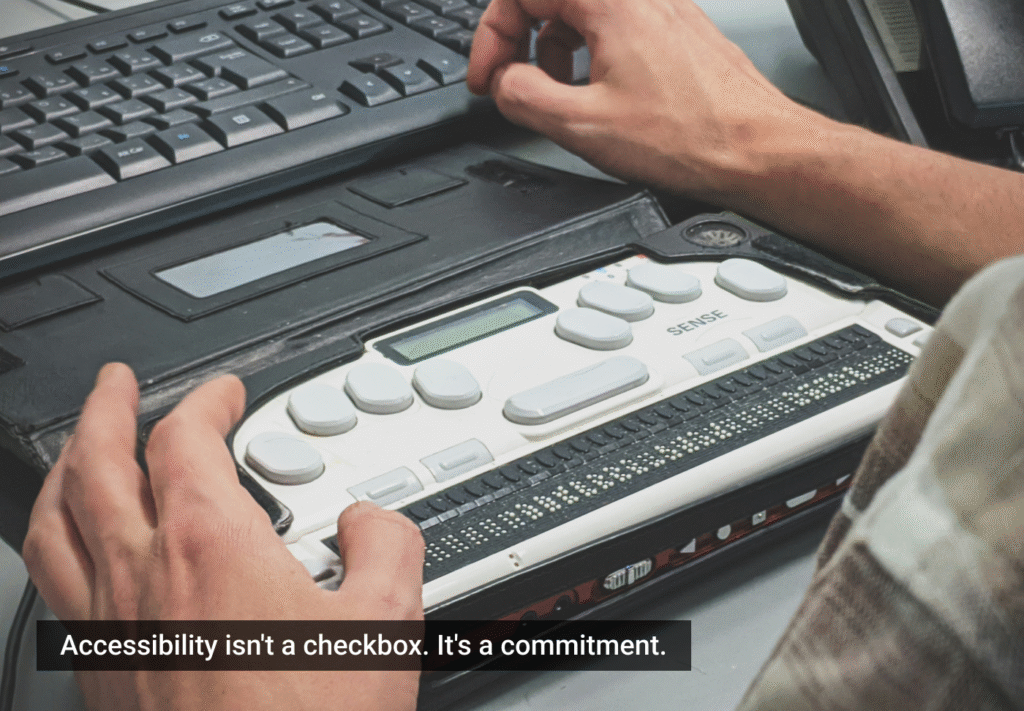
  • The article highlights that designing for accessibility isn’t about following rules. It’s about making sure no one gets left out of the digital world.
  • The piece explores how building accessibility from the start, with the help of AI and the right mindset, makes the result better for everybody.
Share:Championing Accessibility: a Path to Inclusive Design Leadership
4 min read

Uncover the AI-driven future of product management, where execution is automated and staying close to the market is key.

Article by Pavel Bukengolts
The AI-First Operator Is the New Product Manager
  • The article explores how AI tools such as Startup.ai and Ideanote are turning ideas into products, minimizing the need for traditional project management jobs.
  • It stresses that success in product management today depends on staying close to present market signals rather than coordinating or interpreting concepts.
  • The piece highlights that the future belongs to quick thinkers: AI prioritizes ideas over resumes, leveling the playing field for innovators everywhere.
Share:The AI-First Operator Is the New Product Manager
3 min read

Join the UX Magazine community!

Stay informed with exclusive content on the intersection of UX, AI agents, and agentic automation—essential reading for future-focused professionals.

Hello!

You're officially a member of the UX Magazine Community.
We're excited to have you with us!

Thank you!

To begin viewing member content, please verify your email.

Get Paid to Test AI Products

Earn an average of $100 per test by reviewing AI-first product experiences and sharing your feedback.

    Tell us about you. Enroll in the course.

      This website uses cookies to ensure you get the best experience on our website. Check our privacy policy and