
In one of my earlier articles, Designing UI/UX in the Age of Distraction — I explored how designers were challenged to cut through the noise and capture user attention in an environment flooded with stimuli. Back then, design was still largely human-crafted, and the Adobe Suite was the undisputed almighty of creative workflows.
Fast forward to today, and the design canvas has transformed. We are now in an era where AI, contextual intelligence, and automation are rewriting the very definition of experience. Interfaces are no longer static; they are adaptive, predictive, and self-evolving, creating what I call the shift from UI/UX to AX — Adaptive Experience.
The rise of adaptive design
For years, UI and UX were about creating static, linear pathways: menus, buttons, and flows that guided users from point A to B. While effective in their time, these designs assumed that all users were the same and that behavior followed predictable, pre-mapped journeys.
Enter Adaptive Experience (AX), the next evolution in design. Unlike static UI, AX is dynamic, contextual, and powered by AI. It doesn’t just present options; it reshapes itself in real time based on signals, intent, and behavior. The goal is not just usability but anticipation, delivering what a user needs before they even ask.

Think of Netflix, where recommendations shift not only by what you’ve watched, but by when, how long, and even your mood patterns across sessions. Spotify’s mood-based playlists showcase another layer of adaptive design, blending algorithms and emotional signals to curate experiences beyond simple genre filters. Amazon pushes it even further with its experiments in anticipatory shipping, predicting demand before a purchase is made and reshaping the entire user journey.
Adaptive design signals a turning point: from interfaces as static artifacts to ecosystems that learn, evolve, and co-create with users. This is not just design, it’s living architecture.
Contextual engineering & intelligent interfaces
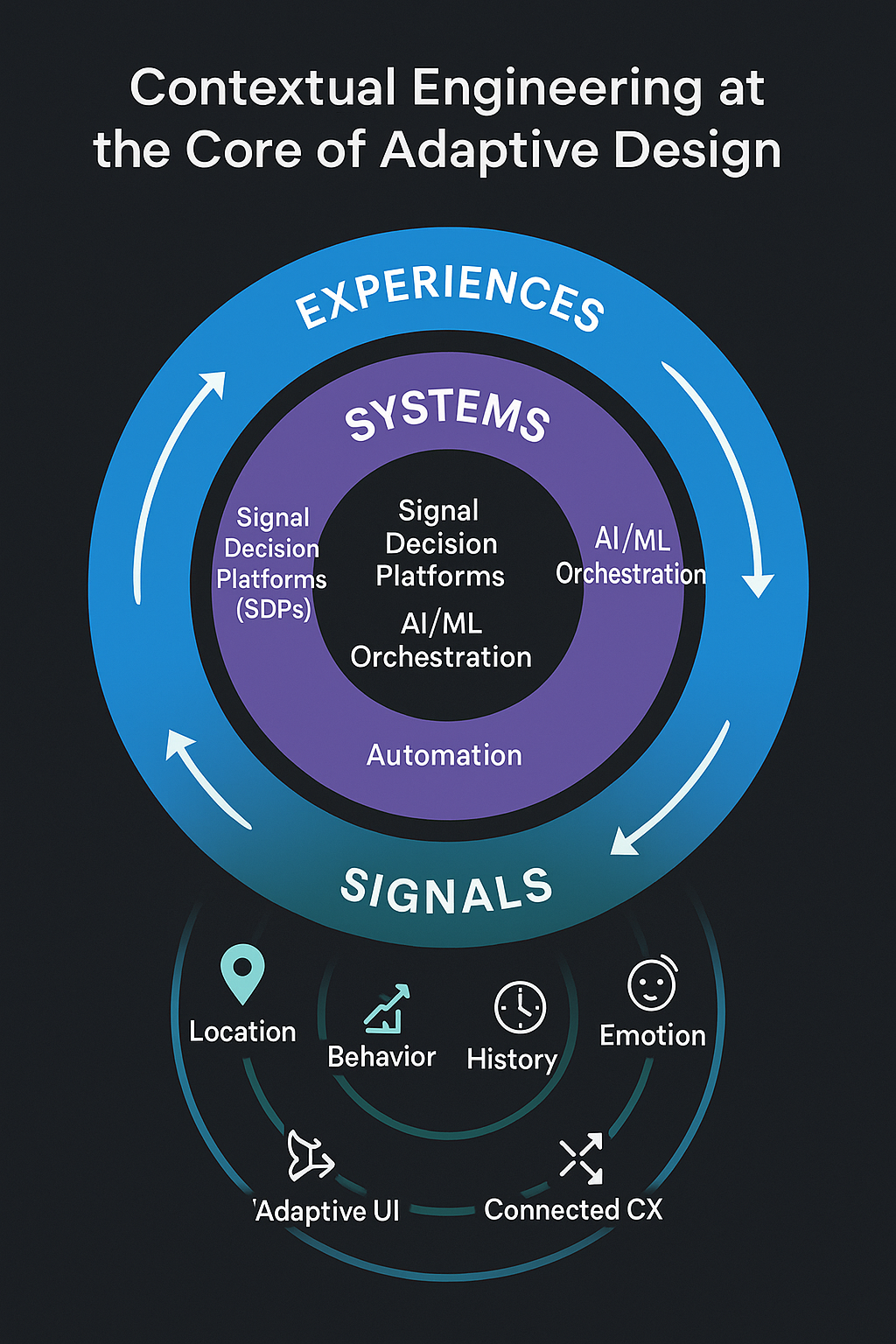
If adaptive design is the philosophy, contextual engineering is the machinery that powers it. Today, interfaces are no longer built on static logic but on signals, location, past behavior, time of day, emotional state, and even subtle cues like scrolling speed or dwell time. These signals feed into Signal Decision Platforms (SDPs), which act as real-time conductors, orchestrating how the interface responds and evolves.
This creates a layered progression:
- UI is no longer just the skin but a responsive surface.
- UX becomes a fluid journey that adapts to micro-contexts.
- CX (Customer Experience) expands across channels, aligning web, app, social, and in-person touchpoints.
- EX (Experience of Everything) emerges when all interactions — human, digital, and ambient — are integrated into one adaptive ecosystem.
We already see this shift in action. Conversational interfaces like ChatGPT, Perplexity, and DeepSeek have redefined expectations; users don’t just click, they converse. Voice-driven design, from Alexa to Google Assistant, brings experiences into the ambient space. AR/VR pushes boundaries further, blending physical and digital realities where context (location, gesture, gaze) dictates interaction. And multimodal AI design allows for seamless blending of text, voice, visuals, and actions, making experiences more human-like than ever before.
The essence of contextual engineering is this: design is no longer about what users see or do, but about how systems perceive, interpret, and anticipate. The future of intelligent interfaces lies not in decoration, but in orchestration.
Human-in-the-loop: designers as experience architects
As AI takes over the heavy lifting of wireframing, prototyping, and even creative iteration, the role of the designer is undergoing a profound transformation. Tools like Adobe Firefly and Figma AI can now generate layouts, color palettes, and user flows in seconds. What once demanded days of manual effort is now automated with astonishing precision.
But speed and automation are not the endgame. In fact, they highlight a new responsibility: ensuring that adaptive systems remain ethical, accessible, and inclusive. AI can replicate patterns, but it cannot inherently understand bias, cultural nuance, or the subtle human need for dignity in digital interactions. That is where the human-in-the-loop becomes indispensable.
Designers are no longer just pixel arrangers; they are experience architects. Their task is to set guardrails, define ethical boundaries, and blend human empathy with machine intelligence. A system may know which button a user is likely to click, but it takes a human perspective to ask whether that button should exist, whether it respects accessibility needs, or whether it fosters inclusion.
In the Age of Adaptive Experience, the designer’s job is less about crafting static screens and more about shaping dynamic systems that serve both business goals and human values.
The future of adaptive experience
The horizon of experience design is no longer defined by screens, but by signals and senses. The next wave will move us beyond traditional interfaces into a realm where interaction is ambient, intuitive, and often invisible.
We are entering the era of Zero UI, where gestures, voice, and environmental triggers replace taps and clicks. From smart homes that respond to our presence to vehicles that adapt interfaces based on driver focus, design is dissolving into the background. At the same time, emotion-aware systems powered by affective AI will enable interfaces to recognize stress, joy, or fatigue and adjust experiences accordingly, from changing a playlist to simplifying a workflow in high-pressure moments.
But this intelligence also raises tension: hyper-personalization vs. privacy-first design. The most adaptive systems will be those that balance deep personalization with transparency, consent, and trust. Users will increasingly reward brands that can anticipate needs without overstepping boundaries.
For marketers, designers, and CX leaders, the challenge and opportunity lie in embracing adaptive systems while keeping human empathy as the North Star. Technology will make experiences faster, smarter, and more seamless. But it is empathy that will make them meaningful.
The future of design is not about pixels or platforms; it is about crafting living ecosystems of trust, context, and connection. The next decade belongs to those who can blend intelligence with humanity and design for adaptation without losing authenticity.
The article originally appeared on Medium.
Featured image courtesy: Ussama Azam.