
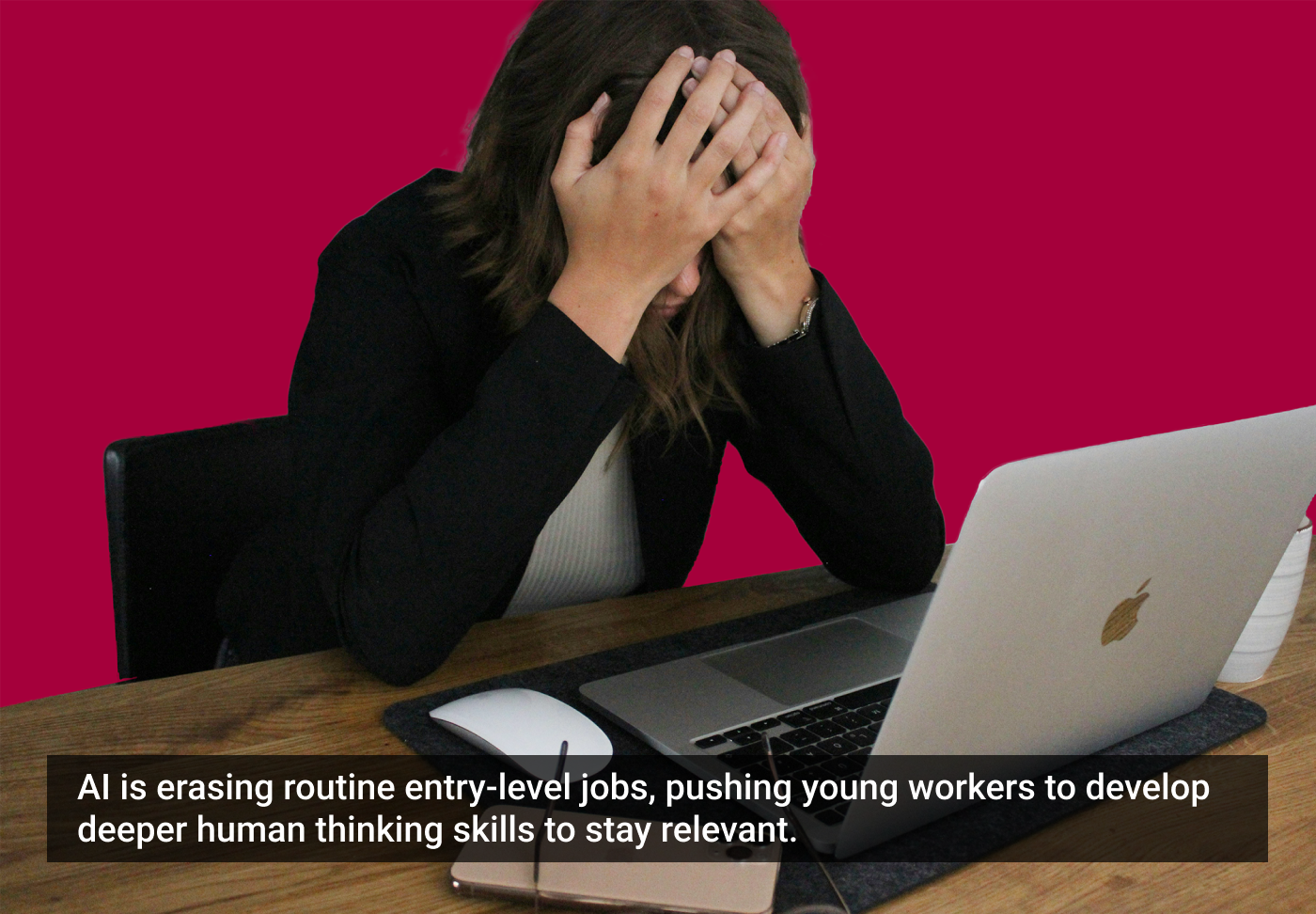
A generation ago, the first job was almost guaranteed. Companies hired junior staff to learn the ropes, make mistakes, and grow. Today, those roles: the junior copywriter, the entry-level coder, the support analyst, are quietly disappearing. Since late 2022, employment for early-career workers in AI-exposed fields has dropped by double digits, leaving young professionals staring at a career ladder with no bottom rung.
Artificial intelligence did not arrive as a friendly assistant. It arrived as a replacement. And the people feeling its weight most are the youngest workers.
The numbers behind the shift
Researchers analyzed payroll data from ADP, the largest payroll provider in the United States, covering millions of employees between late 2022 and mid-2025. It is the clearest picture yet of AI’s impact on the labor market.
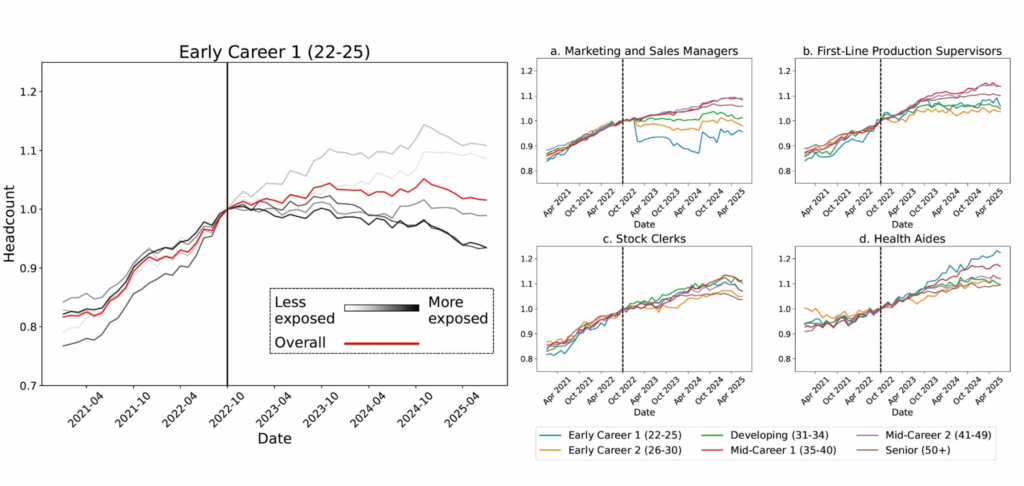
The results are striking. In the professions most exposed to automation: programming, marketing, and customer support, employment for 22 to 25-year-olds fell by 13 to 16 percent. One chart tracking marketing and sales managers shows the youngest cohort in steep decline from late 2022 onward.
By contrast, employment for workers over 30 in these same roles grew by 6 to 12 percent. Researchers credit their resilience to two things: nuanced knowledge that is harder to automate, and the stability that comes with institutional experience.
Economist Erik Brynjolfsson, co-author of the study, called it “the largest and fastest effect on the labor market since the shift to remote work during the pandemic.”
Why young workers are hit hardest
The imbalance is not about intelligence but about structure. Early-career roles are built around routine, repetitive tasks: bug fixes, customer responses, ad copy, which are the easiest to hand over to algorithms.
Unstructured problems, ambiguity, and exceptions require judgment. Judgment is not taught in a classroom; it is earned through experience. That makes it a natural strength of older workers and a gap for younger ones.
Company mindset also plays a role. Businesses treating AI as a replacement cut junior staff quickly. Companies using AI as augmentation, supporting rather than substituting for human work, tend to preserve or even grow their workforce.
The outcome is a broken pipeline. If graduates cannot land their first jobs, they cannot build the experience needed for the next stage. A decade from now, organizations may face not just a shortage of junior workers, but a shortage of mid-level professionals who never had a chance to develop.
The long-term consequences
If left unchecked, this hollowing out of entry-level roles creates systemic risks:
- A broken talent pipeline, with too few trained professionals to replace today’s mid-career workforce.
- A generational imbalance, where older professionals hold ground while younger ones are locked out.
- Policy frameworks that unintentionally reward companies for automating instead of augmenting accelerate the trend.
Researchers caution that AI may not be the only factor. Remote work, the pandemic, and education shifts also play a part. Still, the evidence points clearly to AI adoption as a major driver of early-career decline.
What skills still matter?
The loss of routine jobs does not mean humans are obsolete. It means the definition of valuable work is changing.
Centuries ago, in Athens, Alexandria, or Oxford, education focused on rhetoric, logic, and philosophy. These were not academic luxuries but survival skills for navigating complexity and persuasion. Ironically, they are once again becoming the most durable protection in an age of automation.
Some of these timeless skills include:
- Logic: testing arguments and spotting weak reasoning, especially when AI produces confident but flawed answers.
- Rhetoric: persuading and storytelling, making ideas resonate in ways machines cannot.
- Philosophy and Ethics: asking not only what can be done but what should be done, crucial in decisions about automation and responsibility.
- Systems Thinking: seeing loops, dependencies, and consequences. AI offers fragments; humans connect the whole.
- Writing: expressing ideas with clarity, which aligns teams and improves decision-making.
- Observation: noticing nuance and patterns outside the dataset.
- Debate: sharpening ideas by testing them against challenge, a tradition as old as Socrates.
- History: recognizing cycles and avoiding repeated mistakes. Today’s AI hype is new in form but familiar in pattern.
These are not soft skills. They are hard skills, hard to master, hard to measure, and hardest of all to replace.
What employers are saying
Employers themselves are beginning to signal the same shift. The World Economic Forum’s Future of Jobs Survey (2024) asked companies what skills they expect to be most essential by 2030.

The top answers were analytical thinking, systems thinking, leadership, empathy, and resilience. Technical skills such as programming and marketing, once the bedrock of entry-level jobs, are sliding down the list as automation expands.
In other words, employers are confirming what history already showed: the skills that last are the ones that keep us human.
A choice ahead
The ADP data makes one thing clear: how companies use AI matters. Adopt it as a replacement, and junior roles collapse. Use it as an augmentation, and productivity rises without erasing opportunity.
One path leads to a hollow workforce and a shortage of experienced talent. The other leads to resilient organizations that combine machine efficiency with human judgment.
The return to thinking
AI is not the end of work. It is the end of easy work. And perhaps that is not a threat but an invitation. An invitation to stop chasing every new tool, to stop outsourcing our thinking, and to return to the skills that made us human in the first place.
The philosopher Hannah Arendt once wrote, “Education is the point at which we decide whether we love the world enough to assume responsibility for it.”
If AI is taking away our first jobs, our answer should not be despair. It should be to relearn how to think.
Key takeaways
- Since 2022, employment for young workers in AI-exposed jobs has fallen by 13 to 16 percent, while employment for older workers has grown by 6 to 12 percent.
- Entry-level roles are vanishing because they are built on routine tasks that AI can easily automate.
- The most future-proof skills are human ones: logic, rhetoric, systems thinking, debate, writing, and ethics.
- Employers confirm this trend, with surveys naming analytical thinking, empathy, and creativity as the top skills for 2030.
- Companies face a choice: replacement, which erodes the workforce, or augmentation, which strengthens it.
References
- ADP Research Institute (2025). Analysis of AI’s impact on U.S. payroll data, 2022–2025.
- World Economic Forum, Future of Jobs Survey (2024).
- Belinda Luscombe, “AI Is Already Changing Jobs, According to Stanford and MIT Researchers,” TIME (2025). Available at: https://time.com/7312205/ai-jobs-stanford/
The article originally appeared on UX Design Lab.
Featured image courtesy: SEO Galaxy.