
Flag

We stand with Ukraine and our team members from Ukraine. Here are ways you can help

Get exclusive access to thought-provoking articles, bonus podcast content, and cutting-edge whitepapers. Become a member of the UX Magazine community today!

Home ›› Content and Copy ›› I Want Better Font Size Choices, Google #wtfUX

I Want Better Font Size Choices, Google #wtfUX

by Indrani Stangl
1 min read
Share this post on
Tweet
Share
Post
Share
Email
Print

Save

Google should reconsider its Starbucks-esque approach to font size choices.

When I compose a document—any document, in almost any application—I can choose a font size in increments. But Google has decided what sizes are appropriate for me. It’s like the Starbuck’s approach to fonts: Short, Tall, Grande, Venti.
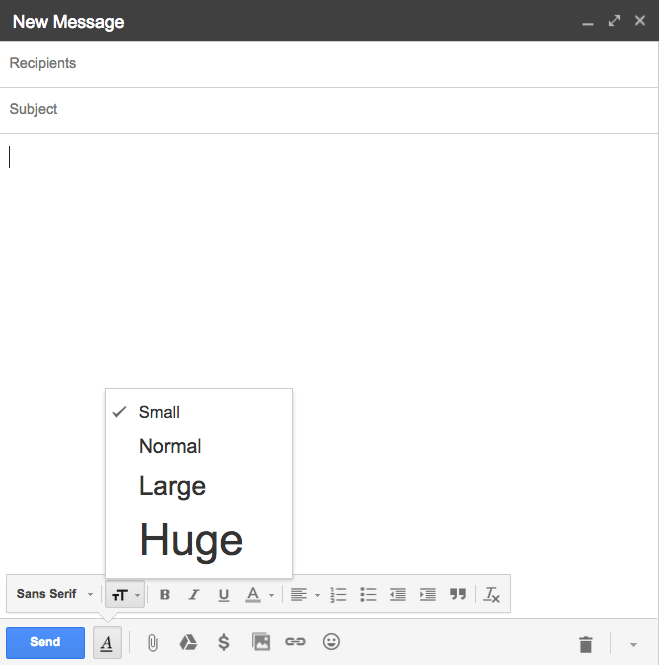
In my opinion, “small” is too small, and so is “normal.” Plus the term “normal” makes me feel shame for my old eyeballs. “Large” is too big, and “Huge” is just completely ridiculous.

Why can’t Google be “normal” and give us more choices?

​wtfUX ​Google!?

Keep these coming. Send them to us via Twitter or Facebook using the hastag #wtfUX or email them to: [email protected] with “#wtfUX” in the subject line. Include as much context as you can, so we get a full understanding of what the f%*k went wrong. Image of pygmy mouse courtesy Shutterstock.

post authorIndrani Stangl

Indrani Stangl
Indrani Stangl is one of the rare Silicon Valley natives who has not flown the coop (yet). She was embedded in the dot.com boom and bomb, and is watching the technological revolution from a front row seat. She works as an administrator at a famous higher education institution, has a private practice as a career coach, and runs a puppy rescue that saves 500 dogs a year from euthanasia. She is otherwise known as the Girl with DesignRage.

Tweet
Share
Post
Share
Email
Print

Related Articles

AI can create wireframes, synthesize research, and draft copy fast. What it can’t do: understand your users, carry context, or be accountable when something goes wrong. That’s still you.

Article by Tushar Deshmukh
AI Is Your New Intern, Not Your Replacement
  • AI is not replacing UX pros; it’s automating repetitive tasks and augmenting human capabilities.
  • Think of AI as an intern: quick, smart, but dependent on human direction, context, and judgment.
  • Human skills like empathy, research, systems thinking, and ethical decision-making are more important than ever.
  • The future belongs to designers who incorporate AI to accelerate execution and devote more time to strategic, human-centered work.
Share:AI Is Your New Intern, Not Your Replacement
20 min read

Another lesson from studying UX with Laura Klein.

Article by Paivi Salminen
The Agile Trap Designers Fall into: Feeding the Beast
  • Agile teams are fast, but designers get stuck in an infinite loop of visual work: redesigning the same components over and over instead of solving real UX problems.
  • Design systems break that cycle, defining the building blocks once, freeing designers to focus on how the product works, not how it looks.
  • When the basics are in place, teams can start working together sooner, prototype faster, and release incremental features without the interface falling apart.
Share:The Agile Trap Designers Fall into: Feeding the Beast
4 min read

Real engagement is about designing experiences that people want to have. Here are some things that games do well that most apps don’t.

Article by Montgomery Singman
Gamification 2.0. Beyond Points and Badges: Designing for Players, Not Metrics. Conclusion
  • Most apps use gamification as a manipulation layer to drive metrics, but people engage with things that are truly worthy of their time, not points or streak guilt.
  • Apps that people stick with do this by designing for intrinsic motivation, making the experience itself rewarding.
  • The true measure of success is whether users feel more capable, accomplished, and enriched for having used your app.
Share:Gamification 2.0. Beyond Points and Badges: Designing for Players, Not Metrics. Conclusion
8 min read

Join the UX Magazine community!

Stay informed with exclusive content on the intersection of UX, AI agents, and agentic automation—essential reading for future-focused professionals.

Hello!

You're officially a member of the UX Magazine Community.
We're excited to have you with us!

Thank you!

To begin viewing member content, please verify your email.

Get Paid to Test AI Products

Earn an average of $100 per test by reviewing AI-first product experiences and sharing your feedback.

    Tell us about you. Enroll in the course.

      This website uses cookies to ensure you get the best experience on our website. Check our privacy policy and