
Save
“Good design isn’t just beautiful — it’s usable, accessible, and inclusive. It respects the diversity of human experience and adapts to meet real people’s needs.” — Dieter Rams
We often hear terms like “usability,” “accessibility,” and “inclusivity” tossed around in design discussions. They sound similar, but each plays a distinct role in shaping how people experience products, services, and systems, among others.
Together, they form the backbone of human-centered design (HCD), an approach that puts people first, always.
Human-centered design: the foundation
Let’s start here: HCD is a creative approach to problem-solving that begins with understanding the people you’re designing for and ends with solutions that truly fit their needs.
It’s guided by empathy, collaboration, and iteration. Designers observe, listen, and test with real users to make sure the end result feels intuitive, effective, and meaningful.
In short: HCD is about designing with people, not just for them.
Now, how do usability, accessibility, and inclusivity each fit into that process?
Usability: making things easy to use
Usability focuses on how effectively, efficiently, and pleasantly people can use a product to achieve their goals. It’s about the experience of interaction: Is it intuitive? Does it make sense? Can people complete tasks without frustration?
Key aspects:
- Effectiveness: Can users do what they came to do?
- Efficiency: How quickly and smoothly can they do it?
- Satisfaction: Does it feel good to use?
Example:
A mobile app with clear navigation, helpful feedback, and a short learning curve has high usability.
If people get lost, confused, or make frequent mistakes, the usability is low.
In short: Usability is about how well a product works for its intended users.
Accessibility: ensuring everyone can participate
Accessibility ensures that people with disabilities can perceive, understand, navigate, and interact with a product, whether they’re blind, deaf, neurodivergent, “old,” or have mobility or cognitive differences.
It’s both a moral imperative and often a legal requirement. Accessibility removes barriers that prevent people from using technology and participating fully in society.
Common accessibility features:
- Alt text for images.
- Keyboard-only navigation.
- Closed captions and transcripts.
- High-contrast color options.
- Screen reader compatibility.
Accessibility is non-negotiable. It’s the foundation of equitable design.
In short: Accessibility is about removing barriers so that everyone, regardless of ability, can use a product.
Inclusivity: designing with diversity in mind
Inclusivity goes beyond accessibility. It’s not just about meeting standards or accommodating disabilities. It’s about recognizing the full spectrum of human diversity.
Inclusive design involves bringing different voices into the design process: people of different abilities, cultures, ages, genders, languages, and experiences. By co-designing with diverse users, we uncover insights that lead to richer, more flexible, and more equitable solutions.
Examples:
- A voice assistant that understands different accents and speech patterns.
- A form that doesn’t force people into binary gender options.
- An app tested with users across various literacy levels and cultures.
Inclusivity is about representation, empathy, and belonging. When we include diverse perspectives, we design better for everyone.
In short: Inclusivity is about designing for diversity and equity from the start.
How they connect
These three concepts work together like layers of a strong foundation:
- Usability: Ease of use.
- Accessibility: Removal of barriers.
- Inclusivity: Representation and participation.
Together, they embody HCD, where every decision starts and ends with people, their needs, contexts, and lived experiences.
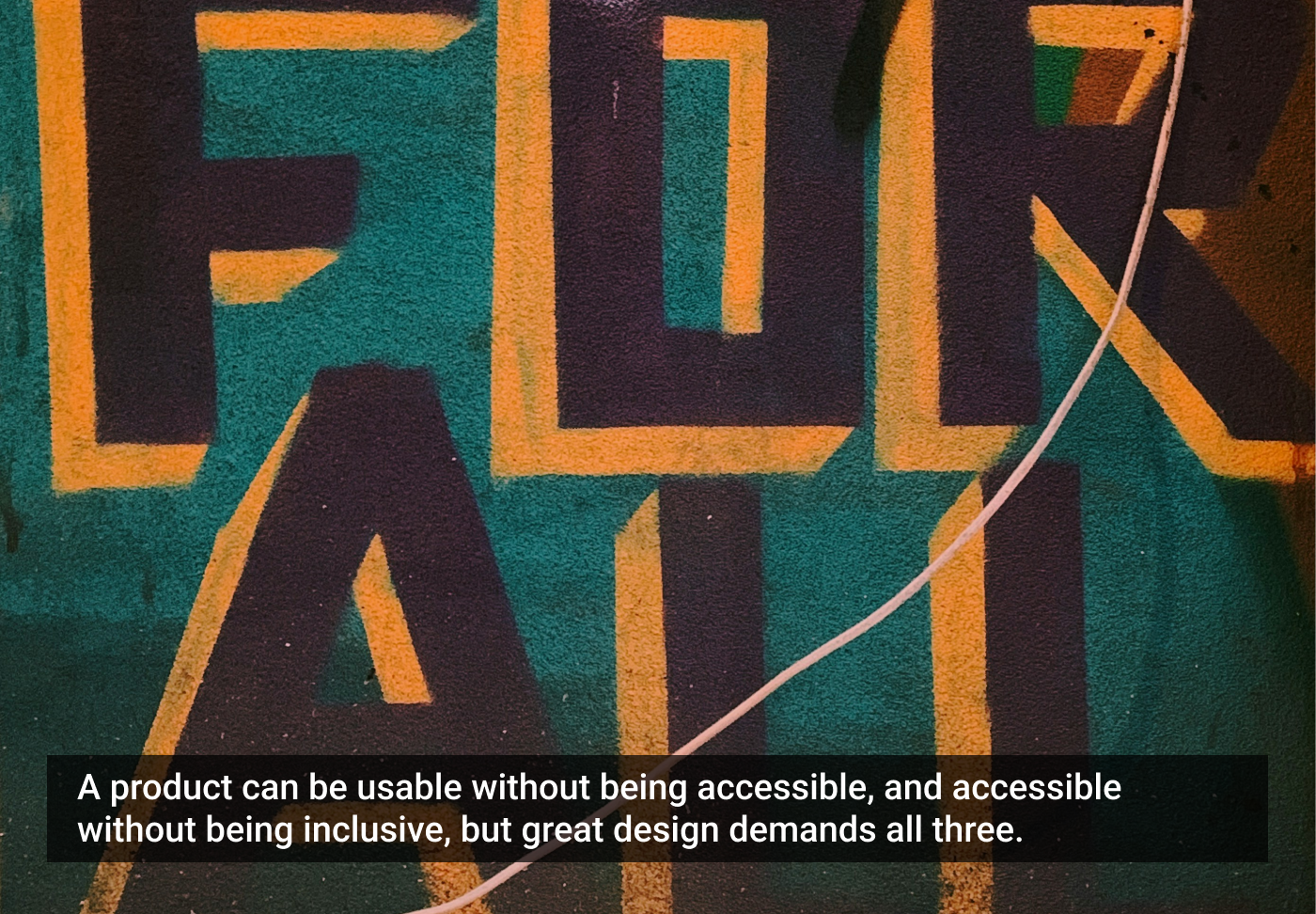
When you combine usability (making it easy), accessibility (making it possible), and inclusivity (making it equitable), you create designs that function and connect.
The article originally appeared on Substack.
Featured image courtesy: Jon Tyson.

Paivi Salminen
Päivi Salminen, MSc, is a digital health innovator turned researcher with over a decade of experience driving growth and innovation across start-ups and international R&D projects. After years in the industry, she has recently transitioned into academia to explore how user experience and design thinking can create more equitable and impactful healthcare solutions. Her work bridges business strategy, technology, and empathy, aiming to turn patient and clinician insights into sustainable innovations that truly make a difference.
- The article shows that usability, accessibility, and inclusivity are different concepts that work together to create good design.
- It explains that accessibility removes barriers for disabled users, while inclusivity designs for all types of human diversity.
- The piece emphasizes that great design needs all three: usability makes things easy, accessibility makes them possible, and inclusivity makes them fair.