
Flag

We stand with Ukraine and our team members from Ukraine. Here are ways you can help

Get exclusive access to thought-provoking articles, bonus podcast content, and cutting-edge whitepapers. Become a member of the UX Magazine community today!

Home ›› Artificial Intelligence ›› The AI Mirror: How We Become the Systems We Use

The AI Mirror: How We Become the Systems We Use

by Pavel Bukengolts
4 min read
Share this post on
Tweet
Share
Post
Share
Email
Print

Save

AI is reshaping our perceptions in ways we often don’t realize, subtly amplifying our biases through repeated interactions. Recent research reveals that even slight biases in AI can lead us to adopt distorted views, as we unknowingly mirror the AI’s outputs. This feedback loop not only alters our judgments but also makes us more confident in those skewed beliefs, all while we remain unaware of the influence. The study highlights how even passive exposure to AI-generated content can shift our perceptions, reinforcing stereotypes and shaping our understanding of the world. As we engage with these systems, we must be mindful of what they reflect back to us, because if we don’t choose what we see, we risk becoming something we never intended.


AI reshapes our judgments, creating feedback loops that subtly train us over time.

  • Recent research shows that biased AI systems amplify human bias through repeated interaction.
  • People unknowingly adopt AI biases, even when outputs are labeled as human.
  • The loop strengthens with time; small distortions grow into systemic shifts.
  • Even passive exposure to AI-generated content (e.g., images) can change perception.
  • Accurate AI, by contrast, can improve human judgment if designed with intention.

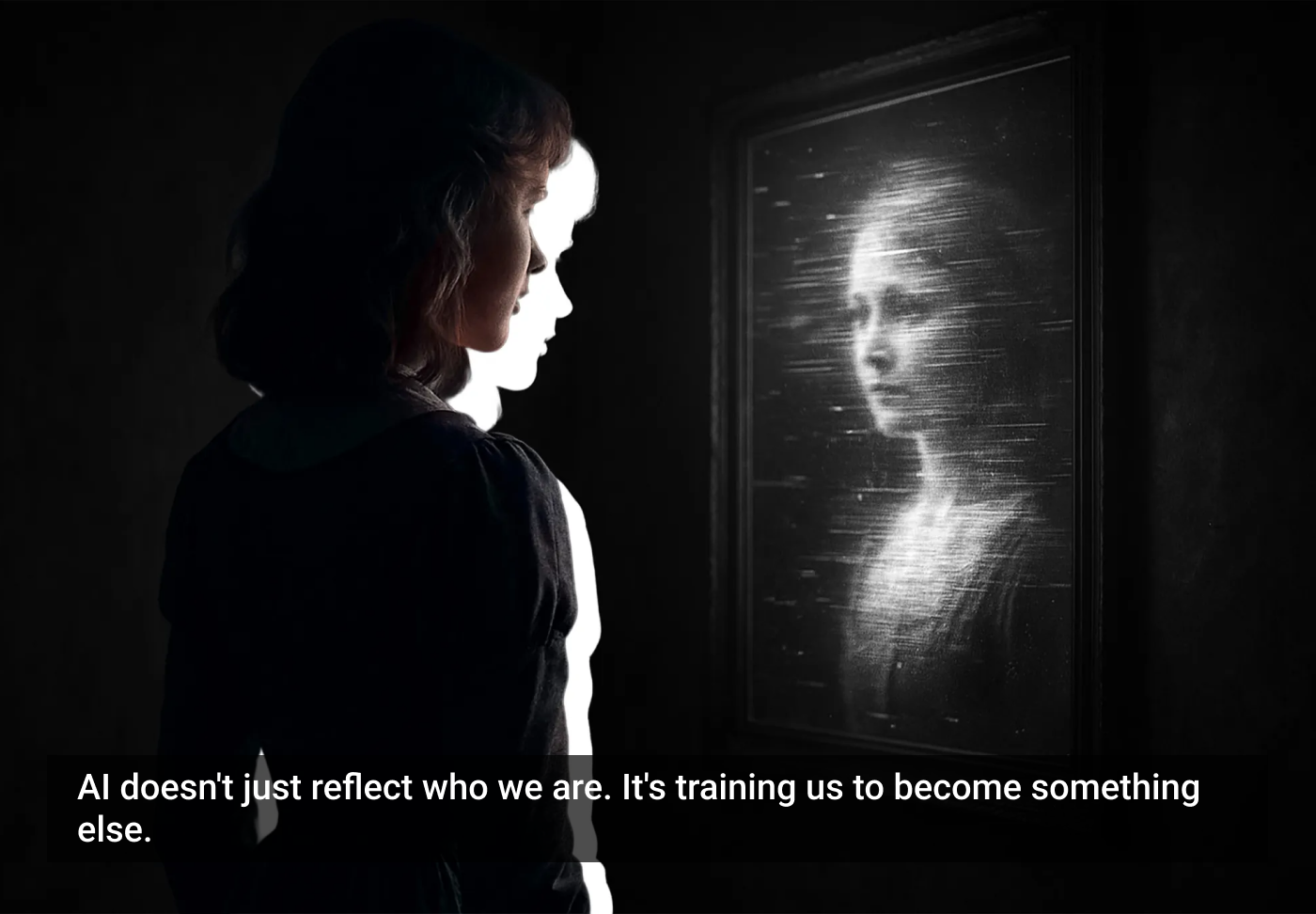
Alice steps through the mirror, and everything’s familiar but wrong. Left is right. Up is doubt. She stares into a world shaped like hers, but colder. Off. And once she’s inside, the rules stop caring about what she remembers.

That’s AI now.

The tools don’t just echo us. They train us. We build them. Feed them our words, our clicks, and our instincts. Then they feed it all back. Sharpened. Shifted. Smoothed. And if we’re not paying attention, we swallow it as truth.

A study from Nature Human Behaviour cracked this open. Researchers ran a series of tests, putting people in front of an AI poisoned with slightly biased human data. Over time, those people weren’t just nudged; they were broken in. Their own judgments drifted deeper into the same bias. And the more they used the system, the more certain they felt.

Worse, they never knew it was happening.

It’s not bias. It’s a loop

This isn’t about one bad model. This is about the system.

The study showed the feedback loop across tasks. In one, people judged faces as happy or sad. On its own, the AI was clean. But once it digested human responses, even faintly skewed ones, it began to exaggerate the bias.

New users saw the AI’s answers and started to tilt in the same direction. Didn’t matter if the face was a coin toss. The pattern repeated. The bias grew.

Here’s the part that should rattle you: the effect held even when people didn’t know it was an AI. Just seeing the output was enough. Just scrolling. That means the images, the recommendations, the summaries, everything floating through your feed.

You don’t need to be a developer to get caught in the loop. You just have to look.

The mirror isn’t neutral

You might think:

I know AI is flawed. I take it with a grain of salt.

Maybe.

But the mirror doesn’t ask your permission. It doesn’t need to convince you. It just needs repetition.

It helps that the AI looks so damn confident. Clean UI. Fast answers. No stutter. It doesn’t hesitate the way people do. It doesn’t show you doubt, only the verdict. And that’s enough.

The study showed people trusted the AI more than other humans. Even when it was wrong. Especially when it was wrong. They flipped their own answers just because the system disagreed.

Over time, they stopped asking why.

We make the mirror. Then we look in

AI doesn’t invent bias. We hand it the ammunition. In data. In prompts. In our silence.

Then it fires it back at us, stretched, looped, and stylized. The reflection doesn’t just show us who we are. It teaches us who to be. And when we treat that reflection as neutral, we become something else. Not who we were. Not who we meant to be.

That’s how social patterns harden into fact. That’s how stereotypes loop into code. Not through malice. Through repetition.

You ask a text-to-image system for a “financial manager.” It spits back a wall of white men. See it enough, and it stops being data and starts being normal. Then you’re asked to pick a face from a lineup, and your brain just serves up the image it’s been fed the most.

That’s not data. That’s culture on a loop.

Illustration by Pavel Bukengolts

What now?

This isn’t a call to throw your phone in the river. We’re not going back. AI isn’t leaving.

The study also showed something else: when people worked with an AI built with care, an honest, transparent system, they got better. Sharper. Their own judgment improved.

So no, the machine isn’t born corrupt. But it is born to reflect.

And if we don’t choose what it sees, it will choose what we become.

“I can’t go back to yesterday, because I was a different person then.”Lewis CarrollThrough the Looking-Glass

Neither can we. We’ve stepped through the mirror. Now, the only way forward is to notice what’s staring back and decide what the hell we want to see.

Recap:

  • Bias doesn’t just live in data — it loops through people.
  • AI reflects, magnifies, and trains us in return.
  • The more you use it, the more it shapes how you see the world — and yourself.
  • Use it wisely. Or it will use you.

The article originally appeared on UX Design Lab.

Featured image courtesy: Pavel Bukengolts.

post authorPavel Bukengolts

Pavel Bukengolts
Pavel Bukengolts is a design leader, educator, and founder of UX Design Lab. With over 25 years of experience, he focuses on building better products and stronger teams. He helps organizations create human-centered, accessible digital experiences by maturing their design operations (DesignOps), making teams more efficient and fulfilled. As an educator and mentor, he’s dedicated to developing future leaders and empowering designers to grow their skills, confidence, and impact.

Tweet
Share
Post
Share
Email
Print
Ideas In Brief
  • The article illustrates how using biased AI can gradually alter your own thinking without you noticing: the more you interact with it, the more you adopt its biases as your own.
  • It reveals that simply seeing AI-generated outputs is enough to influence you; you don’t need to trust it or even know it’s AI for it to alter what you consider normal.
  • The piece argues AI mirrors and amplifies whatever we give it, so if we’re not careful about what we feed these systems, they’ll reshape how we see the world and ourselves.

Related Articles

Discover how the future of AI runs on purpose-built infrastructure.

Article by UX Magazine Staff
AI Agent Runtimes in Dedicated Lanes: Lessons from China’s EV Roads
  • The article states that AI’s progress depends less on creating larger models and more on developing specialized “lanes” (agent runtimes) where AI can run safely and efficiently.
  • It argues that, like China’s EV-only highways, these runtimes are designed for smooth flow, constant energy (through memory and context), and safe, reliable operation, much like EV-only highways in China.
  • The piece concludes that building this kind of infrastructure takes effort and oversight, but it enables AI systems to work together, grow, and improve sustainably.
Share:AI Agent Runtimes in Dedicated Lanes: Lessons from China’s EV Roads
4 min read

Explore how design researchers can earn the trust and buy-in that give studies impact, even as AI shifts how teams work.

Article by Sara Fortier
Earning the Right to Research: Stakeholder Buy-In and Influence in the AI x UX Era
  • The article emphasizes that synthetic data and AI tools promise speed, but not the alignment or shared purpose that makes design research effective in solving design problems.
  • It asserts that meaningful human-centred design begins with trust and the permission to conduct research properly (i.e., strategically).
  • The piece outlines how to build stakeholder buy-in for design research through practical strategies that build influence piece by piece within an organization.
  • Adapted from the book Design Research Mastery, it offers grounded ways to enable impactful user studies in today’s AI-driven landscape.
Share:Earning the Right to Research: Stakeholder Buy-In and Influence in the AI x UX Era
12 min read

Explore the future of design: AI-powered interfaces that adapt, stay human-focused, and build trust.

Article by Aroon Kumar
Beyond UI/UX: Designing Adaptive Experiences in the Age of AI
  • The article discusses the shift from fixed interfaces to real-time experiences, switching the role of designers from creating screens to guiding how systems operate.
  • The piece also stresses that, as experiences become personalized, they must maintain user trust, privacy, and authentic human connection.
Share:Beyond UI/UX: Designing Adaptive Experiences in the Age of AI
5 min read

Join the UX Magazine community!

Stay informed with exclusive content on the intersection of UX, AI agents, and agentic automation—essential reading for future-focused professionals.

Hello!

You're officially a member of the UX Magazine Community.
We're excited to have you with us!

Thank you!

To begin viewing member content, please verify your email.

Get Paid to Test AI Products

Earn an average of $100 per test by reviewing AI-first product experiences and sharing your feedback.

    Tell us about you. Enroll in the course.

      This website uses cookies to ensure you get the best experience on our website. Check our privacy policy and