

Flag

We stand with Ukraine and our team members from Ukraine. Here are ways you can help

Get exclusive access to thought-provoking articles, bonus podcast content, and cutting-edge whitepapers. Become a member of the UX Magazine community today!

Home ›› Content and Copy ›› UX Design Begins With Content. Don’t Outsource It to AI

UX Design Begins With Content. Don’t Outsource It to AI

by Pavel Samsonov
2 min read
Share this post on
Tweet
Share
Post
Share
Email
Print

Save

As if AI-generated “user research” wasn’t bad enough, now I am seeing designers advance LLMs for generating UI content – forgetting the most important design adage, “form follows function.” The digital equivalent is not the function of clicking the button but the function of *accessing the content.*

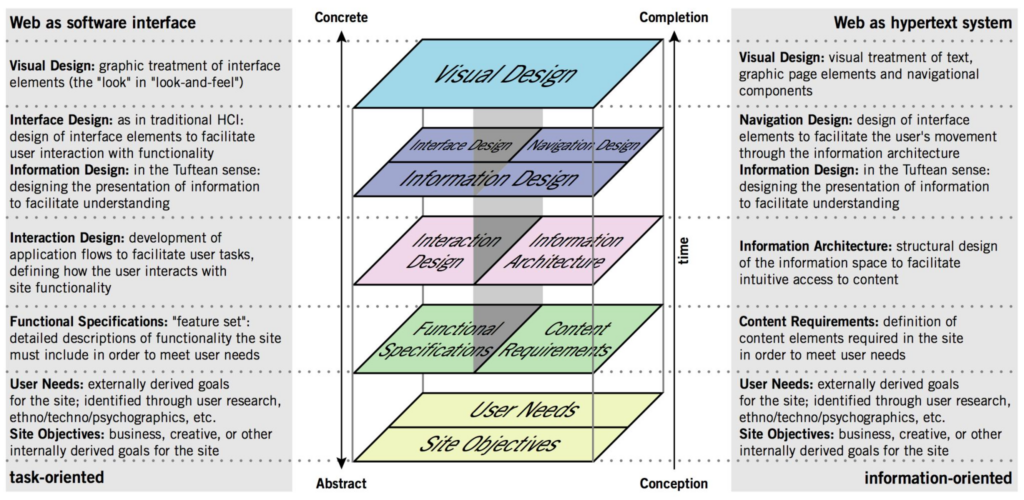
All the way back in 2002, Jesse James Garrett created this incredible model, which I use frequently to structure my work. And to explain to junior designers the extent of the depth they need to consider, because 22 years after this was published few of them even know what a “hypertext system” even is, and envision their work exclusively as a software interface.

Without both of these pillars, your UX design will fall over.

Some UXers understand this partially – but think that the interface is “more important” and the content can come afterward. These are the people who champion ChatGPT as a great alternative to Lorem Ipsum. And they repeat the same mantra as every designer who invites AI into their workflow: “It’s just for now, we will fix it later.”

You will *not* be able to fix it later.

The elements you are generating are *foundational* to the way the product is used. They are not stacked on top. If you decide to outsource your thinking about the hypertext system, redoing it will require ripping out the guts of the software interface layers you have built in parallel.

The content – not the beautiful scroll animations – is the thing people use your product for. It is not lesser than. It is not an afterthought. It even has its own set of roles (content design, UX writing, information architecture, etc).

The content is the scaffolding of the experience. When you minimize it, it is only to your own detriment.

post authorPavel Samsonov

Pavel Samsonov
Pavel Samsonov is a New York-based UX leader exploring the applications of design as a decision-making framework for all areas of product development. He currently builds design practice and leads innovation engagements at AWS. His approach to product & design draws on his experience managing enterprise product teams at Bloomberg, design-driven rapid prototyping in the start-up world, traditional graphic design education, and an academic background in human-computer interaction.

Tweet
Share
Post
Share
Email
Print
Ideas In Brief
  • The article emphasizes the critical importance of content in UX design, warning against the reliance on AI-generated content and underscoring the foundational role content plays in the user experience.

Related Articles

AI can create wireframes, synthesize research, and draft copy fast. What it can’t do: understand your users, carry context, or be accountable when something goes wrong. That’s still you.

Article by Tushar Deshmukh
AI Is Your New Intern, Not Your Replacement
  • AI is not replacing UX pros; it’s automating repetitive tasks and augmenting human capabilities.
  • Think of AI as an intern: quick, smart, but dependent on human direction, context, and judgment.
  • Human skills like empathy, research, systems thinking, and ethical decision-making are more important than ever.
  • The future belongs to designers who incorporate AI to accelerate execution and devote more time to strategic, human-centered work.
Share:AI Is Your New Intern, Not Your Replacement
20 min read

Hiring is automated. The tools built to help you keep up are making it worse. There’s another way — one that puts your data, your drafts, and your decisions back in your hands.

Article by Pavel Bukengolts
Job Search Terminal: A Local-First Tool for an AI-Shaped Job Market
  • The piece argues that most AI job search utilities deal with the wrong problem: they only lower barriers for candidates and perpetuate existing power imbalances.
  • It contends that the choice of local-first, people-centered tools is a political position on professional data ownership, not simply a technical decision.
Share:Job Search Terminal: A Local-First Tool for an AI-Shaped Job Market
5 min read

For researchers, AI tools are making the move from advising to building easier than ever. But the real obstacle was never technical. Meet the researchers who allowed themselves to create — and what the cost was.

Article by James Lang
The New Makers
  • The article says that becoming a maker as a researcher is less about learning new tools or skills and more about giving yourself a new identity, and that without fixing the internal permission structures that define your swim lane, even the most democratized AI tools won’t turn a researcher into a maker — you don’t have a founder; you have a frustrated advisor with a prototype.
Share:The New Makers
20 min read

Join the UX Magazine community!

Stay informed with exclusive content on the intersection of UX, AI agents, and agentic automation—essential reading for future-focused professionals.

Hello!

You're officially a member of the UX Magazine Community.
We're excited to have you with us!

Thank you!

To begin viewing member content, please verify your email.

Get Paid to Test AI Products

Earn an average of $100 per test by reviewing AI-first product experiences and sharing your feedback.

    Tell us about you. Enroll in the course.

      This website uses cookies to ensure you get the best experience on our website. Check our privacy policy and