What if the fact that your design team is burned out has nothing to do with how hard they work? The system is to blame. Broken design systems, missing sources of truth, and changing goals all quietly steal time and trust. It's not a people problem when "I'll just build it myself" becomes a daily saying. The problem is with the setup. You might not think the answer is close, but it is. It starts with a week of honest observations.
Your design team isn't burning out from work. It's burning out from friction. The fix isn't more effort; it's better DesignOps: clarity, mentorship, and flow.
Everything sounds like work… until you listen closer.
It's 9 AM. The coffee's on. Some of us are at the kitchen table. Others are in a shared space. Hybrid is still a moving target. The chatter starts:
"Did you see marketing's feedback?" "Who's handling the accessibility pass?"
Normal stuff. Work talk. Listen closer, and another track fades in:
"I spent an hour looking for the right file." "We're redoing that flow because the brief changed." "I'll just build it myself—it's faster." "Leadership said one thing, but the product shifted direction."
That second conversation is the one that matters. It's the sound of operations failing. We call it "the grind." Teams don't blow up. They bleed out, one papercut at a time. People adapt. Chaos becomes normal. But it's not normal. It's friction. And friction burns time, trust, and your best people. Design operations aren't bureaucracy. It's awareness. I hear it all the time:
"We don't have time/money/resources for the process."
That's the trap. You're already spending the time on rework, confusion, and burnout. Good ops doesn't add time; it reclaims it.
What leaders can do:
- Run an audit: Where does time really go: design, rework, coordination, waiting for clarity?
- Ask what slows them down: Your team knows. Listen for system problems hiding behind people problems.
- Treat repetition as a signal: If the same snags repeat every sprint, it's not the team. It's the setup.
The hidden ops problem: reading between the lines
That quiet background chatter in Slack, in DMs, and in meetings isn't noise. It's data. Most leaders don't hear it. The board is moving, so things must be fine. But teams feel the cracks long before they show up in reports. Here's the translation guide:
"I'll just build it myself." Your design system isn't working.
It's outdated, clunky, or mistrusted. Reuse feels slower than recreation.
"Is this the latest file?" No single source of truth.
Remote teams play digital hide-and-seek. Outdated versions = rework.
"The goal changed again." Leadership gap.
Direction shifts midstream without context. Work gets redone to match moving targets.
A senior re-explaining the process for the fifth time. Knowledge lives in people, not systems.
Mentorship happens in whispers. It's not sustainable.
"Who's approving this?" Broken feedback loop.
Ambiguity creates delay. People wait rather than risk being wrong.
These aren't complaints. They're distress signals—the hidden tax your team pays to bridge the gap between direction and execution. When success is measured by output, not maturity, speed wins. Until it doesn't. I've seen direction change weekly. Designers weren't resisting. They were exhausted from guessing what "aligned" meant this time. When you listen carefully, patterns emerge. The gap between what people say and what they feel.
Between the lines: what teams say, do, think, and feel:
Arrow buttons or swipe—each slide is full width.
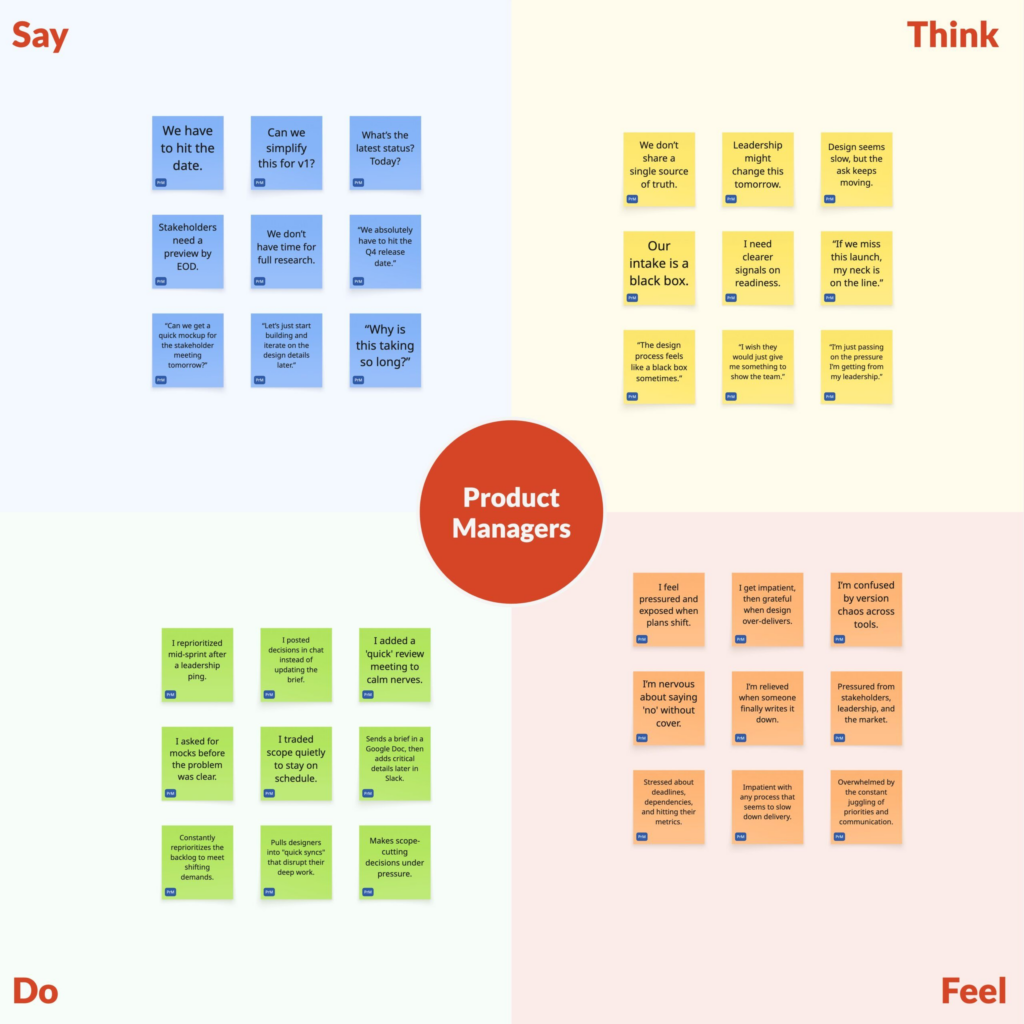
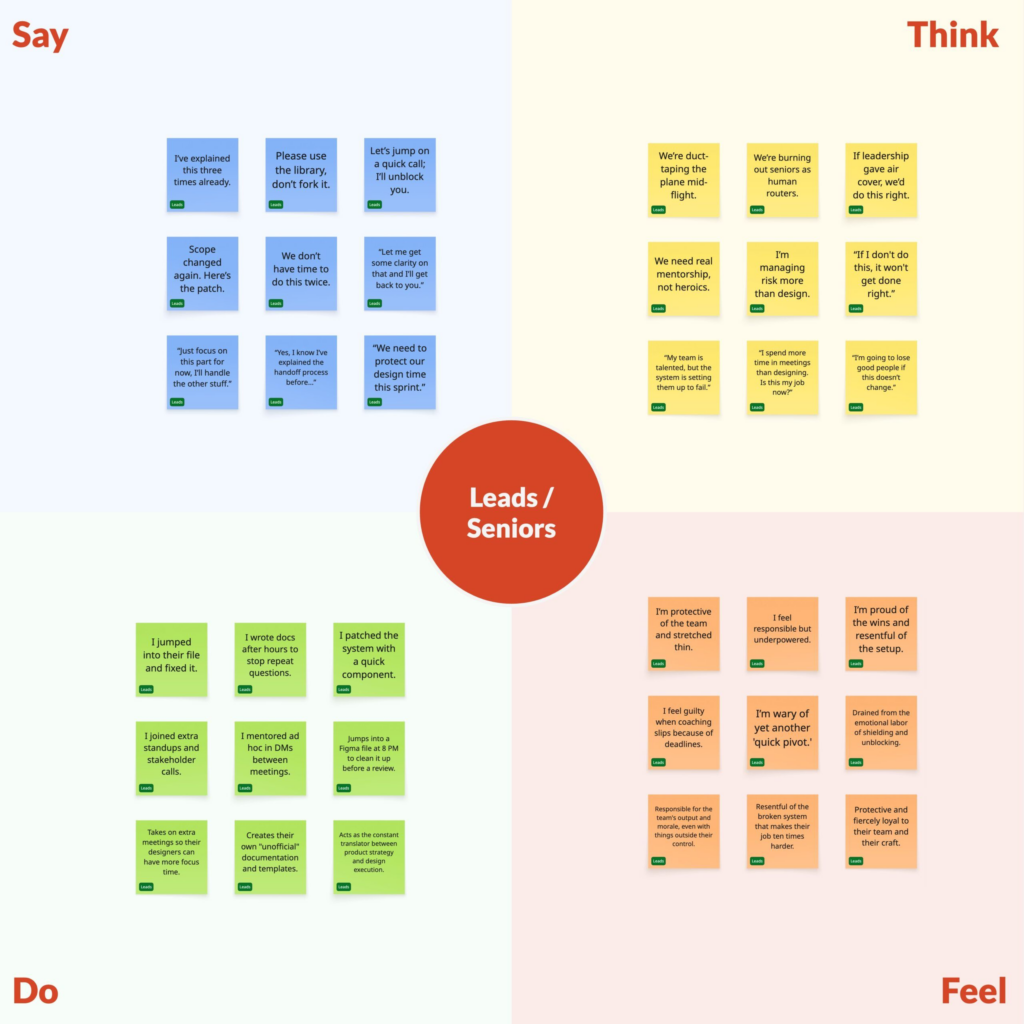
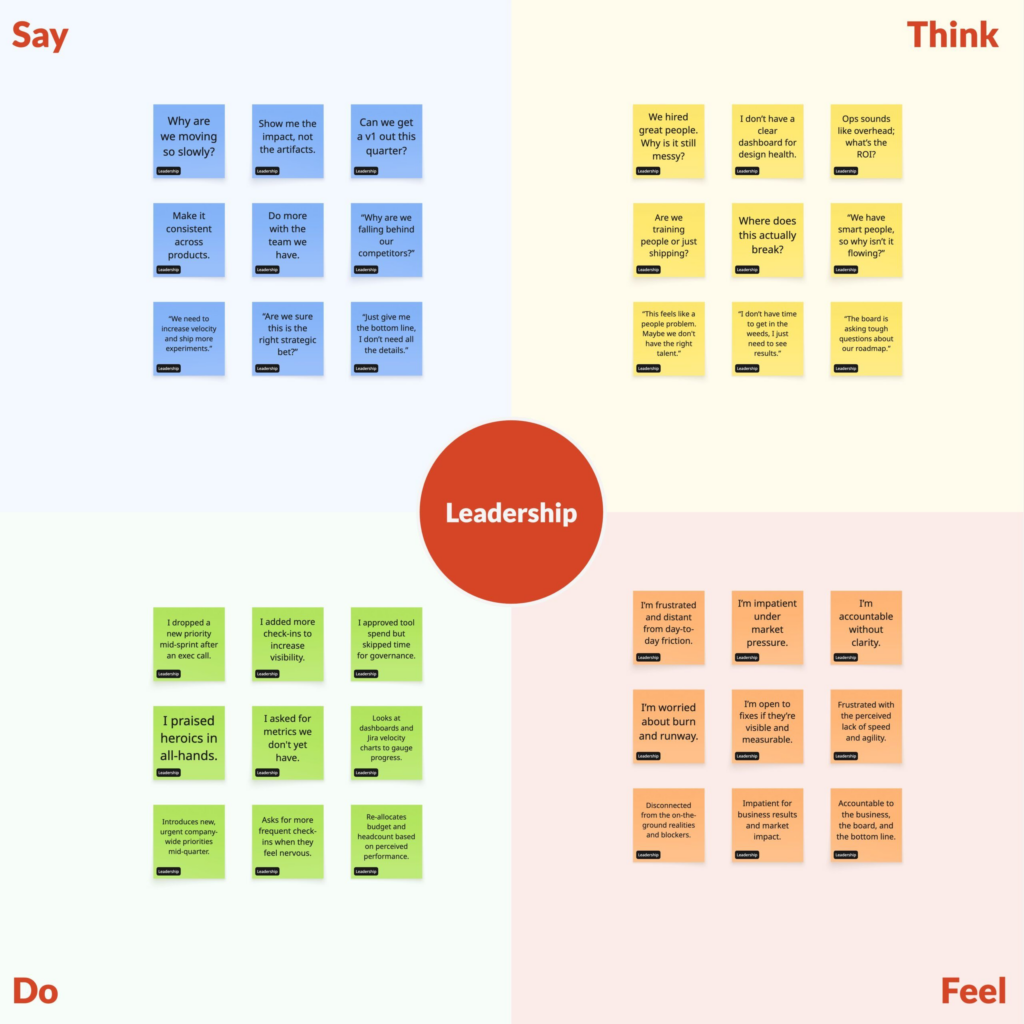
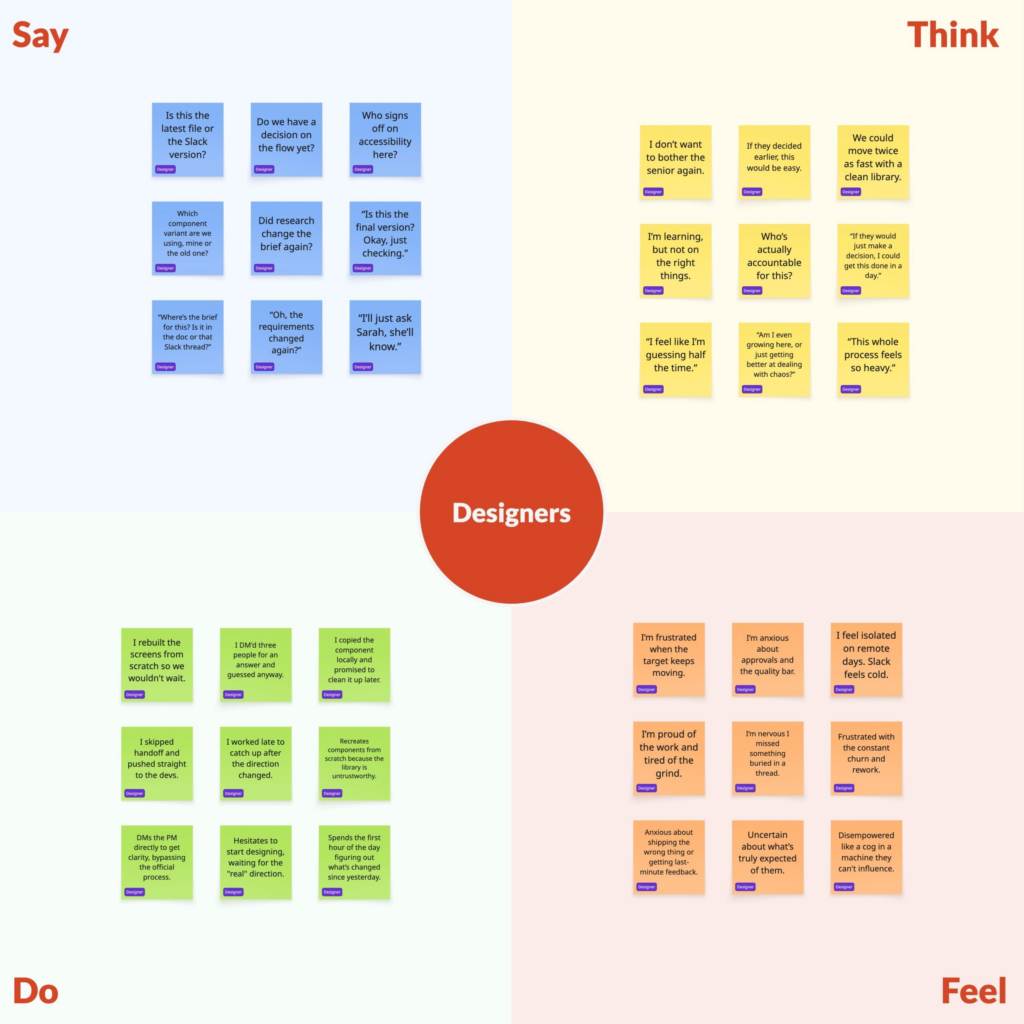
Illustrations by Pavel Bukengolts.
| Persona | Say | Do | Think | Feel |
|---|---|---|---|---|
| Designers | "Oh, the requirements changed again?" | Recreates work and chases down information to navigate ambiguity. | "If they would just make a decision, I could get this done in a day." | Frustrated and disempowered by the constant churn. |
| Leads/Seniors | "Let me get some clarity on that, and I'll get back to you." | Acts as a human shield, absorbing chaos and unblocking their team. | "My team is talented, but the system is setting them up to fail." | Drained and responsible; protective of the team but resentful of the system. |
| Product Managers | "We absolutely have to hit the Q4 release date." | Constantly juggles priorities and pushes for delivery to meet deadlines. | "If we miss this launch, my neck is on the line." | Pressured and stressed by deadlines and stakeholder demands. |
| Leadership | "Why are we moving so slowly?" | Intervenes based on metrics, adding more check-ins and new priorities. | "We have smart people, so why isn't it flowing?" | Impatient and disconnected from the on-the-ground friction. |
Summary of empathy mapping.
You don't need a workshop to see this map. You just need to listen differently. When "say" and "feel" don't match, it's not a talent gap. It's an operational one. Empathy is a diagnostic tool. It shows where the system fails your people.
What leaders can do:
- Clarify direction before velocity: Slow down the first mile. Align on the problem before you sprint.
- Write decisions down: Remote teams live in silence. If it's not documented, it didn't happen.
- Fix visibility first: One place for truth. One rhythm for updates. Everyone knows what's changing and why.
People are the system: aligning what teams say, do, think, and feel
DesignOps isn't about tools. It's about people and the systems that help them thrive. In remote settings, the cracks widen. Hallway fixes are gone. Mentorship won't happen by accident. Leaders think operations equals efficiency. It's really sustainability. A healthy system makes sure:
- Training happens before the crisis.
- Knowledge gaps are surfaced, not hidden.
- Mentorship is built into the work, not squeezed into weekends.
Without it, work piles up unevenly. Seniors route. Juniors guess. Everyone slows down. Treat the process as scaffolding, not red tape, or your team will carry the weight.
What leaders can do:
- Design mentorship: Pair intentionally. Define outcomes. Reward teaching.
- Let work teach: Rotate people through research, systems, and accessibility. Growth in motion.
- Track growth, not just output: Measure new skills alongside velocity.
Measuring what you can't see: from gut feeling to data
For years, team health was judged by vibes. You could sense tension but not pinpoint it. That's why we built the Team Capability Engine, a way to see capability gaps before they become performance gaps. It doesn't replace leadership. It helps leaders see clearly. It shows you:
- Readiness and alignment.
- Skill gaps and role mismatches.
- How capability connects to delivery and morale.
Think of it like an MRI for your org. Not to judge individuals, but to see how the system holds under pressure. This isn't micromanagement. It's clarity.
What leaders can do:
- Trade gut feel for data: Use a lightweight diagnostic to see what's really slowing you down.
- Connect skills to outcomes: Weak research means rework. Thin mentorship signals inconsistency.
- Share the picture: Turn metrics into a conversation, not a scorecard.
The cost of staying blind (and the clarity that follows)
Ignoring ops is never neutral. It's a debt. Every unclear decision adds drag. Every "we'll fix it later" taxes tomorrow's momentum. It's not just culture. It's the balance sheet. Every hour chasing files is like leaking fuel mid-flight. You still move, just slower and more expensively. The results are predictable:
- Burnout dressed up as commitment.
- Innovation stuck behind rework.
- Leadership seen as out of touch.
- Good people leaving because they don't feel seen.
What change looks like:
- Before: Remote team in hero mode. Direction shifts weekly. Seniors babysit broken systems. Juniors are scared to ship.
- After: One shared workflow. Mentorship in the sprint. Weekly leadership syncs for clarity. Confidence replaces chaos.
When you measure capability, train with purpose, and design mentorship into daily work, everything shifts. The team feels lighter. Leaders see farther. Design scales instead of stretches.
What leaders can do:
- Start small: Pick one friction—handoff, feedback, or onboarding—and fix it well.
- Celebrate the fix: Operational wins deserve airtime. Momentum matters.
- Keep checking in: Review capability data quarterly. Maturity evolves.
Call to awareness
If your team is exhausted, it's not because they don't care. It's because the system doesn't. If they're hustling, firefighting, or reinventing the wheel, it's not a talent problem. It's an operational one hiding in plain sight. You don't need to start over. You need to start seeing.
Ask yourself:
- When did you last measure capability, not just speed?
- Where are your mentorship bottlenecks?
- How many hidden frictions sit between direction and execution?
If you do one thing, do this: start a Friction Log. For one week, ask everyone to anonymously note each small slowdown or frustration. No solutions, just observations. Review the patterns. That's your starting map.
"Every system is perfectly designed to get the results it gets."—W. Edwards Deming
DesignOps isn't control. It's clarity. And clarity is what lets good teams do their best work, wherever they log in from.
The article originally appeared on UX Design Lab.