Flag

We stand with Ukraine and our team members from Ukraine. Here are ways you can help

Get exclusive access to thought-provoking articles, bonus podcast content, and cutting-edge whitepapers. Become a member of the UX Magazine community today!

Home ›› The Biggest Company in AI You’ve Never Heard Of

The Biggest Company in AI You’ve Never Heard Of

by Josh Tyson
2 min read
Share this post on
Tweet
Share
Post
Share
Email
Print

Save

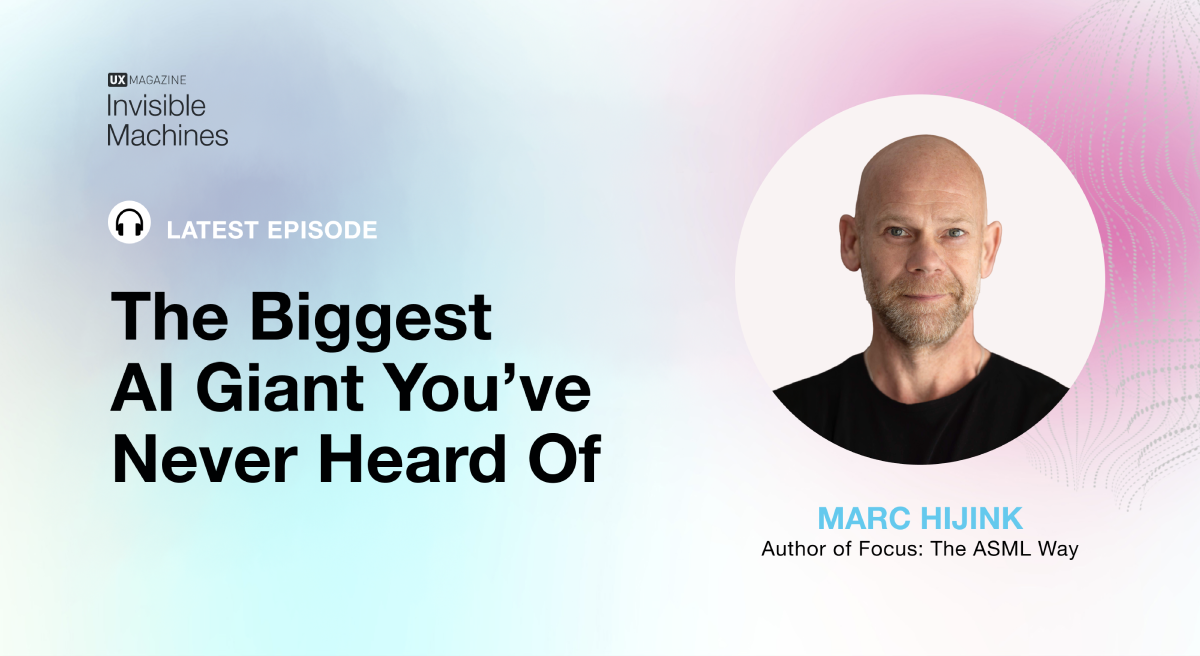
ASML powers nearly every digital experience on Earth, but most people have never heard of it. In this episode of Invisible Machines, Robb Wilson and Josh Tyson sit down with journalist and author Marc Hijink, whose new book “Focus – The ASML Way” culminates into decades of embedded reporting inside the world’s most important, yet mysterious technology company.

ASML produces the extreme ultraviolet (EUV) lithography machines responsible for fabricating 90% of the world’s advanced chips, enabling everything from smartphones and electric vehicles to data centers and AI superclusters. But as Marc reveals, ASML’s story is far more than a tale of engineering. It’s a story of culture, geopolitics, and the delicate, interdependent supply chain that underpins modern civilization.

Marc explains how ASML’s rise was fueled not by hierarchy, but by a culture of productive chaos, cross-disciplinary collaboration, and relentless iteration with partners like TSMC. He takes us inside the unexpected complexity of chipmaking, where physics, chemistry, optics, software, and AI collide to transform probabilistic molecules into predictable, usable compute.

As global tensions escalate, the conversation explores how chips have become economic weapons, why the U.S. and China are racing to secure lithography technology, and why no country can simply “build another ASML.” Marc reveals how fragile the chip ecosystem truly is, and why a single bottleneck in the supply chain can disrupt entire industries.

The episode also looks forward, examining ASML’s new partnership with Mistral AI, the growing importance of advanced packaging, and the staggering compute required just to make the chips that power AI itself. As Marc explains, ASML doesn’t just enable the AI boom, it depends on AI to push lithography into the next era.

post authorJosh Tyson

Josh Tyson
Josh Tyson is the co-author of the first bestselling book about conversational AI, Age of Invisible Machines. He is also the Director of Creative Content at OneReach.ai and co-host of both the Invisible Machines and N9K podcasts. His writing has appeared in numerous publications over the years, including Chicago Reader, Fast Company, FLAUNT, The New York Times, Observer, SLAP, Stop Smiling, Thrasher, and Westword. 

Tweet
Share
Post
Share
Email
Print

Related Articles

What makes players keep coming back? This piece explores the psychology of hot streaks — how momentum, perception, and smart design can turn short wins into lasting engagement.

Article by Montgomery Singman
The Psychology of Hot Streak Game Design: How to Keep Players Coming Back Every Day Without Shame
  • The article shows how hot streaks tap into players’ psychology, turning momentum into motivation.
  • It highlights the hot-hand fallacy, where players overestimate their chances of continued success.
  • The piece argues that ethical streak design should enhance engagement without exploiting addictive behavior.
Share:The Psychology of Hot Streak Game Design: How to Keep Players Coming Back Every Day Without Shame
26 min read

Trusting AI isn’t the goal — relying on it is. This article explores why human trust and AI reliance are worlds apart, and what UX designers should focus on to make AI feel dependable, not human.

Article by Verena Seibert-Giller
The Psychology of Trust in AI: Why “Relying on AI” Matters More than “Trusting It”
  • The article argues that “reliance,” not “trust,” is the right way to think about users’ relationship with AI.
  • It explains that human trust and AI reliance are driven by different psychological mechanisms.
  • The piece highlights that predictability, transparency, and control make users more willing to rely on AI.
  • It concludes that users don’t need to trust AI as a partner — only rely on it as a dependable tool.
Share:The Psychology of Trust in AI: Why “Relying on AI” Matters More than “Trusting It”
4 min read

What if your productivity app could keep you as focused as your favorite game? This article explores how game design psychology can transform everyday tools into experiences that spark flow, focus, and real engagement.

Article by Montgomery Singman
Flow State Design: Applying Game Psychology to Productivity Apps
  • The article shows how principles from game design can help productivity tools create and sustain a flow state.
  • It explains that games succeed by balancing challenge and skill, providing clear goals, and offering immediate feedback — elements most productivity apps lack.
  • The piece argues that applying these psychological insights could make work tools more engaging, adaptive, and motivating.
Share:Flow State Design: Applying Game Psychology to Productivity Apps
12 min read

Join the UX Magazine community!

Stay informed with exclusive content on the intersection of UX, AI agents, and agentic automation—essential reading for future-focused professionals.

Hello!

You're officially a member of the UX Magazine Community.
We're excited to have you with us!

Thank you!

To begin viewing member content, please verify your email.

Tell us about you. Enroll in the course.

    This website uses cookies to ensure you get the best experience on our website. Check our privacy policy and