Flag

We stand with Ukraine and our team members from Ukraine. Here are ways you can help

Get exclusive access to thought-provoking articles, bonus podcast content, and cutting-edge whitepapers. Become a member of the UX Magazine community today!

Home ›› AI Brings Cheap Prediction, Expensive Change

AI Brings Cheap Prediction, Expensive Change

by Josh Tyson
2 min read
Share this post on
Tweet
Share
Post
Share
Email
Print

Save

Most organizations are implementing AI as point solutions, dropping new technology into existing workflows to do the same work, just slightly better. But the real value, and the real disruption, lies in system solutions that completely transform how organizations operate.

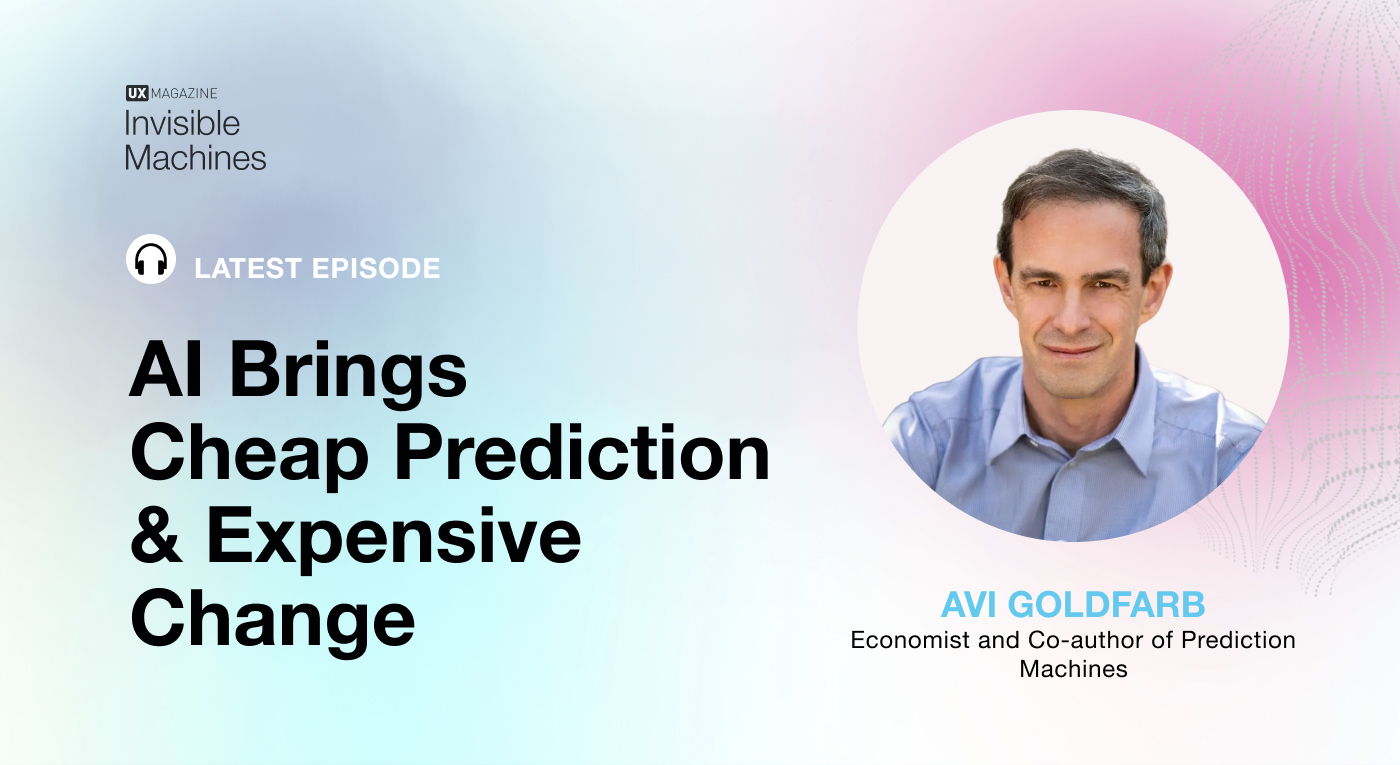
Avi Goldfarb, economist and co-author of Prediction Machines, joins Robb and Josh to explain why AI adoption follows predictable economic principles and why internal resistance, not technology limitations, is the primary barrier to transformation.

Goldfarb’s core argument: AI is fundamentally cheap prediction. Just as the internet made search and copying cheap, AI makes prediction cheap. When something becomes a commodity, the complements, the things that work alongside it, become more valuable. This includes compute power (benefiting Microsoft, Amazon, Google), unique data, and crucially, human judgment.

The problem? System solutions require organizational transformation. They create winners and losers inside companies. When AI enables insurance companies to shift from pricing risk (the domain of powerful underwriters) to reducing risk (requiring marketing and behavior change expertise), the power structure fractures. Vested interests resist. Departments see their importance diminished. Political problems emerge.

Point solutions avoid this friction by leaving organizational structure intact. They’re easier to implement but capture minimal value. System solutions deliver transformation but demand confronting internal resistance and redesigning workflows, supply chains, and power dynamics across the enterprise.

Goldfarb also addresses a hopeful possibility: unlike previous technologies that were skill-biased (favoring educated workers), generative AI might be upscaling, lifting capabilities for massive populations by making writing, coding, and communication accessible to those previously constrained by those barriers.

For leaders evaluating AI investments, the question isn’t whether to adopt AI, it’s whether you’re willing to pursue system transformation and confront the organizational disruption that creates real value.

post authorJosh Tyson

Josh Tyson
Josh Tyson is the co-author of the first bestselling book about conversational AI, Age of Invisible Machines. He is also the Director of Creative Content at OneReach.ai and co-host of both the Invisible Machines and N9K podcasts. His writing has appeared in numerous publications over the years, including Chicago Reader, Fast Company, FLAUNT, The New York Times, Observer, SLAP, Stop Smiling, Thrasher, and Westword. 

Tweet
Share
Post
Share
Email
Print

Related Articles

Discover how a simple comprehension test reveals if mobile content is too hard to read.

Article by Paivi Salminen
Why Reading on Mobile Is Uniquely Challenging
  • The article explains why mobile reading is harder: small screens and distractions make people miss information even when it’s there.
  • It introduces the cloze test, which removes words to measure real understanding: comprehension drops from 39% on desktop to 19% on mobile.
  • The piece argues that mobile content needs simpler language because the real question is: Does this make sense when life gets in the way?
Share:Why Reading on Mobile Is Uniquely Challenging
4 min read

Learn how to build systems where design explicitly models development, handoff is automatic, and AI can extend your work reliably.

Article by Jim Gulsen
Your Design System Works in Figma. Does It Work in Code?
  • The article explains why many design systems don’t work well: designs made in Figma don’t translate well into code.
  • It introduces five practices: structure frames like code, use fewer components with more variants, organize by how both designers and developers actually work, let AI check your naming, and build documentation into your daily workflow.
  • The piece says that good design systems are the same in design and development, and when they match, everything just works.
Share:Your Design System Works in Figma. Does It Work in Code?
6 min read

Join the UX Magazine community!

Stay informed with exclusive content on the intersection of UX, AI agents, and agentic automation—essential reading for future-focused professionals.

Hello!

You're officially a member of the UX Magazine Community.
We're excited to have you with us!

Thank you!

To begin viewing member content, please verify your email.

Get Paid to Test AI Products

Earn an average of $100 per test by reviewing AI-first product experiences and sharing your feedback.

    Tell us about you. Enroll in the course.

      This website uses cookies to ensure you get the best experience on our website. Check our privacy policy and