Flag

We stand with Ukraine and our team members from Ukraine. Here are ways you can help

Get exclusive access to thought-provoking articles, bonus podcast content, and cutting-edge whitepapers. Become a member of the UX Magazine community today!

Home ›› Scaled AI Requires Canonical Truth

Scaled AI Requires Canonical Truth

by Josh Tyson
2 min read
Share this post on
Tweet
Share
Post
Share
Email
Print

Save

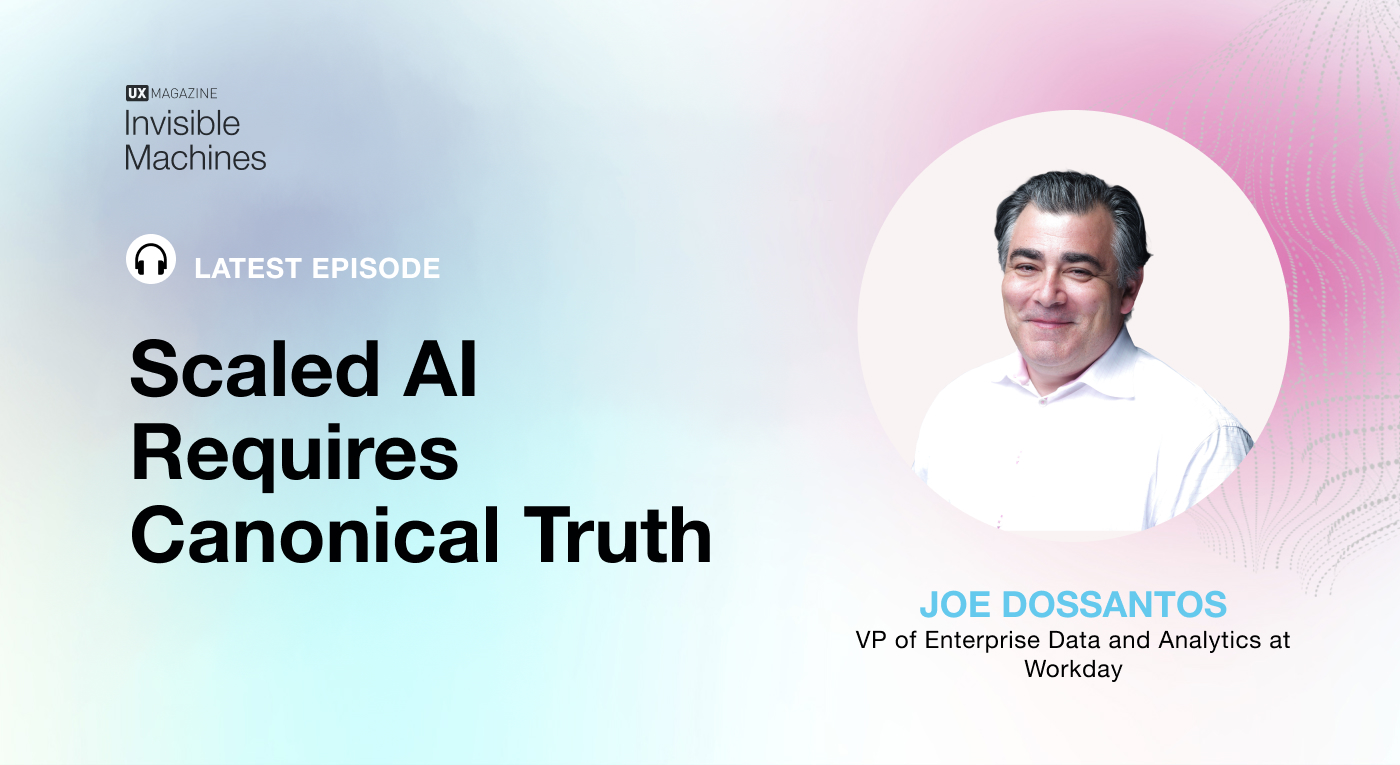
Before enterprises can deploy AI agents that actually work, they need something most organizations don’t have: a single, authoritative source of truth. Joe DosSantos, VP of Enterprise Data and Analytics at Workday, joins Robb and Josh for a wide-ranging conversation about canonical knowledge, the semantic layer, and why data governance, a concept from the 1990s, has suddenly become essential for AI deployment.

The core challenge? Large language models are predictive engines that “anticipate what you probably would mean,” as DosSantos explains. They’re “pretty good at words, but they suck at math.” For B2C applications where multiple interpretations are acceptable, this works fine. But in enterprise contexts, where revenue was exactly $1.625651 billion last year, organizations need deterministic truth, not probabilistic guesses.

The solution requires three layers: establishing canonical knowledge (the laborious human work of defining what data means in your organization), building a semantic layer (the translation mechanism between human definitions and machine-readable formats like YAML), and using the LLM as an interface to deterministic back-end systems rather than treating AI as the system itself.

DosSantos offers a compelling metaphor: trying to deploy AI agents without this foundation is like wanting granite countertops without building the foundation of the house first. You can’t skip it, it’s non-negotiable infrastructure. 

The conversation also tackles AI anxiety, with DosSantos referencing Kate Darling’s framework of thinking about AI as animals rather than human replacements, and Robb Wilson proposing we view AI as simply “smarter machines” — skill saws that know the difference between wood and fingers, stoves that prevent fires, and washing machines that don’t shrink clothes.

For leaders evaluating AI investments, this episode clarifies what actually needs to be built before agents can deliver value: not flashy use cases, but the unglamorous, essential work of data governance and semantic translation.

post authorJosh Tyson

Josh Tyson
Josh Tyson is the co-author of the first bestselling book about conversational AI, Age of Invisible Machines. He is also the Director of Creative Content at OneReach.ai and co-host of both the Invisible Machines and N9K podcasts. His writing has appeared in numerous publications over the years, including Chicago Reader, Fast Company, FLAUNT, The New York Times, Observer, SLAP, Stop Smiling, Thrasher, and Westword. 

Tweet
Share
Post
Share
Email
Print

Related Articles

AI is changing how designers work — speeding up workflows, sparking creativity, and taking care of the tedious parts. But it’s not here to replace designers — it’s here to amplify their insight, empathy, and impact.

Article by Nayyer Abbas
AI Boosts for UI/UX Designers: Fast Growth with Smart Tools
  • The article explores how AI transforms UI/UX design by automating repetitive tasks, speeding up workflows, and enhancing creativity across ideation, prototyping, and research.
  • It argues that AI empowers rather than replaces designers, freeing them to focus on insight, empathy, and strategy while maintaining ethical and user-centered design.
Share:AI Boosts for UI/UX Designers: Fast Growth with Smart Tools
5 min read

AI didn’t just change work — it removed the starting point. This piece explores what happens when early-career jobs vanish, and why the most “future-proof” skills might be the oldest ones.

Article by Pavel Bukengolts
AI, Early-Career Jobs, and the Return to Thinking
  • The article illustrates how AI is quickly taking over beginner-level jobs that involve routine work.
  • The piece argues that the skills that remain most valuable are human ones, like critical thinking, communication, big-picture understanding, and ethics.
  • It suggests that companies must decide whether to replace junior staff with AI or use AI to help train and support them.
Share:AI, Early-Career Jobs, and the Return to Thinking
5 min read

Discover how human-centered UX design is transforming medtech by cutting costs, reducing errors, and driving better outcomes for clinicians, patients, and healthcare providers alike.

Article by Dennis Lenard
How UX Design is Revolutionising Medtech Cost Efficiency
  • The article explains how strategic UX design in medtech improves cost efficiency by enhancing usability, reducing training time, and minimizing user errors across clinical workflows.
  • The piece argues that intuitive, user-centered interfaces boost productivity, adoption rates, and patient outcomes while lowering support costs and extending product lifecycles, making UX a crucial investment for sustainable growth and ROI in healthcare technology.
Share:How UX Design is Revolutionising Medtech Cost Efficiency
7 min read

Join the UX Magazine community!

Stay informed with exclusive content on the intersection of UX, AI agents, and agentic automation—essential reading for future-focused professionals.

Hello!

You're officially a member of the UX Magazine Community.
We're excited to have you with us!

Thank you!

To begin viewing member content, please verify your email.

Get Paid to Test AI Products

Earn an average of $100 per test by reviewing AI-first product experiences and sharing your feedback.

    Tell us about you. Enroll in the course.

      This website uses cookies to ensure you get the best experience on our website. Check our privacy policy and