The first question is almost never the one on the slide.
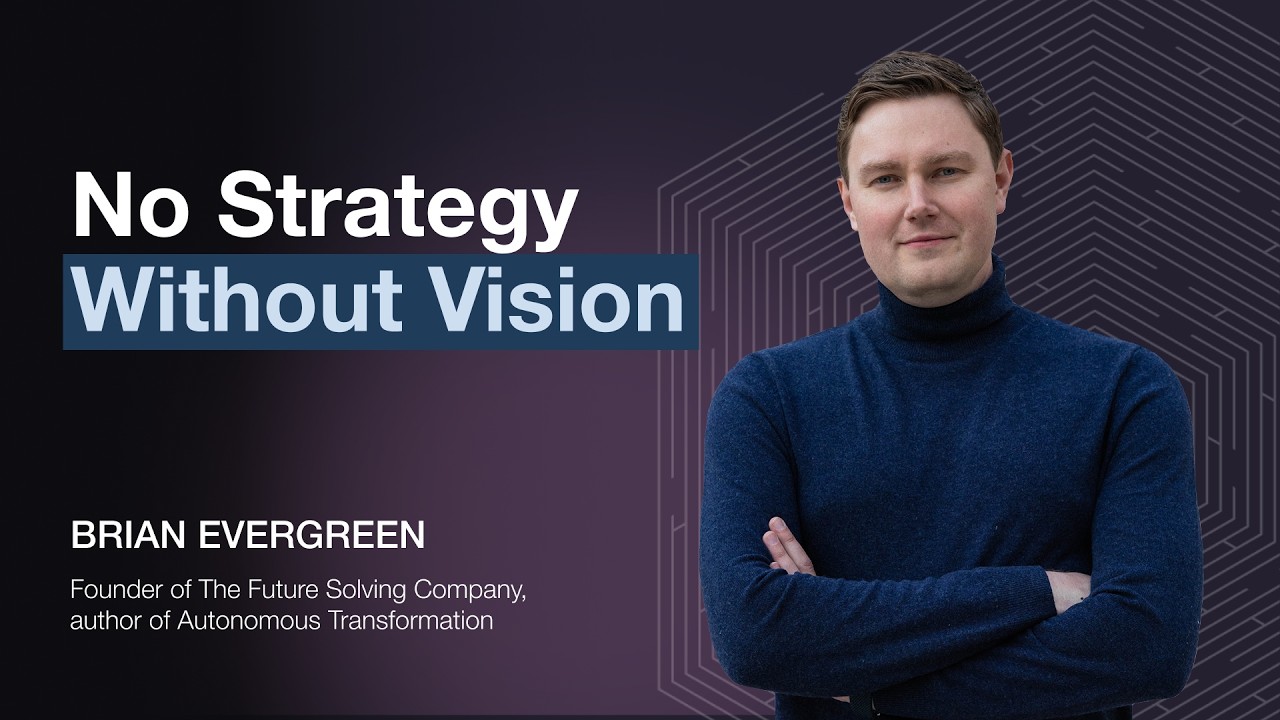
In a recent conversation on Invisible Machines, Brian Evergreen, founder of The Future Solving Company and author of Autonomous Transformation, describes what executives actually bring into the room when they say they need an AI strategy. Often it’s a two-step: build enough literacy to sound credible in a board deck, then race to a use case list and a vendor shortlist. Evergreen is sympathetic to the first half. You should know what agentic systems are, how they differ from generative AI and from classical machine learning, the same way a painter should know pigment and ground. The trouble starts when literacy becomes permission to sprint.
What follows, in his framing, is not strategy but an agentic AI plan: busy, intelligent, and hollow at the center. The organization has a purchasing motion (RFPs, analyst quadrants, feature matrices, oral defenses) that works beautifully when the problem is already a SKU. It fails when the work is exploration, because there is no dataset for next year’s market structure, no replicated experiment for a category that does not exist yet. Trend lines are not physics. Common features across vendors are not interchangeable capabilities; with AI, the missing capability might ship as a side effect of a model update before your procurement cycle ends.
This is why the headline lands as a design critique, not a procurement rant. UX and product teams are trained to reduce uncertainty by making the path concrete: flows, states, acceptance criteria. Agentic AI rewards the opposite move first—hold the interface and the vendor bake-off until you can name the future you’re trying to make legible.
No Strategy Without Vision
Evergreen’s thesis line is blunt enough to tattoo: no strategy without vision.
If you begin from the org chart as it exists today and ask how to make it slightly better, you inherit every constraint as destiny. His alternative is almost childlike in its difficulty: set the system aside long enough to ask what the most amazing version of your work would be, then work backward through what would have to be true for that version to exist. Tools, data contracts, incentives, policy, partnerships. The output is not a mood board; it is a visible map of necessary conditions, the kind of artifact people can align on after the offsite ends.
Robb Wilson, CEO of OneReach.ai and co-host of the show, names what most large companies already have: not an absence of planning, but a highly evolved plan for buying known solutions. That plan is rational right up until the moment you are no longer commissioning a defined product. Wilson and Evergreen both press on the anti-pattern of treating innovation like a science fair where the hypothesis is “which vendor checks the most boxes.” In a world where software can gain capabilities mid-flight, the checklist is not just stale, it misleads you about what “parity” means.
Stop Problem Solving. Start Future Solving
Evergreen’s company name is the conceptual spine. Problem solving, he argues, is an elimination exercise: trim waste, shore up what you already ship, curate the value you already have. Future solving starts with appetite: what do you want to exist that does not exist yet, and what would have to become true to get there? He uses a deliberately unfair image—training everyone in a city to swing hammers might produce sturdier houses, but you will not stumble into the Duomo. Mass literacy plus mass use-case hunting produces motion without architecture.
Josh Tyson brings in Morgan Stanley’s early work on a governed knowledge layer, not a dump of PDFs, but a system with ownership, freshness, and accountability, because that is what “what would have to be true” often bottoms out to in practice. Evergreen’s response is about language: a good vision is visceral. Not “we will be more profitable,” which is a scoreboard, but something you can picture in a room: the advisor answering in real time, the clinician staying in the human moment, the partner who laughs shadow IT out of the room because the relationship is that trusted. If people cannot feel the outcome, they will not carry the change when the pilot ends.
The Emotional Work of Proof
History in the episode does the emotional work of proof without turning into a slide of logos.
Evergreen tells the Blockbuster on-demand story: a credible streaming-shaped pilot years before the category went mainstream, then a decision that treated new value as a threat to late-fee economics. Wilson, who was in consulting circles when that era turned, adds the structural detail that makes the parable sting for anyone building bottom-up innovation programs: Blockbuster’s customer-of-record was often the franchisee, not the renter. A strong streaming initiative read as cannibalizing the people the balance sheet depended on, unless leadership future-solved a new model with them, not against them. The technology was not the missing piece; alignment was.
Bell Labs in 1952 supplied the counter-move. Confronted with the embarrassing age of their top inventions, leadership forced an unnatural exercise: assume the telephone network is destroyed and irreparable; rebuild from scratch with today’s science, economics, and regulation. The point is not nostalgia for monopoly labs; it is that breakthrough cadence can be convened. You do not get a year of touch-tone and voicemail seeds from hoping creativity appears between calendar holds.
Friction Is Infinite Without a Direction
Later, the conversation turns to friction—how AI might compress middle layers, expose decisions, and change who sees what inside an organization. Evergreen does not dismiss friction mapping. He warns that friction is inexhaustible without a north star: you can always find more of it. Vision, in his phrase, is the steamroller with enough momentum to cut through inertia—enroll people in a future they want, and they will clear obstacles in its service. Wilson offers the UX rhyme: reducing steps in a funnel helps, but motivation can override friction when the promise is real. That is why adoption as a proxy for success can lie: wide usage of the wrong future is still the wrong future.
Close your eyes and you can hear the product implication. If the future is “movie night for twenty, two vegetarians, usual toppings,” maybe the winning experience is not another pizza app but intent handled end-to-end—relationships, not transactions, with the logistics layer invisible. Maybe a child asks what “login” meant the way someone once mistook a floppy disk for a 3D-printed save icon. That is not vaporware cosplay; it is a claim about authorship. Interfaces collapse when someone owns the whole story across silos. If your organization does not write that story, a platform company will by default.
The future is not discovered by measuring today harder. It is authored by whoever is willing to name it in language humans can carry, make the map of necessary truths visible, and only then argue about agents, models, and roadmaps. Real AI strategy is not a vendor bake-off on the deck of a ship whose heading nobody has agreed to yet.
Listen on the podcast hub, or watch it on YouTube.