
Flag

We stand with Ukraine and our team members from Ukraine. Here are ways you can help

Get exclusive access to thought-provoking articles, bonus podcast content, and cutting-edge whitepapers. Become a member of the UX Magazine community today!

Home ›› What ‘Cheap Prediction’ means for Enterprise

What ‘Cheap Prediction’ means for Enterprise

by Josh Tyson
2 min read
Share this post on
Tweet
Share
Post
Share
Email
Print

Save

What if AI isn’t actually “intelligent” at all, but simply makes prediction radically cheaper?

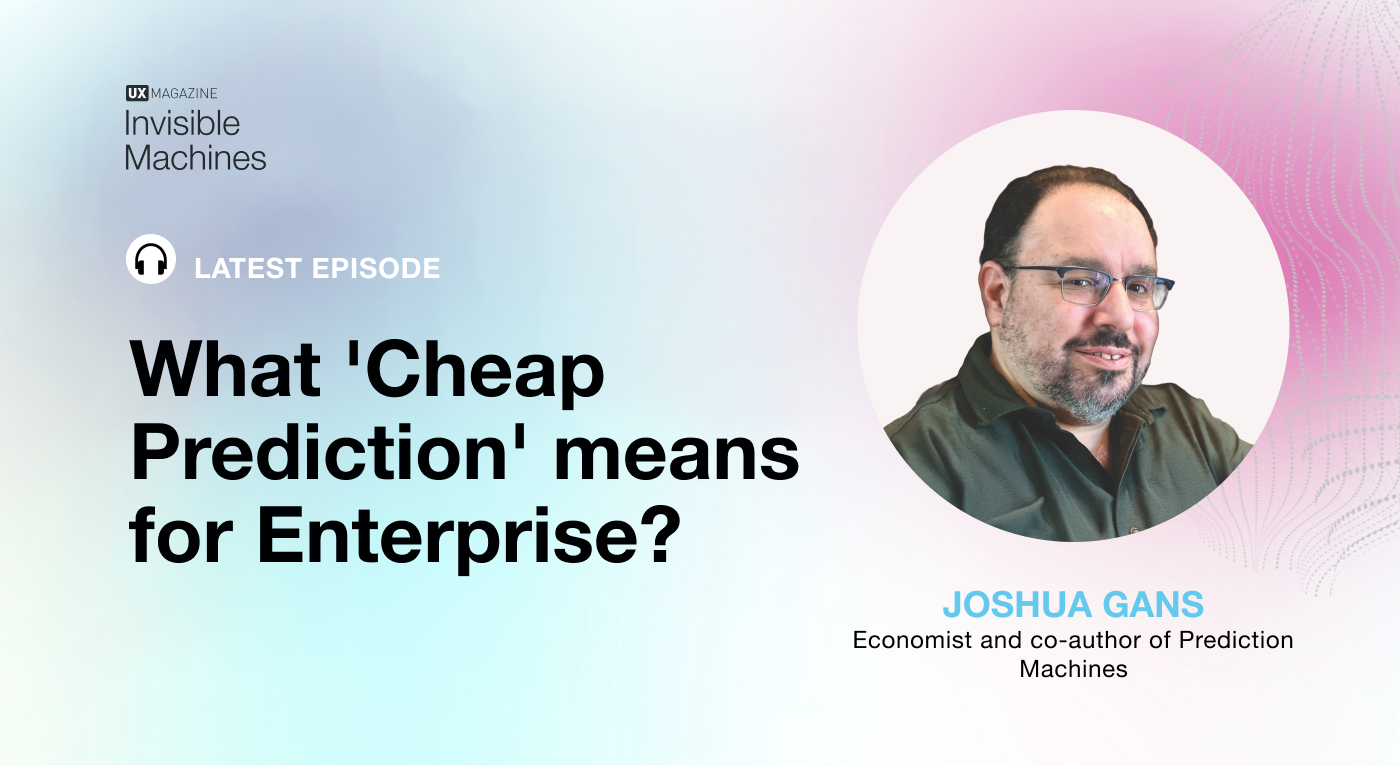
Joshua Gans, economist and co-author of Prediction Machines, joins Robb and Josh to reframe how enterprise leaders should think about AI. Rather than chasing the hype around artificial intelligence, Gans argues we should understand AI as an advance in computational statistics that drops the cost of prediction, reduces decision-making friction, and fundamentally reshapes organizational structure. His new book, The Microeconomics of Artificial Intelligence, examines the ways AI enhances and perhaps enables decision-making, and how that’s poised to affect organizations and industries.

The implications are profound. Gans uses airports as a metaphor: public terminals are expensive, elaborate structures built entirely around managing uncertainty. Travelers don’t know exactly when to arrive, so they build in massive time buffers, which airports capitalize on by selling food, retail, and services. Private terminals, by contrast, are sparse. The wealthy don’t wait because better logistics eliminate uncertainty. When prediction improves, the costly apparatus built to manage uncertainty becomes unnecessary. 

Many organizations, Gans suggests, resemble public airports — full of people waiting for phones to ring, managing buffers, absorbing uncertainty. As AI makes prediction cheap, this middle-management friction layer flattens. The “hidden secret,” as Josh Tyson notes, is that the people selecting AI systems to automate work are essentially “selecting their usurper.”

But Gans pushes back on replacement anxiety. Prediction and judgment are complements, not substitutes. While AI will eliminate friction and flatten hierarchies, it will initially supercharge frontline workers rather than replace them. The mistake organizations are making? Forbidding employees from experimenting with AI tools, pushing adoption underground and preventing the learning curve needed for proficiency.

For leaders navigating AI adoption, this conversation offers a clearer lens: stop thinking about intelligence, start thinking about prediction costs, friction reduction, and the organizational restructuring required to actually capture value. True AI transformation isn’t about deploying models, it’s about redesigning decision-making architecture across the enterprise.

post authorJosh Tyson

Josh Tyson
Josh Tyson is the co-author of the first bestselling book about conversational AI, Age of Invisible Machines. He is also the Director of Creative Content at OneReach.ai and co-host of both the Invisible Machines and N9K podcasts. His writing has appeared in numerous publications over the years, including Chicago Reader, Fast Company, FLAUNT, The New York Times, Observer, SLAP, Stop Smiling, Thrasher, and Westword. 

Tweet
Share
Post
Share
Email
Print

Related Articles

Learn when to talk to users, and when to watch them in order to uncover real insights and design experiences that truly work.

Article by Paivi Salminen
Usability Tests vs. Focus Groups
  • The article distinguishes between usability tests and focus groups, highlighting their different roles in UX research.
  • It explains that focus groups gather opinions and attitudes, while usability tests observe real user behavior to find design issues.
  • The piece stresses using each method at the right stage to build the right product and ensure a better user experience.
Share:Usability Tests vs. Focus Groups
2 min read

Explore how interaction data uncovers hidden user-behavior patterns that drive smarter product decisions, better UX, and continuous improvement.

Article by Srikanth R
The Power of Interaction Data: Tracking User Behavior in Modern Web Apps
  • The article explains how interaction data like clicks, scrolls, and session patterns reveals real user behavior beyond basic analytics.
  • It shows how tools such as heatmaps and session replays turn this data into actionable insights that improve UX and product decisions.
  • The piece emphasizes using behavioral insights responsibly, balancing optimization with user privacy and ethical data practices.
Share:The Power of Interaction Data: Tracking User Behavior in Modern Web Apps
14 min read

Explore how design researchers can earn the trust and buy-in that give studies impact, even as AI shifts how teams work.

Article by Sara Fortier
Earning the Right to Research: Stakeholder Buy-In and Influence in the AI x UX Era
  • The article emphasizes that synthetic data and AI tools promise speed, but not the alignment or shared purpose that makes design research effective in solving design problems.
  • It asserts that meaningful human-centred design begins with trust and the permission to conduct research properly (i.e., strategically).
  • The piece outlines how to build stakeholder buy-in for design research through practical strategies that build influence piece by piece within an organization.
  • Adapted from the book Design Research Mastery, it offers grounded ways to enable impactful user studies in today’s AI-driven landscape.
Share:Earning the Right to Research: Stakeholder Buy-In and Influence in the AI x UX Era
12 min read

Join the UX Magazine community!

Stay informed with exclusive content on the intersection of UX, AI agents, and agentic automation—essential reading for future-focused professionals.

Hello!

You're officially a member of the UX Magazine Community.
We're excited to have you with us!

Thank you!

To begin viewing member content, please verify your email.

Get Paid to Test AI Products

Earn an average of $100 per test by reviewing AI-first product experiences and sharing your feedback.

    Tell us about you. Enroll in the course.

      This website uses cookies to ensure you get the best experience on our website. Check our privacy policy and