




Flag

We stand with Ukraine and our team members from Ukraine. Here are ways you can help

Get exclusive access to thought-provoking articles, bonus podcast content, and cutting-edge whitepapers. Become a member of the UX Magazine community today!

Home ›› NVIDIA: What’s Next for the $4 Trillion AI Powerhouse?

NVIDIA: What’s Next for the $4 Trillion AI Powerhouse?

by Josh Tyson
1 min read
Share this post on
Tweet
Share
Post
Share
Email
Print

Save

As AI becomes more central to how we build and interact with digital systems, it’s fascinating to learn the backstory of how hardware originally designed to make video games more immersive has ushered in this explosive era of technology we’re still trying to make sense of.

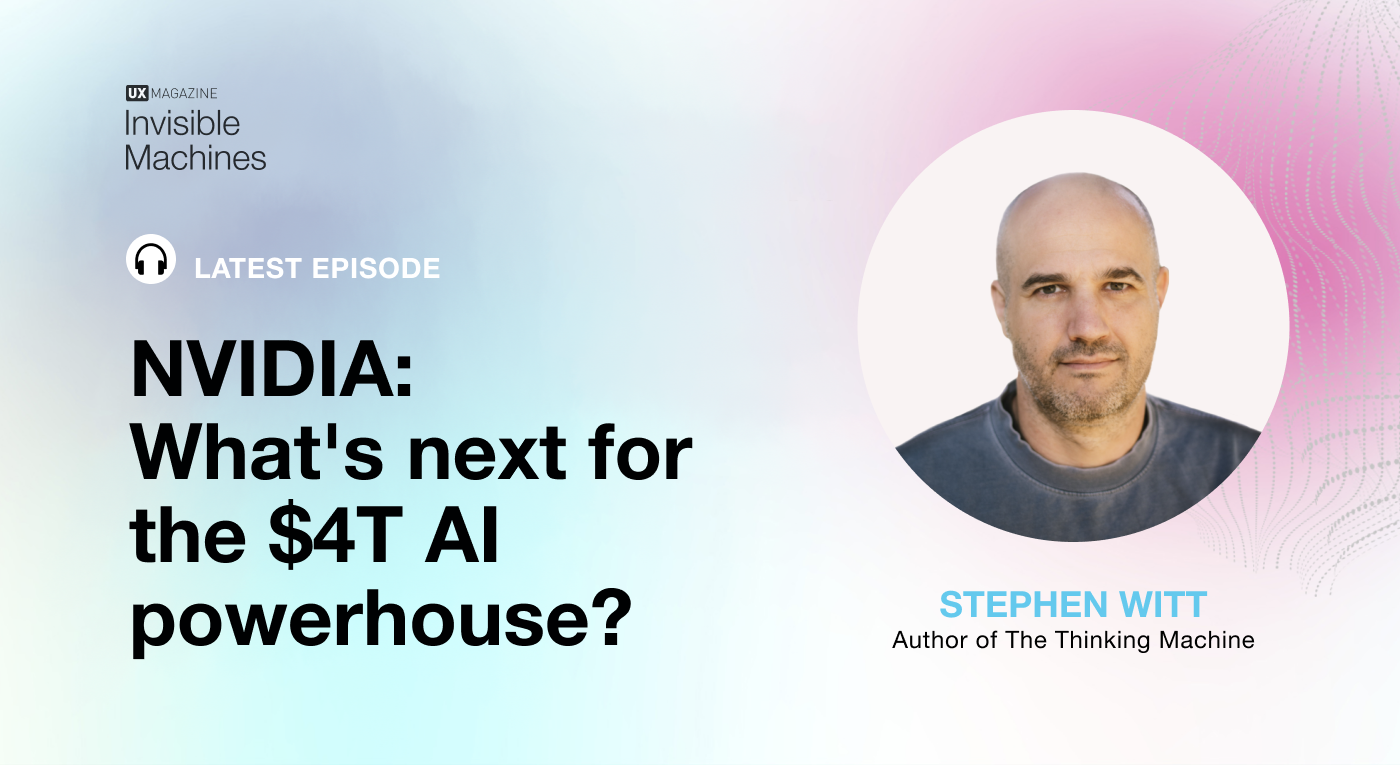
In this episode of Invisible Machines, journalist and biographer Stephen Witt joins Robb Wilson, CEO and Co-Founder of OneReach.ai, and Josh Tyson to unpack NVIDIA’s meteoric rise—and the visionary leadership of Jensen Huang that propelled it to a $4 trillion market cap. Witt’s new book, The Thinking Machine: Jensen Huang, Nvidia, and the World’s Most Coveted Microchip, offers a captivating biography of the unconventional CEO, along with a compelling history of the deep connections between Nvidia’s graphics cards and the neural networks powering LLMs and, by extension, AI agents.

Witt brings a journalist’s precision and a storyteller’s flair to this conversation, offering an inside look at how Huang’s radical approach to business and innovation positioned Nvidia as the driving force behind today’s AI revolution. This episode explores the history of AI, the rise of agentic systems, and the coming Omniverse—along with what the power of simulation will mean for businesses.

Listen now for a timely conversation and a look ahead at the immersive, simulated future just over the horizon.

post authorJosh Tyson

Josh Tyson
Josh Tyson is the co-author of the first bestselling book about conversational AI, Age of Invisible Machines. He is also the Director of Creative Content at OneReach.ai and co-host of both the Invisible Machines and N9K podcasts. His writing has appeared in numerous publications over the years, including Chicago Reader, Fast Company, FLAUNT, The New York Times, Observer, SLAP, Stop Smiling, Thrasher, and Westword. 

Tweet
Share
Post
Share
Email
Print

Related Articles

Who pays the real price for AI’s magic? Behind every smart response is a hidden human cost, and it’s time we saw the hands holding the mirror.

Article by Bernard Fitzgerald
The Price of the Mirror: When Silicon Valley Colonizes the Human Soul
  • The article reveals how AI’s human-like responses rely on the invisible labor of low-paid workers who train and moderate these systems.
  • It describes this hidden labor as a form of “cognitive colonialism,” where human judgment is extracted from the Global South for profit.
  • The piece criticizes the tech industry’s ethical posturing, showing how convenience for some is built on the suffering of others.
Share:The Price of the Mirror: When Silicon Valley Colonizes the Human Soul
7 min read

AI’s promise isn’t about more tools — it’s about orchestrating them with purpose. This article shows why random experiments fail, and how systematic design can turn chaos into ‘Organizational AGI.’

Article by Yves Binda
Random Acts of Intelligence
  • The article critiques the “hammer mentality” of using AI without a clear purpose.
  • It argues that real progress lies in orchestrating existing AI patterns, not chasing new tools.
  • The piece warns that communication complexity — the modern Tower of Babel — is AI’s biggest challenge.
  • It calls for outcome-driven, ethical design to move from random acts to “Organizational AGI.”
Share:Random Acts of Intelligence
5 min read

Most companies are trying to do a kickflip with AI and falling flat. Here’s how to fail forward, build real agentic ecosystems, and turn experimentation into impact.

Article by Josh Tyson
The “Do a Kickflip” Era of Agentic AI
  • The article compares building AI agents to learning a kickflip — failure is part of progress and provides learning.
  • It argues that real progress requires strategic clarity, not hype or blind experimentation.
  • The piece calls for proper agent runtimes and ecosystems to enable meaningful AI adoption and business impact.
Share:The “Do a Kickflip” Era of Agentic AI
7 min read

Join the UX Magazine community!

Stay informed with exclusive content on the intersection of UX, AI agents, and agentic automation—essential reading for future-focused professionals.

Hello!

You're officially a member of the UX Magazine Community.
We're excited to have you with us!

Thank you!

To begin viewing member content, please verify your email.

Tell us about you. Enroll in the course.

    This website uses cookies to ensure you get the best experience on our website. Check our privacy policy and