




Flag

We stand with Ukraine and our team members from Ukraine. Here are ways you can help

Get exclusive access to thought-provoking articles, bonus podcast content, and cutting-edge whitepapers. Become a member of the UX Magazine community today!

Home ›› Exploring AI Agents

Exploring AI Agents

by Josh Tyson
1 min read
Share this post on
Tweet
Share
Post
Share
Email
Print

Save

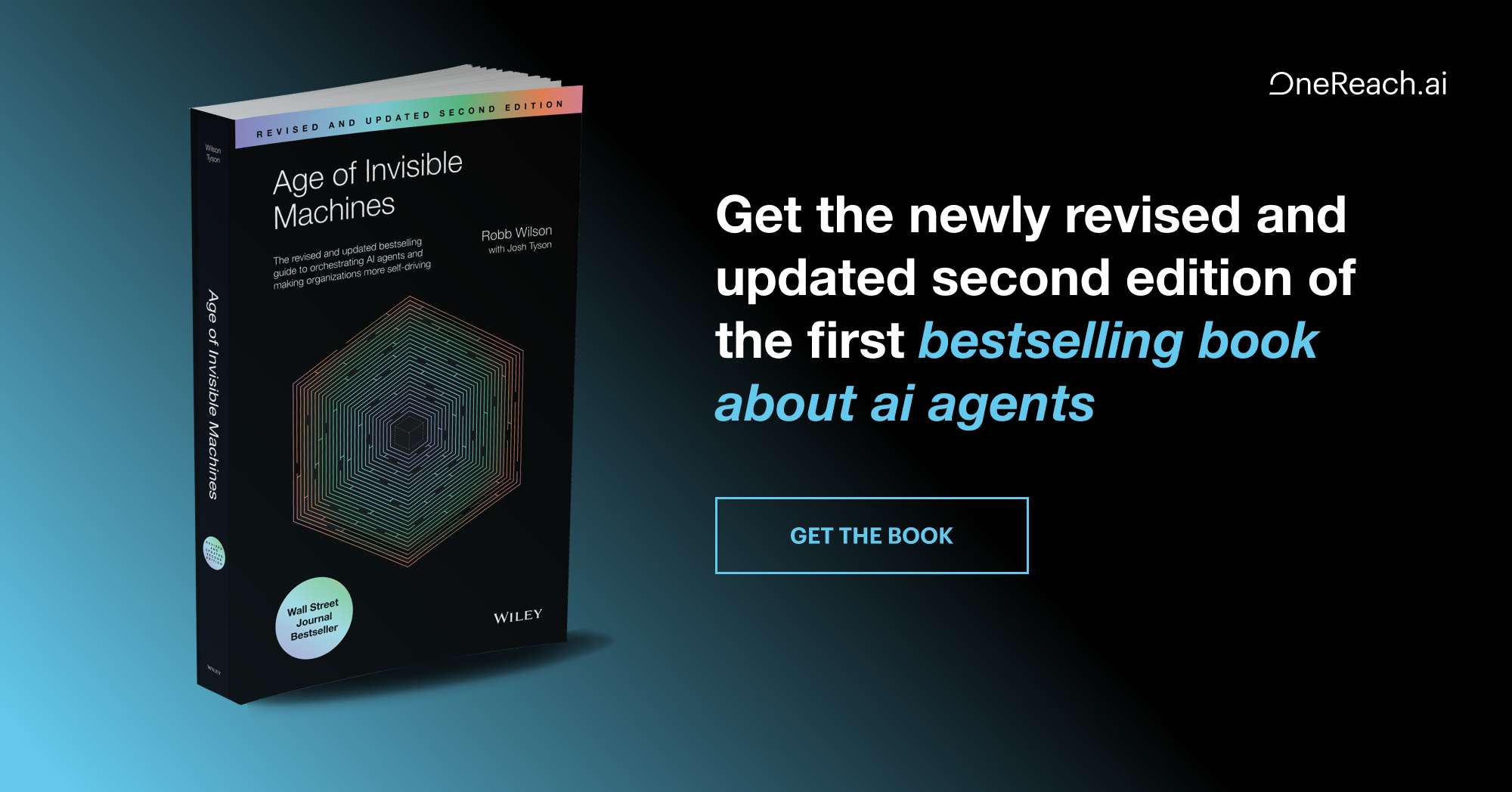
Robb and Josh share a practical and far-reaching primer on AI agents, which have quickly come to dominate much of the conversation about IA. What are agents really? What kinds of technology ecosystems do they inhabit? How did organizations give agents real agency? What will the proliferation of agents mean for the future of software? Join Robb Wilson (CEO and co-founder of OneReach.ai) and Josh Tyson for a conversation that answers these questions and many more, drawn from conversations with enterprise buyers.

Check out the full episode here.

post authorJosh Tyson

Josh Tyson
Josh Tyson is the co-author of the first bestselling book about conversational AI, Age of Invisible Machines. He is also the Director of Creative Content at OneReach.ai and co-host of both the Invisible Machines and N9K podcasts. His writing has appeared in numerous publications over the years, including Chicago Reader, Fast Company, FLAUNT, The New York Times, Observer, SLAP, Stop Smiling, Thrasher, and Westword. 

Tweet
Share
Post
Share
Email
Print

Related Articles

What if your productivity app could keep you as focused as your favorite game? This article explores how game design psychology can transform everyday tools into experiences that spark flow, focus, and real engagement.

Article by Montgomery Singman
Flow State Design: Applying Game Psychology to Productivity Apps
  • The article shows how principles from game design can help productivity tools create and sustain a flow state.
  • It explains that games succeed by balancing challenge and skill, providing clear goals, and offering immediate feedback — elements most productivity apps lack.
  • The piece argues that applying these psychological insights could make work tools more engaging, adaptive, and motivating.
Share:Flow State Design: Applying Game Psychology to Productivity Apps
12 min read

Learn how understanding user emotions can create intuitive, supportive designs that build trust and loyalty.

Article by Pavel Bukengolts
The Role of Emotion in UX: Embracing Emotionally Intelligent Design
  • The article emphasizes that emotionally intelligent design is key to creating meaningful UX that satisfies users and drives business success.
  • It shows how understanding users’ emotions — through research, empathy mapping, journey mapping, and service blueprinting — can reveal hidden needs and shape more intuitive, reassuring digital experiences.
  • The piece argues that embedding empathy and emotional insights into design strengthens user engagement, loyalty, and overall satisfaction.
Share:The Role of Emotion in UX: Embracing Emotionally Intelligent Design
5 min read

As AI takes on more of the solution work, the real craft of design shifts to how we frame the problem. This piece explores why staying with uncertainty and resisting the urge to rush to answers may be a designer’s most powerful skill.

Article by Morteza Pourmohamadi
The Frame, the Illusion, and the Brief
  • The article highlights that as AI takes over more of the solution work, the designer’s true craft lies in framing the problem rather than rushing to solve it.
  • It shows how cognitive biases like the need for closure or action bias can distort our perception, making careful problem framing essential for clarity and creativity.
  • The piece argues that framing is itself a design act — a practice of staying with uncertainty long enough to cultivate shared understanding and more meaningful outcomes.
Share:The Frame, the Illusion, and the Brief
3 min read

Join the UX Magazine community!

Stay informed with exclusive content on the intersection of UX, AI agents, and agentic automation—essential reading for future-focused professionals.

Hello!

You're officially a member of the UX Magazine Community.
We're excited to have you with us!

Thank you!

To begin viewing member content, please verify your email.

Tell us about you. Enroll in the course.

    This website uses cookies to ensure you get the best experience on our website. Check our privacy policy and