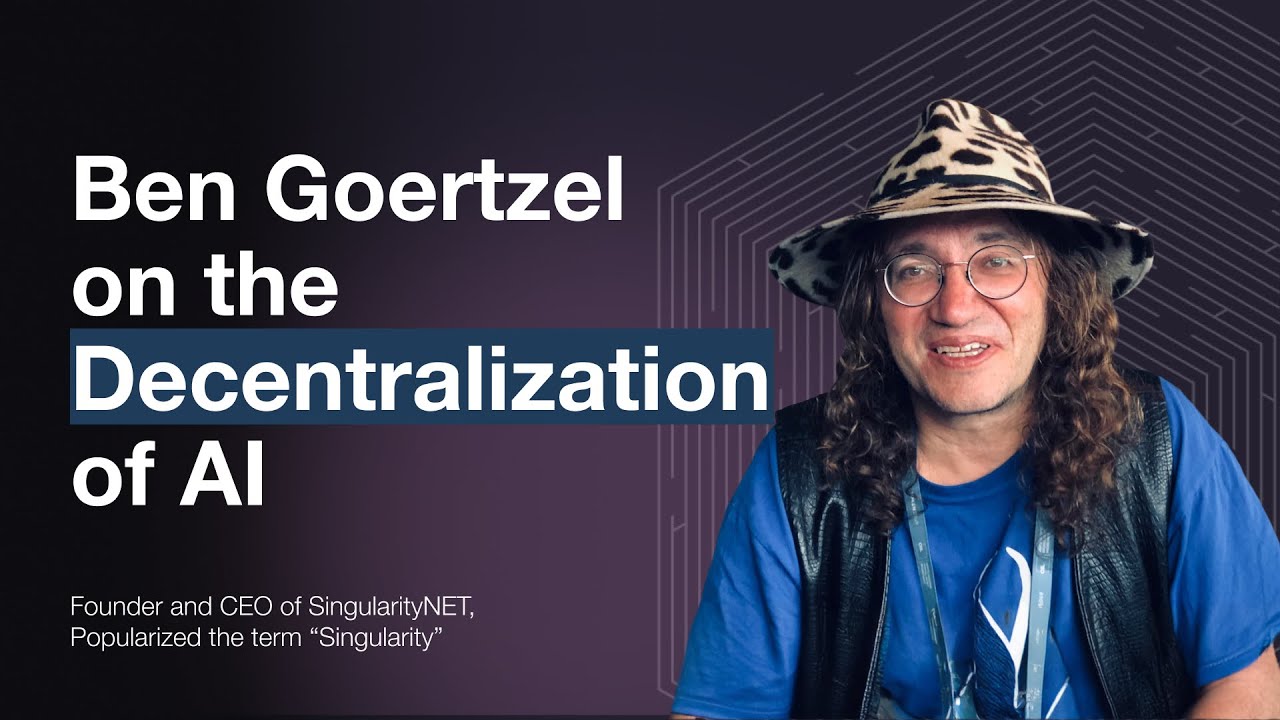
Ben Goertzel returns to Invisible Machines at a hinge moment: the public web is being re-threaded as an agent fabric, with MCP and adjacent protocols promising plug-and-play interoperability. In the same breath, Goertzel reminds listeners that SingularityNET and allied stacks have been living with reputation, payments, and multi-agent choreography for years—not as a slide deck, but as infrastructure that had to survive contact with adversarial economics and messy human coordination.
The episode orbits two overlapping systems he is building today. Hyperon, the successor to OpenCog, is where neural, symbolic, and evolutionary methods are meant to compose rather than compete: a new Metta language (fast compiler now landing), a distributed atom space for the knowledge metagraph, and a bet that AGI is less a single model breakthrough than an ecology of specialists that can negotiate objectives. In parallel, the ASI chain work with the Artificial Superintelligence Alliance is an attempt to carry those ideas into a decentralized economy—DevNet live, testnet on the horizon—where shards, staking, and reputation try to align incentives with work that actually helps a community instead of recycling meme-cycle liquidity.
On definitions, Goertzel draws a line between broad AI and AGI: models that can do many tasks are not automatically systems that generalize far beyond their training distribution in the strong sense he has written about since 2005. He is skeptical of milestone theater (“90% of human jobs”) that ignores the thin tail of science, culture, and invention that disproportionately moves civilization. The crisper blocker he names is self-reflectivity—the ability to introspect and deliberately improve one’s own reasoning process—which he treats as the hallmark of open-ended intelligence rather than encyclopedic recall.
Market dynamics enter as more than commentary. Goertzel describes today’s oscillation between hype and pullback as a mathematical singularity in cycle speed: winters and summers compressing toward six-month beats, which changes how institutions should plan. Robb Wilson’s worry about hegemonic concentration still rhymes with the facts on who trains the largest foundation models, yet the grassroots surface area of tools, datasets, and forks looks more like Linux and GitHub than like a single switchboard—if enterprises preserve exit rights and composability instead of locking into one vendor’s story about what counts as “AI.”
The practical tension for designers and architects is familiar from earlier protocol waves: you need conversation as tissue between nodes—human to machine, machine to machine—without mistaking the chat layer for the trust layer. Decentralization is not moral decoration; it is an engineering strategy for preserving the degrees of freedom you will need when the next model class arrives and your current favorite API behaves differently.
For UX Magazine readers building roadmaps, the through-line is not picking the winning LLM. It is whether your stack can route objectives across heterogeneous agents, observe behavior at the seams, and evolve policy when the environment changes. Goertzel’s wager is that open, participatory networks will discover those policies faster than closed gardens—not because they are nicer, but because they expose more failure modes early enough to learn.
Prefer the long read on orchestration patterns first? See Orchestrating LLMs, AI Agents, and Other Generative Tools (Robb Wilson and Josh Tyson, UX Magazine). For the terrarium-versus-forest framing of open architecture, see Open vs Closed: a Critical Question for Designing and Building Experiences (Josh Tyson, UX Magazine). Prefer to read along with the episode? Here is the full episode transcript.
Listen on the podcast hub, or watch it on YouTube.