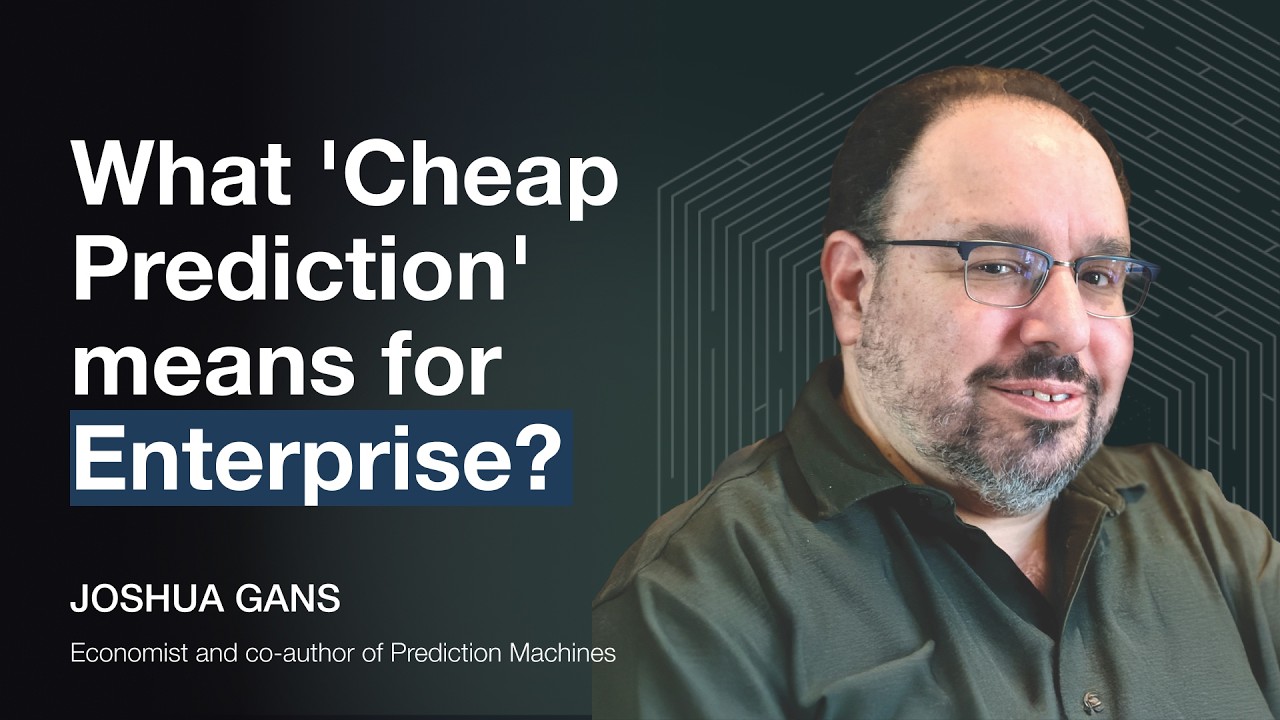
What if the banner “artificial intelligence” is mostly a marketing problem? In Invisible Machines, economist Joshua Gans—co-author of Prediction Machines and author of The Microeconomics of Artificial Intelligence—asks executives to trade the science-fiction noun for a boring one: cheap prediction. The underlying shift, he argues, is not a ghost in the machine but better computational statistics at scale, which lowers the cost of filling in missing information so decisions can move.
That re-labeling is tactically useful. It moves budget conversations off vibes and onto unit economics: where does your organization rent time, space, and headcount while it waits for a forecast it does not yet have? The social posts around this episode sharpen three touchpoints that travel well outside any single industry: retail logistics pushed to its logical extreme, hospital beds held for observation, and airports as monuments to uncertainty.
Start with the deliberately uncanny retail thought experiment: what if Amazon shipped goods before you ordered them, because models already knew your pantry better than your weekend memory? The creep factor is real; so is the economic logic Gans is teasing. When prediction error is low and reverse logistics is manageable, the shopping experience stops being a search problem and becomes a trust problem. Enterprises should hear that as a design brief for consent, reversibility, and explanation—not as permission to confuse surveillance with service.
The hospital thread lands harder because it reframes capacity debates. The constraint is not only how many beds exist; it is how long people stay in them while clinicians wait for information. An extra “day for observation” can be therapeutic prudence, but it can also be an expensive buffer against not-knowing. Gans invites leaders to name that pattern explicitly: much of our infrastructure is not only delivering care or throughput; it is managing uncertainty. If better prediction shortens the safe path to discharge, the return is not a nicer chatbot in the ward—it is capacity unlocked without pouring new concrete.
Airports make the metaphor legible. Public concourses swell with food halls and lounges because travelers must hedge against delays they cannot model; private terminals stay sparse when logistics compress the wait. Translate that to your enterprise: where have you built amenities for delay—extra handoffs, status meetings, ticketing queues, eligibility backlogs—because teams cannot coordinate on a shared forecast fast enough? AI’s ROI story, in this frame, is not only “automate the task.” It is dismantling the apparatus you erected to tolerate not-knowing once not-knowing gets cheaper.
Inside the firm, Gans links prediction, decision, and friction into one ecosystem. Cheap prediction does not vaporize judgment; it re-prices it. Josh Tyson’s line from the episode captures the political sting: the people who select systems to automate work are, in a sense, selecting their usurper. That is why pilots stall even when models work: point tools preserve hierarchy, while systemic prediction shifts who holds the pen on risk.
Gans is cautiously optimistic about where leverage shows up first. As friction falls, frontline operators can absorb more context and act with less translation—while layers that existed mainly to shuttle information face honest pressure. This is not a promise that titles disappear overnight; it is a warning that middle buffers justified by uncertainty will need new value propositions once forecasts arrive in seconds instead of meetings.
Which makes the policy mistake on everyone’s roadmap look worse in daylight: forbidding employees from experimenting with capable tools does not erase demand; it routes adoption underground. Shadow use starves the organization of shared playbooks, shared evals, and shared guardrails—the very things you need to climb the learning curve safely. Gans’s counsel rhymes with procurement reality: treat early use as sampling and governance work, not as a purity contest you can win by memo.
None of this collapses the timeline. In the same conversation he warns that even successful local adoption can create bullwhip effects: one silo’s responsive AI can amplify variance if upstream and downstream processes still run on calendar-time coordination. True transformation stays tied to redesigning decision architecture—who escalates, what counts as evidence, how disagreements between models and managers get resolved.
Simulation and digital twins, when they are honest twins rather than slide ornaments, can tighten that loop: richer counterfactuals mean fewer real-world rehearsals spent discovering what you could have inferred. The economics still push back to the same ledger line—prediction got cheaper, so which buffers were priced as insurance against missing data?
If you take only one planning question from the episode, borrow it from the social copy: Where are you paying the highest price to wait for information you could predict instead? Answer that with inventory honesty, and the technology roadmap stops being a parade of demos and becomes a map of which cathedrals you can finally tear down.
Listen on the podcast hub, or watch it on YouTube.