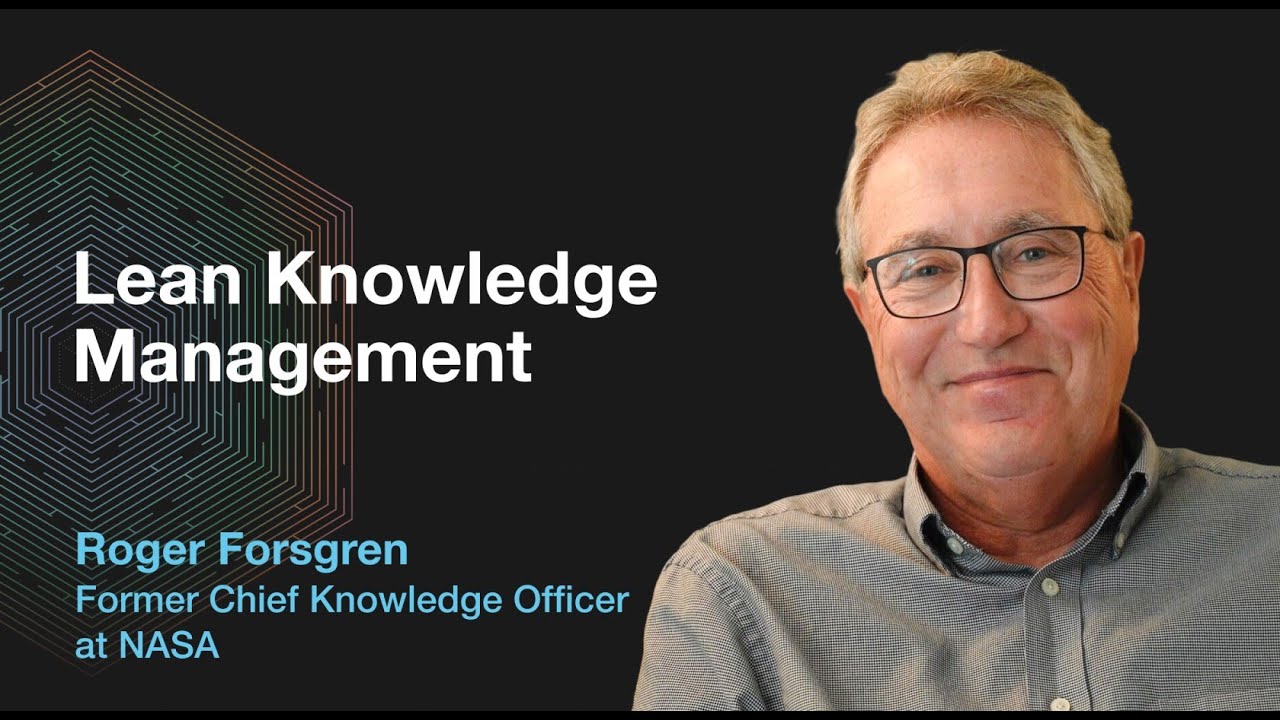
Roger Forsgren spent thirty-eight years at NASA—mechanical engineer to Chief Knowledge Officer—and wrote Lean Knowledge Management: How NASA Implemented a Practical KM Program. In S3E14 he joins Robb Wilson with guest host Mike Lee (food futurist, NASA nerd, author of MIE) for a conversation on why successful knowledge management rarely gets credit, why engineering math is rarely the failure mode, and how lean KM changed NASA culture after Columbia.
Mike Lee previously joined Invisible Machines solo in S2E13; his futurist work lives at The Future Market. For the graph-native knowledge layer Sudhir Hasbe argues agents need now, see The Graph Is Your Cortex and the S7E13 transcript.
Three Rules That Actually Work
Forsgren arrived overwhelmed by academic knowledge-management theory. What stuck was lean and practical—three principles Robb Wilson recognized immediately as UX philosophy:
Don’t boil the ocean. NASA is enormous—18,000 civil servants plus roughly 60,000 contractors. Forsgren focused on the technical workforce: the people designing the James Webb Space Telescope, machining flight hardware, doing the engineering that is the agency’s bread and butter.
Pick who it’s for. Not knowledge for everyone—a specific persona, a specific team, a specific mission context.
Find the critical information. Not all information at NASA—just what that audience must know to decide well. Measure whether they got it; iterate from there.
That discipline—bounded audience, critical slice, start small—is the same instinct Sudhir Hasbe names as feature reduction for agents: don’t dump a million tokens; deliver the governed slice that matters for this task.
Under the Chief Engineer
After the Columbia tragedy, Congress and the president demanded change. NASA placed Knowledge Management and engineering training inside the Office of the Chief Engineer—the Yoda figure who holds final say on human spaceflight. Forsgren reads that placement as signal, not bureaucracy: upper management treating KM as mission-critical, not a library side quest.
The culture shift included a dissenting opinion policy: if you see a problem on a human-rated project, you have a moral obligation to speak up—even when management pressure says go. Engineers were once rewarded for taking off the engineering hat and going with the flow; post-Columbia, the obligation runs the other direction.
Smart People, Bad Decisions
Forsgren’s most useful—and terrifying—frame: Challenger, Columbia, and the Hubble mirror were almost never analytics failures. NASA’s math was fine. Failures were human decision-making under pressure—variables the decision-makers did not weigh, incentives they did not see, voices they did not hear.
Knowledge management at NASA, in his telling, is less about storing documents and more about making those human failure modes legible before launch day. Case studies work because engineers learn by putting themselves in the chair: Would I have said go?
The Mars Climate Orbiter Lesson
The billion-dollar Mars Climate Orbiter loss is knowledge management on steroids: one team at JPL worked in English units while Colorado built to metric. Trajectory corrections looked wrong; nobody caught the unit mismatch until the probe sailed past Mars. Forsgren uses it to argue that disasters are often miscommunication—emails misread, assumptions unstated, languages (literal and organizational) out of sync.
Lean KM cannot eliminate human error—but it can train teams to treat precision in communication as engineering discipline, not soft skills.
Return on Mission Success
Knowledge management shares training’s curse: success looks like nothing happened. The International Space Station—$120 billion, decades of multinational coordination—works so reliably it barely makes news. Forsgren could never walk into a budget meeting and claim he saved $3 billion with a course; instead NASA measured return on mission success—project managers reporting that forum attendees returned more motivated, wrote clearer technical email, or communicated risk more honestly.
The ROI is the absence of problems—which makes KM eternally vulnerable in budget cycles until something breaks. Forsgren argues the ISS proves the subtle layer works even when it is invisible.
Push, Not Just Pull
Forsgren rejected compulsory training. Forums and courses were voluntary—and consistently filled—because they were engineered to be interesting: case studies, guest chief engineers on the ninth floor at headquarters talking face-to-face with shop-floor engineers, pushing knowledge into the organization instead of waiting for someone to search a repository nobody trusts.
That push mindset anticipates today’s agent debate: answer the question before it is asked by building curriculum and governed context—not operating an open-ended help desk over an uncurated corpus.
The Fifth Year: Communication, Critical Thinking, Ethics
Forsgren hosted engineering-school deans and asked: if you had a fifth year, what would you teach? Unanimous answers: communication (engineers are notoriously bad at it), critical thinking beyond the math, and engineering ethics.
He walks through case studies—Ford Pinto cost-benefit on human life, Volkswagen Dieselgate software designed to fool emissions testers, Albert Speer’s moral abdication as Nazi armaments minister (Forsgren’s essay The Architecture of Evil). The point is not melodrama—it is that brilliant engineers without ethical backbone can prolong harm at scale. AI raises the stakes further: the same discipline that kept Speer’s spreadsheets flowing can now automate deception.
Lean Means Saying No
Even inside NASA, teams arrived with seductive search experiments—custom engines that beat Google on obscure German university PDFs but required four programmers per query. Forsgren’s lean answer: come back when the product is mature and serves the technical workforce without a entourage. Libraries wanted funding too; lean KM stayed focused on engineers, not every knowledge-adjacent constituency.
That filter matters now as enterprises bolt RAG onto everything: curation and audience discipline beat heroic retrieval demos that cannot survive contact with real operators.
AI, Fluid Knowledge, and Forsgren’s Warning
Mike Lee closes the arc toward a generation that expects knowledge to erupt from a box instantly. Forsgren is excited and wary: AI can facilitate lean KM’s human labor—but still needs human judgment to filter outputs. Apollo was designed by hand before fax machines; today’s tools are exponentially more efficient—and exponentially more dangerous without ethics and bounded context.
Robb connects the dots to SpaceX’s launch cadence: success breeds overconfidence; the hundredth flight is when you study the program hardest. Knowledge management is the institutional immune system against that drift.
Why It Belongs in the Knowing Before Doing Cluster
Forsgren’s NASA program is the institutional ancestor of everything Sudhir Hasbe argues in S7E13: know the critical relationships before agents act, govern knowledge for a specific workforce, measure mission success not demo applause, and treat human decision traces as first-class data. Graphs are the technical substrate; lean KM is the organizational discipline that keeps the substrate honest.
Watch S3E14 on YouTube · Mike Lee’s S2E13 episode · Open the full ideation cluster