This might be hard to imagine if you weren’t there, but in the 1960s and early ’70s, many American airports had kiosks and vending machines selling flight insurance. Companies like Mutual of Omaha, Tele-Trip, and others installed coin-and-bill-operated machines near boarding gates and ticket counters. Passengers would fill out a card naming their beneficiary, feed it some coins, and the machine dispensed a policy that paid out if they were killed or injured as the result of a crash (and expired as soon as the plane landed safely). These days, airline accidents are rare enough that grim novelties like this no longer exist.

The transformation of the U.S. commercial airlines’ safety and reliability is the result of numerous factors, such as improved pilot training, new, more reliable manufacturing and assembly processes, as well as advances in instrumentation, and air traffic control systems. In large part, however, this unprecedented increase in airline safety is due to knowledge sharing efforts such as the Aviation Safety Reporting System (ASRS).
With artificial intelligence quickly emerging as a tool that can enable Knowledge Management (KM) systems to sift through and sort enormous amounts of data, organizations would be wise to heed the real, meaningful lessons needed to make KM a useful and cost-saving endeavor. But before investing in AI, one needs to approach the question I am often asked: Does knowledge management actually work?
It’s an appropriate question. Is KM the productivity and safety boost its proponents claim, or is it just another “flavor of the month” like ISO9000, six sigma, and agile/scrum project management that becomes widely hyped, implemented, and then forgotten? As I mention in my book, Lean Knowledge Management: How NASA Implemented a Practical KM Program, the problem with KM is that its success rate is very hard to quantify:
When a mistake happens, everyone hears about it. When a mistake is prevented, it goes unnoticed. KM works in the background. It’s like in an old Cold War movie where the hero secret agent, working anonymously and behind the scenes, prevents the outbreak of World War III, and despite saving humanity, no one ever hears about his crucial actions or recognizes his contribution.
But then I discovered a fantastically successful KM program that every single American has benefited from, ASRS.
On December 1, 1974, Trans World Airlines Flight 514 took off from Columbus, Ohio carrying a flight of holiday travelers heading home to Washington D.C. after their Thanksgiving holiday. During midflight, the pilots were notified that National Airport was closing due to snow and high winds and the Boeing 727 was diverted to Washington Dulles International Airport.
Because of near blizzard conditions and their unfamiliarity with the landing approach required for Dulles, the pilots asked air traffic control to help line them up with the runway. From their maps the pilots and flight engineer knew they were in a rugged, mountainous area and had to maintain an altitude of at least 1,800 feet as they approached the airport. When a flight controller radioed, “Flight 514 you are cleared for approach” the pilots, by now nearly blinded by heavy cloud cover, assumed air traffic control had them under a radar-controlled approach and that they were beyond the mountains. As they began their final descent, Flight 514 crashed into the Blue Ridge Mountains at Mount Weather, Virginia, almost twenty-five miles from the airport. All eighty-five passengers as well as seven crew members were killed.
The National Transportation Safety Board’s (NTSB) accident investigation ultimately blamed the crash on a lack of communication between Air Traffic Control and the TWA pilots. The board also learned that several weeks prior to Flight 514’s crash, a United Airlines plane had narrowly escaped the same fate while approaching Dulles.
The NTSB dug deeper and upon investigating the United Airlines near miss, the board discovered that United had documented the incident within an internal reporting system. United developed and maintained a proprietary database that alerted United pilots and employees of potential problems. Airline employees voluntarily shared knowledge concerning any safety issues they had encountered in the hopes of increasing overall safety for the airline.
In their final report concerning the Flight 514 accident, the NTSB recognized the value of United Airlines’ internal safety reporting system and lamented the fact that such a system was not in place for the entire airline industry.
Lessons from the Past Lead to Knowledge Sharing: The Aviation Safety Reporting System (ASRS)
Upon discovery of United’s in-house reporting system, NASA and the FAA signed a memorandum of agreement in August of 1975 to develop and operate the Aviation Safety Reporting System, which was based on the United model and whose purpose was to identify and correct safety issues before they became real problems. The ASRS would cover almost everyone utilizing American airspace, including all employees within the commercial airlines industry such as pilots, flight and maintenance crews, and ground support personnel. The voluntary self-reporting of potential or real problems would guarantee anonymity as well as immunity. NASA would be responsible for managing and operating the new safety system and the FAA would provide funding.
How ASRS Works
Pilots as well as other employees can submit anonymous reports concerning safety issues caused by themselves or others without any fear of reprisal from their employer or punishment from the FAA. These reports are gathered and categorized by NASA. The FAA reviews the reports and compares them with other information systems such as flight recorders and previous ASRS submissions. If a problem is recognized, the FAA can send a warning and guidance to airlines, pilots, or other relevant support staff.
The aviation community has moved away from the “forensic” approach of making safety improvements based solely on accident investigations to a proactive strategy that incorporates a mix of actual flight data, data from other government agencies, and voluntarily submitted information from airline employees.FAA Website
Tragically, America’s remarkable history of commercial aviation safety ended at 8:47 p.m. on Wednesday, January 29, 2025, when American Airlines Flight 5342 struck a U.S. Army Blackhawk helicopter midair while attempting to land at Washington D.C.’s Reagan National Airport. All 67 passengers and crew aboard the American Airlines flight perished, as well as 3 servicemembers aboard the helicopter. It was the first fatal airline accident in 16 years and during that time, almost 11 billion passengers safely flew within domestic airspace on U.S. commercial airlines. This statistic becomes even more impressive when one considers there have been more than 100 million flights in that timeframe. The ASRS and voluntary reporting has played an important role in America’s impressive commercial aviation safety record.
Publication of CALLBACK
ASRS educates the aviation public and promotes its services through its free monthly newsletter CALLBACK. This online platform has more than 35,000 email subscribers and generates more than 450,000 annual views. It highlights some of the more interesting submissions pertinent to anyone involved in air travel.
The ability to create a voluntary and open environment permitting a practitioner to candidly report a problem can best be seen in CALLBACK’s “Part 91 — A Hazardous Oversight,” where an anonymous private pilot described the lessons learned from forgetting to remove his plane’s towbar. Such a refreshing frankness and willingness to share a serious personal mistake of this magnitude demonstrates the effectiveness of ASRS’ voluntary program.
A Tangible Example of the Value of Knowledge Sharing
One of the major challenges in launching and maintaining a knowledge management program is providing concrete examples that demonstrate the value gained from gathering and sharing knowledge outweighs the program’s costs and efforts for an organization. Knowledge Management is often viewed as an inconspicuous program that improves safety and reliability while operating in the background through training and cataloguing lessons learned. However, the ASRS is a definitive and quantifiable example of how knowledge sharing can improve not only an organization’s efficiency, but more importantly, its overall safety. The knowledge management approach of ASRS has helped create an unprecedented level of safety within American airspace and, because of its sheer size and the magnitude of its influence throughout the airline industry, may be described as one of the largest and most effective knowledge gathering and sharing efforts in history. It’s not hyperbole to suggest that through transparency and open communication, ASRS has helped change an entire industry’s safety culture.
Currently, more than ninety-five U.S. air carriers and supporting organizations belong to ASRS. From 1975–2022 there have been almost 2 million submissions. In 2022 the ASRS averaged approximately 387 individual submissions per day.
The U.S. Air Force has a similar program called the Airman Safety Action Program (ASAP) and the Air Force provides its air crews a convenient mobile app for making submissions. Since the program started in 2009, there have been more than 7,500 ASAP submissions.
A variety of healthcare industries have also looked into implementing programs similar to ASAP. California Kaiser Permanente ran a trial program in their hospitals and, although they had difficulties getting physicians to participate, probably due to potential malpractice claims, the program “…captured novel errors, provided a safe space to report those errors, and encouraged secondary insights into causes of the errors.”
So is knowledge management worth it? You could easily argue that flying is the safest mode of travel within the United States because of it.
Watch the episode
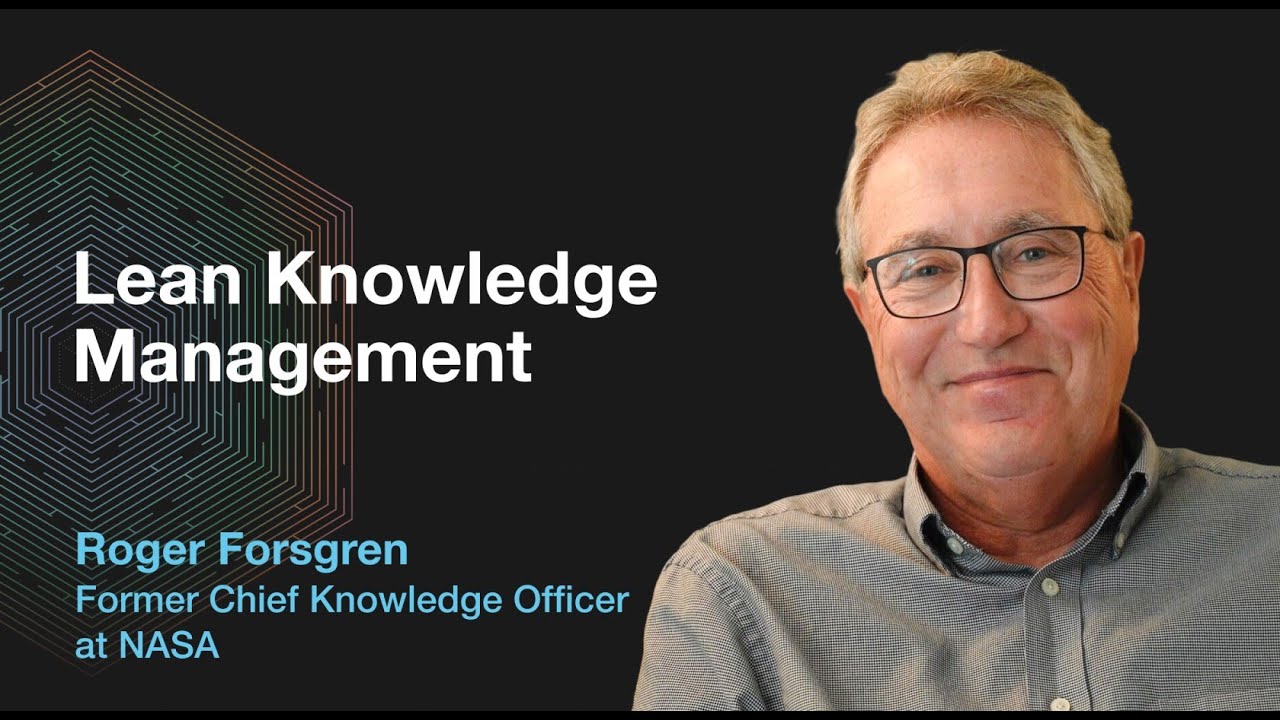
Roger Forsgren joined Invisible Machines for S3E14 on lean knowledge management at NASA—with guest host Mike Lee.
Invisible Machines · Roger Forsgren · S3E14 · Open on YouTube ↗