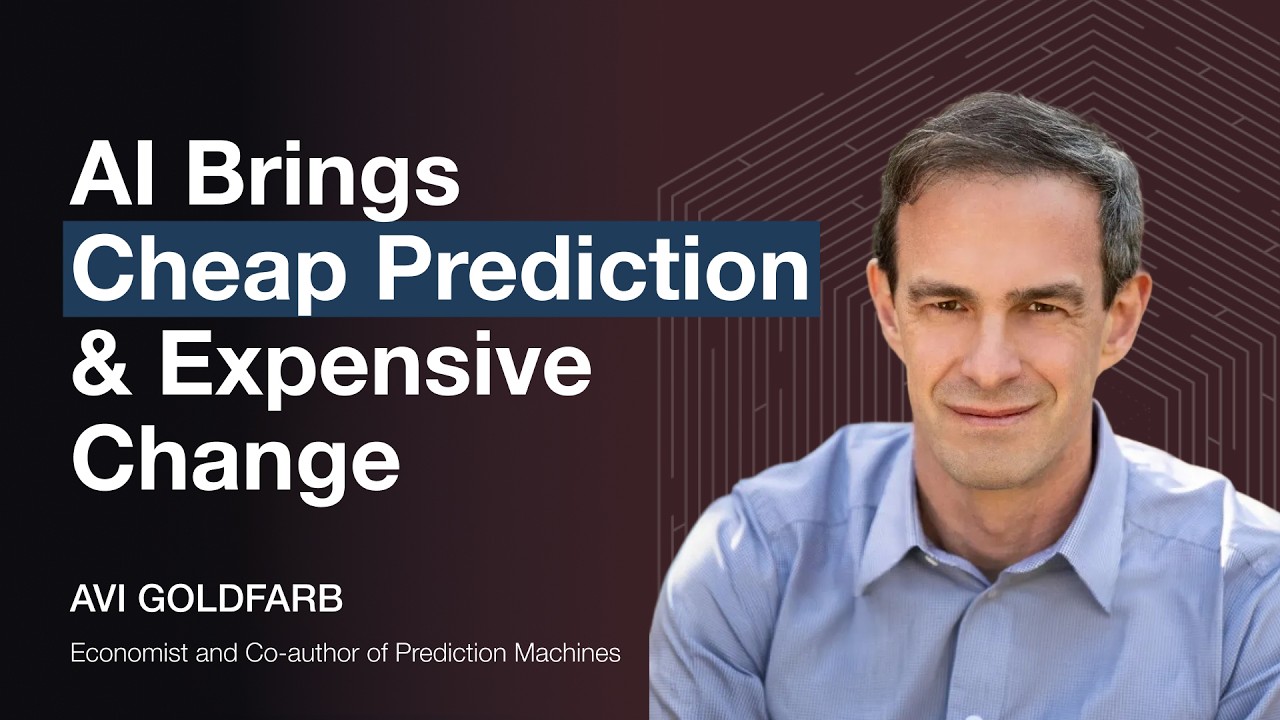
Most organizations are still implementing AI as point solutions, dropping new technology into existing workflows to do the same work, just slightly better. The real value lies in system solutions that completely transform how organizations operate. Avi Goldfarb, economist and co-author of Prediction Machines, joins Robb and Josh to explain why AI adoption follows predictable economic principles and why internal resistance, not technology limitations, is often the primary barrier to transformation.
This conversation, recorded back in 2023, reminds us that most organizations continue to struggle with the same issues surrounding systemic change in 2026. Goldfarb’s core argument: AI is fundamentally cheap prediction. Just as the internet made search, copying, and communication cheap, AI drives down the cost of filling in missing information—whether that shows up as drafting prose, suggesting code, or estimating risk. When something becomes cheap at the margin, standard economics says we do more of it—but it also shifts where value pools.
The puzzle Goldfarb keeps pressing on is complements: when prediction commoditizes, what becomes scarce and valuable alongside it? Sometimes the answer is boring infrastructure you still have to buy—compute sold by cloud giants can remain a durable business even if particular models face downward price pressure. Sometimes it is distinctive data with a short shelf life that lets you build a model others cannot trivially clone. Often it is human judgment—deciding what prediction is for, whether to trust it, and how to redesign the workflow around it.
He refuses the fashionable conceit that we suddenly need “a new economics.” When prices shift sharply, standard intuitions still work; what matters is naming what actually fell in price so teams stop debating vibes and start debating reallocations. In conversation he repeats an analogy leaders often underestimate on day one: for millions of workers, writing has never been the whole job, yet fluency quietly gated promotions and credibility in adjacent domains where prediction matters far less than drafting competence ever suggested.
Cheap drafting turns writing into less of a hard bottleneck for those upside careers without magically handing executives fully-formed judgment about markets or incentives; likewise cheap coding accelerators reward operators who know where fragile integrations hide inside messy realities.
That is partly why Goldfarb is impatient with adoption metaphors that only tally displaced specialists instead of counting constrained complements freed up for marginal hires who suddenly compete beyond grammar polish alone.
In the episode, Goldfarb distinguishes two adoption paths that sound similar on a slide but behave differently in politics. A point solution swaps machine labor into an existing process you already understand. It is easier to explain, easier to approve, and unlikely to threaten anyone important: you did what you did before, only a little cheaper. A system solution asks what becomes possible when prediction is abundant—new products, new routes through a supply chain, new definitions of what your firm sells. That is where upside concentrates—and where losers appear inside your own building.
His insurance example is deliberately mundane because it is structural. Underwriting has historically been the power center: pricing risk is the core competence many insurers organize around, and that is where prestige and talent accumulate. Better prediction could extend that story—or it could pivot the business toward reducing risk (sensors, interventions, faster repairs) rather than only pricing it. Risk reduction is not a tweak to the underwriting deck; it drags in behavior change, marketing, service design, and cross-functional coordination in places those muscles were never built to carry institutional weight. Underwriting may perceive its centrality shrinking even when executives agree the strategy should move.
Goldfarb is sympathetic but blunt about incentives at large incumbents: tying customers across products, defending regulation that favors legacy models, and funding dozens of small pilots can all function as containment strategies when the alternative is reorganizing who wins. Startups exist partly because incumbents cannot absorb unlimited internal losers—even when everyone sees the technological promise.
The harder lesson for practitioners is timing and sequencing. Goldfarb echoes classic disruption trade-offs: betting early on self-disruption can waste money if the wave arrives decades late; betting late leaves you buying your way out at a premium. Under patient leadership, though, many system shifts still arrive as sequences of point experiments—the trick is picking pilots that fit both the old workflow and a plausible future workflow so you are not learning twice.
For leaders evaluating AI investments, the question isn’t only whether to adopt models with better benchmarks. It is whether you are willing to pursue system transformation and confront the organizational disruption that creates real value—and whether your roadmap trains complements (people, data, incentives, and narrative) rather than decorating an unchanged machine.
Listen on the podcast hub, or watch it on YouTube.