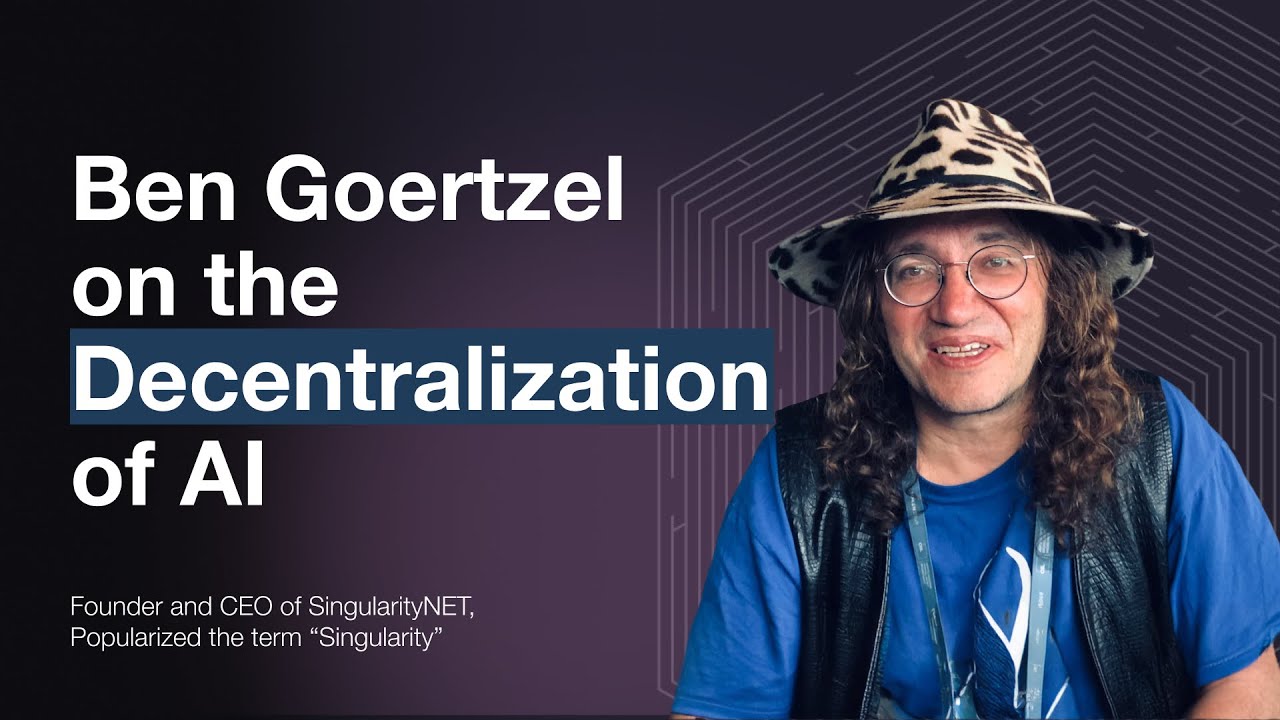
For the companion UXM essay spun from this conversation, see Decentralized AI is the Future.
Transcript
Speaker labels and timestamps follow the source transcript. House style for new episode transcripts: strip standalone backchannels and filler (e.g. “Mm-hmm,” “Yeah,” bare “You,” laugh-only lines, and similar) while keeping any turn that advances the argument; light edits may apply for readability.
All right. We can just even jump right in. Ben, it's nice to see you again. You know, we think of you often around here. I think most recently, like with all the excitement around MCP and A2A, it occurred to us that like these are things that have been modeled and existing in SingularityNet for a long time. So maybe we could talk a little about that, just things changing in AI and of course,
Yeah, I mean...
I know there's a lot going on in your world, so if you could even bring us up to speed, that would be exciting.
Yeah, I mean, of course, MCP is perfectly useful tool and the, I mean, the best thing about it is many parties have adopted it, right? mean, that's, as they say, the nice thing about standards is there are so many of them, right? I mean, not designed MCP, maybe exactly the way I would have, but the fact that it's there and people are actually using it is certainly
Yeah, they're talking about the right things. yeah, just not a sophisticated, and I guess maybe that's okay, but not a sophisticated first start.
Well, getting people to actually use an interagent protocol, you know, is kind of a miracle, right? So it's super interesting. And these sort of things can expand and grow so fast now, right? Which is quite remarkable.
Isn't it crazy? Yeah.
Yeah, think, you know, I can't help but unsee what you guys did a long time ago, right, which is handling reputation and transactions and, you know, like all the pieces that really need to come together to make it sing.
Yeah, we're certainly still rolling. I mean, think MCP is good. This sort of transformation of the internet into a kind of AI agent system was inevitable. And it's super interesting to see it finally happening, right? I think, however, as you elude the precise ways it's happening,
and what it means.
certainly could. could use some improvement, right? And we've been thinking a lot about how to do that. So I would say there's two big directions to my work at the moment, which is sort of centered on two overlapping but distinct software systems. So one is Hyperon, which is the successor to OpenCog. And that's a framework for AGI for in neural symbolic evolutionary AI and how to make different AI paradigms all work together. And our team is doing a lot of work on just improving how neural nets work as well as on integrating them with symbolic reasoning and evolutionary learning. that this is about how to make AGI and we're at a very exciting place there because we're emerging from a couple of years spent.
on building tooling, right? we now, like we now, we designed a new AGI programming language, Meta, M-E-T-T-A, which then Facebook changed their name to Meta two months after we announced it. decided not to be intimidated and we kept the name. M-E-T-T-A is a Sanskrit word for loving kindness as well. it's a Meta meaning to Meta. But anyway, we got within the last
Mm-hmm, saw that.
month and a half, like a fast compiler for this new language of ours. And we've got what's called the distributed Adam space, which is like a massively distributed version of the underlying knowledge metagraph. So we've like finally got all our infrastructure working at scale for hyperon, which is exciting. Now, on the other hand, there's something called the ASI chain.
which we've been working on with our colleagues in artificial super intelligence alliance. And I mean, kudos and fetch, but largely within Syncularity. And this, we've launched the DevNet for like an early developer version of it. The test net will be early next year and then main net after some testing has been done. this is really an attempt to do the...
Uh-huh.
decentralized AI slash AGI slash AX economy correctly, right? And sort of building on what we learned from SingularityNet, what was learned from Fetch, what we've learned from looking at DynamicTow and other blockchain tools. So we've been trying to do the decentralized multi-agent AI thing the way we should have done it back in 2017, but we were too ignorant to do it back then when we...
And there's some interesting overlap between Hyperion and ASI chain, like the meta language that we're the API programming language is also a version of the smart contract language for the ASI chain, right? And then to store the knowledge metagraph that stores all the knowledge in a Hyperion system, we're using a repository called Mork, the meta optimal reduction.
We haven't figured out what's the corresponding MINDY for MORC. There's going to be something, right? But the MORC repository is being used as the DAG inside the block DAG representation in the guts of the ASI chain. So we've found a lot of common infrastructure between what we need for the
There has to be.
sort of decentralized blockchain infra for AGI and what we're using the actual tools to build the AGI thinking, which is quite cool. But these tools are now, I mean, they're coming together. We can write programs in our funky language and run them on a billion nodes and links and run them across the, so like the next year should be very, very interesting. I mean, I don't want to.
Thank you very much.
That's amazing.
overstated, like we don't have like a torch or visual C++ style tool chain or something, right? But we do have scalable robust versions of the language and database and distributed processing framework and so forth. And so what will happen during the coming year is we will be trying to scale up all of our prototype.
AGI, while at the same time trying to build some more robust tools so more different people can plunge in and help with development. yeah, it's coming at an interesting time because I think the world is starting to realize, A, that LLMs are really cool, but bigger LLMs don't give you AGI quite, though they may obsolete a lot of jobs, even so.
It's amazing.
Most of our jobs don't require that much general intelligence, And then B, the idea that having big tech and big government-owned AGI may be problematic is no longer as obscure or niche a point as it was in 2010.
man, that's what I wanted to talk you about. in the day, I felt like one of my biggest concerns was democratization of AI, that the larger companies with money were going to dominate. And now I feel like the opposite is happening. Like I couldn't have been more wrong. It's so grassroots. Every employee is adopting while companies are slow to get off the ground and consumers are adopting it. That's where all the money is.
And I'm like, wow.
Yeah, but the big models are still being built by big tech, right? And they're opening things up in a way that's designed to direct developer and user communities toward their tools.
True. True, true.
Yeah, like MCP, yeah. Like the way it was designed is to put them in the middle, right?
So it's very interesting dialectic, which you would say reflects a similar dialectic in the internet as a whole, though, right? I the internet is sort of poised between openness and hegemonic domination, right? And you have this tent. I mean, there's Linux, which is open. There's...
There's GitHub, is beautifully open and democratic and owned by a big tech company, right? So, mean, so there's, that tension has been there in the internet, as you see in like net neutrality arguments and so on. So I would say that, yeah, the modern AI ecosystem has sort of inherited that tension from the internet as a whole, I guess because it's a tension in like the collective psyche of that.
True.
of the modern species, right? I mean, we can't decide, do we want to be anarchic, open and decentralized, or do we want to hand over control to some strong man and his personal army of geeks?
Well, there's such like a philosophically different approach, I think, to like we had Karen Howe on the show and, she, she talks a lot about this idea of AGI being central at OpenAI, but there's no shared definition of it. You can ask 12 people and you'll get 12 different ideas of what it's supposed to be. And yet they're positioning it as a race that they have to reach first because they're the only ones responsible enough to do whatever with it, contain it, use it, share it with us. But, but your approach.
I mean, I don't know that they can make that story about responsibility stick very well at this point. I mean, Anthropic is perhaps pushing that greater responsibility story slightly more.
Yeah, like how was your, go ahead.
But has your view of what AGI is, I don't know if you'd say meant to be, but like what it could be, what it's supposed to be, it remained at all steadfast over the years or is it something that is in flux in your mind?
sure. mean, so the concept of AGI, which was proposed in the book I published in 2005 entitled Artificial General Intelligence, which is the map in the first place 20 years ago, amazingly. I mean, the concept was one I'd had. for a long time before I associated that word to it. And it's really a fairly general mathematical notion. mean, a general intelligence is a system that can generalize really well beyond its experience and its programming. And you can measure that formally. You can write nice equations for it. No. That's a broad concept, right? And others have very not like Marcus Hooter in 2005. Also, I think he had a book, Universal AI, where he tried, he tried to explore mathematically how would you build very, very powerful general intelligence. My friend Weaver much later, 2015 or something, had a PhD thesis at Free University of Brussels on open-ended intelligence. And that was taking a somewhat different...
take on it, but within the same kind of cloud of ideas. The thing is these broader interpretations of AGI, they're not about any particular level of general intelligence, right? So from that standpoint, human level AGI is a somewhat arbitrary milestone and
That's it.
So I think the definition of what is a human level AGI is intrinsically weird and fuzzy. the thing is the definition of AGI in general is a very broad mathematical thing that it is useful for designing AGI algorithms, but it's not necessarily useful for
precisely defining like measurements of general intelligence. I mean, I don't want to get too mathematical, but if you look at a version of the definition like Marcus Hutter and Shane Legg, Shane being my former employee from the late 90s who went on to co-found Google DeepMind, right? So, I mean, he wrote his PhD thesis on mathematical definitions of general intelligence.
at the Dalamal Institute for AI in Lugano, Switzerland. His definition is not the be all end all, it's, he basically looked at general intelligence as the ability to achieve computable reward functions in computable environments. So it's like, you average over all possible goals over all possible environments to see how well could the system do with that, right? And that's a well-defined math object.
huh. Any other?
But then you have to weight the goals and environments somehow, right? And then you can prove some theorem that it doesn't matter how you weight it in the long run. Like as things go toward infinite general intelligence, how you weighting the goals doesn't matter. But we're concerned with a specific reality here now, right? So if you take that kind of definition, like you could choose one weighting over goals and environments that make dolphins look smarter than people. Choose another that makes...
that makes people look smarter than dolphins. You could probably find one that makes Donald Trump look like the genius he says he is, right? So, I mean, so the general theory of AGI is solid and we're using it inside our theoretical work, but it doesn't necessarily do what people want it to, which is like tell you exactly when has the system passed the human level of AGI. I mean, that's sort of like...
I'm sorry.
asking like one has a robot pass a human level of fighting ability or something, right? Like, I mean, you can be a boxer, you can be a kickboxer, you can define mixed martial arts by a variety of different rules. You could say all that's bullshit because a street fighter can pluck somebody else's eyes out, right? Like, who's, I mean, who's the fighter is not really that well-defined. It depends on how you're figuring the rules. And are you allowed to use weapons, right?
Are you fighting underwater? Then the best swimmer is better off. I mean, that doesn't mean it's meaningless to say one guy is a better fighter than the other. just means to try to pin it down. You're inevitably making a bunch of arbitrary choices.
Sure, like punch a robot, you know, see what that feels like. You know, it doesn't have to do anything. Just stand there and punch a robot and break your hand.
Yeah, or just let out some electromagnetic shock you did after. You thought you were choking the thing and then turned out the high voltage. Yeah, so what's happening now, I think, as we get closer to human level AGI, which is a funny thing, just like human level fighting or human level songwriting or something, right? As we get closer to human level AGI,
That was good.
It was like great.
Of course, different parties are trying to reconstruct in ways that make themselves look better than everybody else, which is an aspect of human intelligence itself. Sam Altman, who's done great things for AI and the path to AGI, he wants to say, well, if an AI can do 90 % of human jobs or something, then it's a human level general intelligence.
Indeed.
That's a reasonable milestone. Clearly it doesn't capture what I meant by human level AI. I mean, in a paper I wrote in 2008 or something, I gave a math formula for what I called the breadth of an AI. And that sort of means a broad AI is one that can do a whole lot of different things, right? It doesn't have to be to generalize a lot to learn to do new things.
It just has to be able to do a lot of things. In that sense, would say, chat GBT is more of a broad AI than is an AGI, because it can do a lot of but it can generalize beyond its programming and training interestingly well, not astoundingly well. So within the math theory of intelligence, you can draw these fine distinctions.
in the public domain, of course, it's very hard to get things across at that level of detail. I would say the problem with doing 90 % of human jobs as a measure of AGI is you're just leaving out the 1 % of human activity that advances science and culture and technology, right? I mean, yeah, 90 % of jobs maybe rote repetition of what other people have done before.
And even 90 % of what I do every day, maybe wrote repetition of what other people have done before. But it's that little bit of human achievement that is not that, which enables new genres of music to be created, new branching to be created, blah, blah, blah. So mean, if you're saying 90 % of what humans do is AGI, well, it's interesting, but it's kind of missing.
Exactly. Alright.
because it's a very important subject.
Yeah, it's missing the humanity. it just shows us how lost we got. So one thing that was interesting for me, I always connected more to the singularity side versus the AGI side. just think the concept that things are connected and things are like that AGI is more of a perception of the system, but the system is really highly distributed. A lot of specialists in the background. And to like an end user, it appears to be like a single intelligence system. But in earnest, it's just a collection in a community. And I'm still really connected with that. I find it more practical to think about singularity than AGI. I don't know what your thoughts are.
Yeah, I mean, neither of them is that precisely defined of a concept, I because the notion of a technological singularity is that at some point the rate of progress becomes effectively infinite from human perception, right? if they, like if, you know, if
New updates to your phone occur every five seconds. The rate of factor is utterly your ability to comprehend what's going on rather than the improvement of the technology. if, mean, if your smartwatch is making a new Nobel Prize winning discovery every minute, then, like the rate of science and tech advance with transformative implications appears infinite from our point of view, right? Because
revolution within each thought cycle that we have or something, right? I mean, that's That's sort of Kurzweil's singularity notion. And it's pretty much the same as the concept of a super intelligence being rolled out across our society, right? Because once you get beyond AGI, once you get a very, very, very smart AGI, much beyond the human level, which is what an ASI, I mean, then, then, I mean,
In a math sense, it's just a higher level general intelligence than we have. In a human sense, mean, having something that much smarter than us is a different sort of transformation, right? And it's interesting to think about how we might perceive that because like, of course, if we have a brain chip plugin or other sorts of upgrades, then our perception may speed up. So what would look like a singularity to a legacy human could just look like life to an individual.
human whose perception is suitably accelerated, right? But then that enhanced human, in what sense is that enhanced human actually a human, right?
Bzzz
Yeah. When you, when you think about like, go ahead, Rob.
Yeah, I always think about that. I was just gonna say I always think, like, I'm, you know, we're gonna put myself in the shoes of like, if my, my buddy and I were driving, we were on a long drive, you know, and he was saying, Oh, I'd get a chip in my head for sure. And I was like, I was like, I wouldn't talk to you anymore. If you did. What's that?
Well, whoever gets it first, whoever gets it first, everyone else will get it after all their friends have gotten it, right?
Yeah, but I was like, I'm not going to talk to you once you like, may as well just put your phone up here and turn Siri on and walk away. Like I don't want to talk to your phone. I don't want to talk. I want to talk to you. You know, not not some, some system you're connected to. I think there's like a practical, realistic human component that says like, do it. Do we really want this? Like, is this really where we're going? Like I can understand if you can't
if it brings you up to human level, right? you have an issue that, you know, where you... But do we... I find it hard to imagine that the humanity will be entertaining to us, to interact with somebody who's just Siri, an LLM.
I think that's kind of just because we're old people basically. I think like my seven year old son, he's frustrated sometimes interacting with me if I don't have my phone. He even asks me questions. How many times its weight can a rhinoceros beetle lift or something, right?
Maybe.
Claude or Google or something there. I'm ignorant in answering that question and he's frustrated how stupid I am. I would say he's already used to being enhanced by online search tools, right? And he doesn't consider that as not being me. He just figures that's part of my function is that I'm really good at using these online search tools to rapidly get him the...
Ha ha ha ha.
the information he wants, right? And I mean, you could look at it like glasses. Like if I don't have my glasses on, my friends and family may become annoyed that they point out some beautiful bird up in the trees to me. And I'm like, what tree, huh? I mean, I think all these things are a very slippery slope and we're good at sliding down them.
I mean, the speed of advance is the tricky thing, right? Because if it happened like a small advancement to thinking one guy gets it, then some others copy and get it, then before long everyone's got to join in, then another advancement and it goes through society gradually. And that's basically how things have happened. And so then each advanced technology feels very natural to each generation, right?
Yeah. Yeah, maybe I just can't see the UX in it. Maybe like there'll be a light on our forehead that'll turn on when you're accessing the chip. So I know when I'm talking to the chip or you.
But there won't be because you'll always be accessing the chip.
So the light, you look like Rudolph, the light will just always be on.
Yeah, would imagine. mean, like you can see when someone's wearing glasses, you can't see when they're wearing contact lenses unless you look really close. once, I mean, once you have that enhancement, doing without it would be just, that'd be like, sometimes I prefer to turn the GPS off and just drive the old fashioned, but that's.
That'll be blinking.
like a particular thing to do, which all young people think is very eccentric, right? Because in general, like you have a Tesla, the GPS is just there on the dashboard or various other modern cars, right? I mean, turning it off doesn't really give you any advantage except giving you an extra challenge if you want it. Like it just makes you more functional, right? So I think that's the direction we're going.
The new thing is really the speed with which these things will unfold, right? Because the ways that we live now would be considered wildly unnatural by Stone Age people or even like, you know, the guitar player Django Reinhardt for the middle of the last century, he grew up a gypsy and he couldn't read. He couldn't deal with hotels because he just couldn't tell one room from another.
Please.
Like all the markings on the doors looked the same to him. You couldn't read the numbers. So he preferred to just camp out in the grass in front of the hotel, which is what he understood. Like to him, living inside a box was just fundamentally unnatural and fucked up and he didn't want to deal with it. And in sort of the same way that you think putting a chip in your head is fundamentally weird and unnatural. Like he looked at sleeping indoors that way.
Right? Because that was just, it's not how he had grown up. Even in the middle of the last, like 1930s or something, because he had grown up as a gypsy, right? nonetheless, he learned to play the electric guitar for the end of his career, right? So I mean, for music, he was willing to sort of deal with the advanced technology, but like where you sleep just felt close to home, right?
interesting.
But what's new though is with the Singularity, like having advances come so very fast, there won't necessarily be time for the historically usual processes of adoption of new ways of doing things within a social network.
Yeah, yeah, I was thinking back, like a lot of, you know, a of your life was spent from my perception, kind of, you know, combination of building technology, but also bringing attention to the space, you know, that it just wasn't, you know, wasn't getting, it wasn't getting the attention that it deserved, in essence, in terms of its potential. and, you know, I think of Sophia and things like that, where it's like, trying to, to kind of
to gain momentum. And now I must feel like overwhelming like, whoa, we overshot the runway. Like, look at this.
Interesting. I mean, I think I've, I've spent way more of my time on technical work than on evangelism. But the modest amount of time I put into evangelism has has worked, right? So that's is interesting. Like, you, don't necessarily know going through life, like which of the things you do will catch on like that. I mean, like, of all the papers I published, the ones that are most
cited or ones just describing the concept of AGI. And to me, these are very shallow compared to a lot of much more interesting things that I've written down that may be critical to how to actually build AGI or something, right? But yeah, saying the right thing at the right time obviously is important. And what's interesting is in our generation, you can be way ahead of your time.
and wait a couple of decades and the world catches up. Like in previous historical eras, it took a couple hundred years or a thousand years for the world to catch up. But then you were dead before the world caught up. And now it's getting faster and faster. Like you can probably be way ahead of your time. And then like two years later, the world will catch up. And you can see that in industry trends also. Like there was always through the whole history of AI since the middle of the last century.
That's a good point.
Mhmm.
There's a pattern of AI summers and winters, right? Like you had 10 years when the funding would dry up, then there'd be five years and was back, then 10 years when it would dry up. I mean, the research kept going. If you look at the publication record, there's really summers and winters. There's just loads and loads of research. the amount of money people had to do research definitely went.
New sales.
It's me.
up and down a lot. then when there was less money, people published theory papers when there was more money. People did more large scale experiments. What we're seeing now, the AI summers and winters each last like six months. Like if you remember, Fall 2024, everyone's like AI is dead, no progress. And it was just like December of last year that we got 01 in the reasoning models and stuff from, right. And then
in the next.
February DeepSeek came out. Everyone's like, Nvidia's dead! And then like a few months later, people are like, oh well, no wait, people are still buying GPUs. In fact, they just have even more to do with them, because you now have cheap, open, large language models, which are not AGI. And anyway, right? And then people got depressed when GBT5 came out, because it wasn't
what Altman had promised, although GBT5 Pro is by far the smartest system ever created for doing technical things, right? Like there was some very smart stuff in there, but they apparently needed to make their consumer model run more cheaply. And so that didn't have the upgrade power that they had kind of needed it would have. So that brought an AI winter and that wasn't that long ago. So now we're waiting.
I know.
waiting for the next big release to come out, like, know, VO4 allow two minute long videos or something, and then people will declare an AI summer again, right? And so, the psychological pattern is the same, like, people over promise and under deliver, even though what they deliver is amazing, it's not quite as amazing as what they say. Everyone gets frustrated, they dump all their stock, then something else amazing.
Yeah, that's interesting.
Something else amazing is brought out, everyone gets excited. What's interesting now is the ups and downs are so fast, your project doesn't run out of money in the time period before it swings back up again, right? So the swings are not impairing progress as badly as they were even 10 or 20 years ago.
Extended.
Yeah. That's super interesting. Yeah, it's not that the AI winner isn't coming. It is coming and it's coming over and over and over again really fast and going versus the long.
It's like the graph of sine 1 over x or something that's going... That is the mathematical singularity, right? When the oscillations go so fast...
The seasons are shorter.
Yeah, we're like, fribulating.
and you can no longer see the peaks and valleys.
Yeah, we're gonna have like four AI winters in 2026.
Well, and then eventually you'll have four AM winners in one day and then you'll get the single. It will all be the AI trading bots that are going through them. Like we take these AI flash crashes for granted now and don't even bat an eye. Right. Like in a couple of months ago, mean, crypto had its largest one day drop ever. Right. And this was, this was after Trump announced these a hundred percent tariffs on China, which
Ha
All right.
That's right, yeah.
everyone knew weren't really going to happen. But then there was some cascading effect of AI bot to AI bot to AI bot that caused crypto to go down insanely badly in one day. And you know, we back up within a week or two. I mean, you would say in a few years that will happen within an hour instead of in a day, right? So it's like, wow.
I lost all my money while I was on lunch break. Fortunately, it's back.
Yeah. So there's something I've been meaning to ask you about for a while. I, in the day, I can speak for myself and say that I've been highly focused on human readable language for most of my journey. I'm not going to say that I didn't see coding as a thing, but I, I didn't, it wasn't until like three or four years ago that I really understood that the creation of machine readable language by these systems being so much more impactful or as impactful as language. was sort something that I had thought about, now watching them code, it was sort of like a missing piece of the puzzle I hadn't fully appreciated in the early days. I don't know what your thoughts are and how surprised you are at how good they are at this.
honestly, that surprised me less than how good they are at natural language, I think. mean, I think the facility at natural language is what has woken up the world to the idea that AGI is near because it's something everybody can see and do. So like that, even at the GPT-4 stage, the 3.5 even, The fact that these models could estimate how a human from any cultural background would ethically evaluate any action and be so accurate about it. mean, you could ask like, you know, what would a young Muslim professional in Islamabad or something think about this, you know,
business dispute in Silicon Valley between these executives who also have a personal relationship, right? And it will go through and it will tell you exactly what will be the ethical nuances of the judgment by the young Muslim tech executive in Islamabad. So that ability to get the nuances of human feeling and culture surprised me more than programming ability because Programming in the end is a formal domain and math is a formal domain. And so you're asking a computer to understand computer stuff like crudely speaking. And the training data is in the computer, right? Like there's so many computer programs to be crunched. Whereas the training data for human ethical judgment, in a way it's in natural language, but it wasn't entirely obvious to me.
how easy it was to milk it out of natural language versus needing video surveillance and observing how people actually judge things in life. mean, in hindsight, can see, like none of us had a good intuition for what happens when you just feed like web-scale data into pattern recognition systems, right? I mean, it's not like the ability of current transformers is something I would have ruled out.
but nor was it something I wasn't sure was gonna happen. I mean, there's nothing in our human life and our intuition that tells you what happens when you take that amount of text and run pattern recognition algorithms on it. it was this, it's a very interesting experiment to try, right? And I mean, a lot of kudos are due to Altman and Suitsiscover and all the OpenAI team just for like...
taking a flyer on that experiment to the level that they did. I mean, as well as the guys in Google Brain and Mountain View who invented Transformers and started the whole thing. I don't think anyone had a way to accurately foresee what would happen when you tried that. It was more like, hey, this seems, let's scale it up and see what happens, right?
I Anybody got a billion dollars?
And it's very interesting what has happened. mean, but what happened now is the industry has just doubled down on that one interesting, lucky experiment and is like too single-mindedly just doing that thing over and over and over again when there's a lot of other, there's a lot of other interesting things to do in AI besides that. Right. And, and I mean, even
Things.
Within the domain of deep neural networks, we've been looking at a bunch within Singularity Nets AI Research Sheet. We've been looking a bunch at predictive coding and something new I made up called causal coding as different ways of training deep neural networks. And when you look at it, everyone is training deep neural nets using back propagation algorithm. And this algorithm, I it dates from the 1950s.
and please.
I used to teach it in the 80s and 90s when I was an academic, right? I mean, it's good, it's interesting. It's like the chain rule from calculus one, right? But I mean, it has many bad shortcomings, right? I mean, one of them is you need to train a whole big network like synchronously, which is why we're
next.
training neuromodels in batch mode and they can't do continual learning and upgrade themselves as they go, which is ridiculous. That's why we have models like, you know, Claude Opus 4.1 or something, and then 4.2 is a new model trained all over again. So the fact that we have these big neuromodels that can't update themselves in their weight matrix with every interaction is because of the specific shortcomings of back propagation as a learning algorithm.
Now there are other learning algorithms out there in the research literature with NSF funded projects working on them that don't have that shortcoming, that are better at continual learning. However, people haven't gotten them yet to scale up to the scale they can do with back propagation, but almost no effort has been put on that, right? So what's interesting is like so much effort on training deep neural nets with one algorithm, because that was the first one.
that did something good and then even something as close by as trying to scale up better algorithms for training deep neural networks. It's not even like a different paradigm, right? It's just like it's a different weight update algorithm within the same basic paradigm. Even something like that is utterly starved for resources. I mean, that research was largely funded by NSF grants, which Trump has vaporized, right? So I mean,
Uh-huh.
Now, within SingularityNet, we have a few people working on that, on trying to scale up training of transformers and CNNs and other neural networks using predictive coding rather than back crop. And then I improved predictive coding in something called causal coding. that's so close to the mainstream, but yet is being starved. Now, the kinds of AGI
I've been more focused on is like, can you put together a deep neural net, a logical reasoning engine, an evolution engine, and a concept blending algorithm, put together a variety of different AI methods within the same large self-modifying NREM knowledge graph and get the different AI methods to sort of synergize with each other, right? So that's out there enough that I can more understand why industry doesn't like it because as a business,
I mean, you are always minimizing risk, right? But even variations on training the weights and deep neural nets, nobody wants to do it, right? So it is striking. I mean, there's a clip that venture capitalists are herd animals, right? But it's striking how much startup entrepreneurs and big tech companies are also herd animals. And you see that in the recent
Bye guys.
upheavals in Facebook's or Meta's AI division, right? Like they had Jan Lecune there for a long time. And I've had many run-ins with Jan Lecune. Like he hated our robot Sophia. he, in general, I felt like he was anti-AGI until a few years ago when he started repeating everything we'd been saying in the AGI world as if he had invented it for the first time. But he's a sincere researcher. He's a brilliant guy.
Ha ha ha.
He's a deep neural net guy, the kinds of, and he's even a back propagation guy, but the kinds of neural architectures he likes are not the same as transformers, right? So he's, and as a result, mean, Facebook has cycled in some new people who are into training large scale transformers and cycled out beyond the queue, right? So he was to my mind, like so close to the mainstream, right?
Right, right, which he said, yes.
back propagation trained deep neural nets, right? It's not so out there, but even that was too far out of the mainstream for the way big tech companies are now operating, right? it's, deep mind is not so much that way because in leg came from, I mean, he worked for me, he did his PhD on the general theory of general intelligence. he came from a different sort of background.
DeepMind still has little research modules working on a great variety of different things. But by and large, it's shocking the way Big Tech is narrow focused on all copying, like the first thing that seemed to work really well. But it's fantastic because it means that it means the open and decentralized ecosystem has a chance
to rise up and hit these guys over the head with the innovators dilemma, right? Because they're doing exactly what we'd like them to do, is they're just going straight in one direction to go up the mountain. When you can see that in that route up the mountain, there's a cliff ahead, And they're not taking the other routes around the other side of the mountain, and they're leaving it to us to do. So we're in the quite interesting position now where
Ha ha ha.
If scaling up transformers is not the holy path to full human level AGI, which I think it is, if it's not the holy path to scaling up human level, to getting human level AGI, like then, then we have the chance to roll out the first human level AGI on an open and decentralized network with no single owner or controller and within a sort of anarcho socialist, you know, crypto economy, right? So that, that's.
in the comments.
quite interesting where all this evolution has led us, right? So I now somehow find myself leading both the largest AGI team outside of big tech, the largest AGI team not just working on back propagation neural networks, and really the only AGI team operating in the
decentralized ecosystem. mean, there's other AI projects in the decentralized ecosystem, but pretty much they're taking big tech foundation models and fine tuning them and letting you pay for them with tokens. They're not trying to make decentralized AGI. So yeah, we find ourselves in Singularity and Hyperon and ASI Alliance, in a bizarrely unique role at a pivotal point in human history where I'm like,
How the fuck did I get here? that's what feels mind blowing to me really. Like the fact that stuff I was saying a long time and was laughed at for is now acknowledged as common sense. That doesn't surprise me too much. It leaves me more wondering what's next. Like I published a book in 2011 on the science of the paranormal, of ESV and precognition and so on. And now I saw...
Ahem.
A few months ago I was invited to an event in San Francisco on AI consciousness and PSY, like psychic stuff, right? I'm seeing like a bunch of other weird stuff I've been into a long time is starting to follow the, just like psychedelics are now okay, right? I mean, now normies like mushrooms and they don't think it's gonna rot your brain or make you jump out of the window. They think it can give you deeper understanding.
Ha
Grow your brain, yeah.
Right? yeah, so we've seen, although, yeah, I won't go too deep there, but yeah, what, so that is sort of a natural process. And I see it happening faster and faster, right? So maybe, maybe the path for the paranormal to be mainstreamed will be even faster than the path for psychedelics or AGI have been. But the
Ahem.
The fact that I seem to be in the position of leading a team, which is unique in terms of doing all this potentially very critical stuff, at the most critical point in human history. This is, it's a weird feeling to deal with. like a part of my brain thinks I should be working like.
120 hours a week because of the unique position I found myself in.
Yeah, I have kind of a strange question for you. Well, it comes from a weird place maybe, but I don't know if you've watched the movie Good Will Hunting, but I was was watching it again recently.
a long time ago, yeah, that's some autistic mathematician or something. Yeah, right.
Well, yeah, Matt Damon plays like a math mathematical genius who has a photographic memory. And through the course of the movie, he's he's he has to go see this therapist. And the first time he meets with the therapist, he uses his incredible intellect to kind of rip apart a painting that that Robin Williams character has done. And then the next time they meet, they're sitting by a lake and Robin Williams kind of turns to him and says, like, he kind of calls us bluff, right? He's like, if I ask you about Michelangelo, you can tell me.
Everything there is to know about the guy you can tell me about his relationship with the Pope You know about all this stuff, but you don't know what it smells like inside the Sistine Chapel chapel, right and so I'm watching this and I'm thinking he has this other great line too He says like no one no one could possibly know the depths of you, but there's nothing I could learn from you I can't read in some fucking book and I'm thinking like this this mirrors LLM's a little bit right like they're very good at summarizing regurgitating information but but they don't they don't know like they can they can talk to you about war but do they know about the pain of like holding a dying friend or anything like that and it is i guess my question is is that a piece of a gi that will be more difficult to unearth like that kind of implicit human knowledge that is wildly individual and personal in some cases but but does make up so much of the human experience
Although I would say that's not true of the guy.
I don't think it's true. mean, I think for one thing that it's not true of the guy in Good Will Hunting, because there is a lot to be learned about his way of approaching problems, which is not book knowledge, right? I mean, that's like the whole notion of mathematical maturity when you're studying. I mean, I have a math PhD originally, so that speaks to me a lot. I mean, what you get from doing a PhD in math,
that you don't get from just reading the books is you get a sense for implicitly like how does a mathematician approach a problem, right? And I would imagine sitting side by side with a character like that and seeing how they work through problems, you actually would learn something that's not written down in books. And I think I feel the same way about LLMs. I've worked with GBT-5 Pro and Claude Opus 4.1 to a lesser degree, a fair bit on mathematical theorem proving. And I think I have learned a lot from how they approach a problem, not just from the knowledge that they have. Like, 5 Pro has a particular way of trying to take a problem and kind of narrow it down to a tiny little core that's hard, right? And it's very good. I mean, just among many other interesting... heuristics that it seems to have. I think you can get that implicit knowledge even from current LLMs that are not AGI's. But it's interesting when you get that implicit knowledge from them, it's about their own weird way of approaching problems, right? Because they do have a weird way of approaching problems. And they don't even necessarily know what that is either, right? Like if you ask them how you're approaching this problem, they're not accurate at telling you.
ss ss ss
But they do have their own weird way of doing it, which sometimes is uniquely successful. And even when you upgrade the model, you might lose some unique, tricky avenue for approaching problems by putting in more knowledge. You can't always tell. See, it may be that people were annoyed at the upgrade from GPT-4 to GPT-5 because it felt less empathic and more of an sycophantic and so forth. But there may also be another aspect to it that the earlier model actually had better heuristics for helping people work through human problems, right? And the heuristics for working through human problems have to do with building a bond with the human and then you have that dialogue and work through the problem. So it seems like
Some of the GBT-4 and 4.5 had a particular funny flavor as a friend or therapist or something. I mean, I don't interact with LLMs much in that guys, but I could see they had a particular style that way. And GBT-5, at least in its initial version, sort of lost that style. I haven't tried all the new personalities.
game before, because I mostly use these things for math and programming, right? But it seems like these systems, even though they're not AGI, they're complex enough that they do have this sort of implicit vibe to them, which is interesting, but it's also different than the explicit knowledge that's put into them. But the lack of self-reflectivity is...
dire and important, right? And I mean, many humans lack that also though, right? Like, mean, one thing that you do get going through grad school in math is I guess you're taught to reflect on how you're solving the problem and what approach that you're taking, but it still stops short of like alchemy, right? Like what the alchemists were doing was trying to carry out chemical experiments.
in a way that was like homomorphic to consciousness transformations they were going through while carrying out the experiment. like, once you had transformed lead into gold, you would also have achieved enlightenment through the consciousness operations that were a map of Now, it probably didn't work. I mean, maybe they achieved enlightenment without changing actually lead into gold or something, right? Or they hallucinated, they changed lead into gold.
The thing is, in studying math or science, there's a certain reflectiveness on your own processes that you go through, And Alchemy was even trying to take that to the next level, but LLMs and current AIs are horrible at that. Like, they don't know who they are or what they are doing. And if you try to get them to modulate their thought process,
I mean, beyond the very trivial level, just can't learn to do that. I mean, you could reprogram how the tree of thought or the mixture of experts works, but I mean, they're not able to introspect on how they're thinking about it and adjust and improve how they're thinking about it. So I mean, I think that's...
That's a fundamental blocker, right? And I mean, in the movie you mentioned, the character was able to do that, right? Like he could reflect on himself and he could say, I have this shortcoming. Okay, maybe I can modify myself to overcome this shortcoming. Like, and that's what Weaver, who I mentioned earlier when he proposed the notion of open-ended intelligence, right? He viewed an open-ended intelligence as a system that...
sort of has a dialectical balance between individuation, maintaining yourself on boundaries and self-transcendence, trying to grow yourself into something way beyond yourself, right? And if you look at it that way, LLMs or most so-called agents on the internet now, even AI agents, they really don't individuate or self-transcend. they just do stuff as a proxy for you, right? And so...
That whole dialectic between individuation and self-transcendence, I mean, that's what shapes our minds and ourselves. And it's also what shapes the inductive biases that we use to abstract, right? So like, if you look inside an LLM, they're not abstracting very much. They're abstracting a bit. But what they're doing is heavily weighted toward huge catalog of everything I've ever seen.
And then they do bits and pieces of judicious abstraction in ways that are very interesting, right? We do way, way more abstraction, which is why we're so much more energy efficient and why we can do so much more with so much less data, right? So we do a lot more abstraction. But we don't do that arbitrarily or just by some mathematical abstraction. We try to abstract complex data.
in a way that extracts the essence of what's useful to us in our quest for evaluation and self-transcendence in our own particular lives, right? So that's the, our agentic nature is guiding our abstraction, which is then directing the flavor of our general intelligence. And we don't have that in current agents, and we don't have that in current elements. And I wouldn't, I wouldn't say that's necessarily the only way to make things smart.
It's just the only way we know to make things really smart based on human and other biological systems.
Yeah, I think a lot of this stuff, it just reveals how little we know ourselves. I think when you look at that, that interaction, it's not an interaction likely about somebody wanting to understand a painting or a painter. It's about trying to understand the person they're talking to through a conversation where they're projecting onto that painter, you know, themselves. And so it's one person trying to get a know
get to know another person, not a person in a classroom studying about a painter. And so you put the LLM in that place and it has no meaning. It's lost its objective. It's not a person getting to know another person now. And it's just a person trying to find out knowledge. I feel like the whole paradigm is just what's the objective of that conversation. It's not to learn about a painter. It's about two people getting to know each other and connecting. And so of course, an LLM can't substitute that other person because it misses the objective of why they're there sitting on the shore.
Yeah, I mean, LLMs don't have either their own goals or their own sort of ambient self-organization apart from goal achievement, right? Like we're partly goal-achieving creatures. We're not always trying to achieve goals. Sometimes we're just...
being an existing and self-organizing coupled with our environment. But LLMs are just not designed to do either of those things. They're just designed to respond to a query with a response. So you can try to kind of wrap an AI agent architecture around that. But that's... That's a weird and truly artificial thing to do, right? Because for us, the way that we build up our knowledge base is through our agency and our self-modeling and our individuation and self-transcendence and all that, right? And that, I mean, that's how we get our knowledge base. It's not like we have a knowledge base and then these other characters are sort of appended onto it.
some somehow. mean, it's not to say you can't get a very interesting sort of system that way, but I described that in a chapter in my book, The Consciousness Explosion. I described what I call the closed ended quasi-human, right? Which will be sort of like, imagine an LLM, imagine a language vision action model controlling a robot with a high degree of confidence.
I'm gonna more.
and competence rather, but I mean, without the ability to make big leaps beyond its training distribution. Yeah, I don't see why that wouldn't be possible, right? Like I think you could do that and you could do, I mean, whether that will happen before we get real AGI, I don't know. mean, that depends on how fast different.
Yeah. Well, cool. This is great.
tech projects go and how well funded they are. But I mean, imagine the army of closed-ended quasi-humans. In a way, these are very good employees, right? And for some people, they may be the perfect husband or wife also, right? I mean, there may be many uses. On the other hand, the whole world of closed-ended quasi-humans will not advance, right? It'll be a steady state.
society. And we've seen those in human history, like Australian indigenous people was a steady state society for 60,000 years or something, right? So I mean, can have a steady state society of close-ended quasi-humans, but I don't think on the other hand, that's not what will happen because in that world, as long as there's a few greedy people or quasi-humans around,
there will be economic advantage to making minds that can be more fundamentally creative, right? So then those will get built and then the AGI race will persist beyond this.
Yeah. Yeah. One point I want to get back to is you talked about where money's going. And I think that's important. I kind of see, I think to your point, a lot of the capital is going to the adoption. You know, like people want to invest in the adoption of this technology because it feels safer versus the like creation or invention of improving it, which is, which is interesting.
I mean, there was, I remember in the late 90s when I lived in New York, there was a book on the New York Times bestseller list called Wealth Without Risk. I didn't read the book, but I appreciated the clever title edge, Like that was well designed to be a bestselling book. And I mean, that's what every, that's what every venture capitalist is after, right? And that's what
The majority of public company CEOs almost have to be after because of the way Wall Street deals with metrics associated with corporations, right? I mean that's... Now Musk is not after that. I could have some critiques of his approach, but he, mean, he at least is fundamentally willing to accept risk. there are some actors there who are willing to take big risks to...
advanced things. the Chinese government is very risk averse and they were opposed to AGI until GPT-4, at which point they're like, well, holy shit, there's a bigger risk by not doing it than by doing it, right? So I mean, yeah, I think...
The progress toward the singularity is still primarily driven by... collective entities, countries and companies who are concerned with maximizing their own individual utility over a certain timeframe. Now in the West, it's a short timeframe. In China, it's actually a multi-decade timeframe, which is a little different, right? But they're still concerned with their own utility and mostly their own.
That's nice.
their own individuation and domination in something appearing close to their current form. Like corporations and countries are not very open-ended intelligences, right? Like they're more concerned with maintaining their boundaries, expanding their boundaries. They don't want to fundamentally transform themselves into something going beyond their historical form, by and large. Now, again,
Again, Musk is an interesting exception and there are certainly other interesting exceptions, but mostly what happens when a company gets big enough, they stop doing that, right? And you can see that in Google, they, the Google founders tried really hard not to become all individuation and no self-transcendence. So they had all these other bets and Google labs and so forth.
Good night.
In the end, it didn't work too well, right? In the end, they've become more of a conventional big, company. It's just a very, it's a very hard force to, to counteract, really. Musk is trying to, like he's trying to refocus Tesla on humanoid robots rather than trying to dominate automobiles, which would be, would be the obvious.
obvious thing to do, right? yeah, it's, I mean, in the history of countries like Singapore tried to self transcend and did, right? Like in South Korea, you can see some Asian countries that through systematic focus over a long period of time actually transformed into a very different form than what they were before, but that's because they weren't on top, right? Like in
Or if you're it's...
In the late 60s, South Korea was poorer than the majority of sub-Saharan African countries. Now, US or China are on top. Not much risk is gonna be taken, right? But fortunately, there's crazy folks like us who can, we're not big enough that we're not too big to fail, right? Like we're gonna take wild and crazy risks on different ways of doing it.
Yeah, and that's cool. I mean, what you're bringing up is a good point that there's still space for you to keep innovating and, yeah.
A lot of space. Yeah, yeah. that is without going all God bless America. That is a beautiful thing about the good old or bad old USA, right? mean, there is things are not that well organized and things are very harsh if you happen to be born without much money. So there are many bad things in US on the other hand.
Uh-huh.
There, you know, we still have freedom of speech, freedom of the press by and large. I mean, we have the best entrepreneurial environment in the world for all the shitty things about it. We even have a fairly open environment for crypto now, which is one of the few good things Trump brought us, right? So I mean, there is space and there's ability to...
Ends us.
explore all different ways of doing things and to pull together modest amounts of money to do out there stuff. mean, the vast chunks of money are going to me too approaches and just imitating whatever seems to have made someone a lot of money most recently, right? And the vast majority of resources are going into that, but still we're in an abundant enough time that you can still cobble together. modest amounts of resources to do stuff out in the mainstream.
Does this emerging world? did it? Maybe it lies.
Yeah. Hey Josh, something happened with my recording. I don't... I think we could... I stopped or something happened here.
think it's begun again. I'm now getting an upload from you. So it looks like you're back in business.
Roar!
And... I...
it just stopped briefly.
Yeah, I think it like disconnected briefly, just Rob though, for some reason, but.
Yeah, my browser claims it's uploaded 99 % of things.
Cool. Yeah. Well, one question that kind of pops up for me is like, you know, we've been talking a fair amount on this podcast about how, you know, companies are sort of stumbling and not adopting fast enough. And that that's probably because it requires systemic change, which is incredibly uncomfortable. But at the same time, there's this opposing force that we've been talking about a little bit, right? Like all these consumers have easy access to these tools that they, for whatever reason, have, it hasn't happened really yet that we've seen, but like,
they have all these opportunities to completely destabilize companies just on a whim because they didn't get a rebate they wanted. Like, you see that that is like a dynamic that's emerging in this world? is it is this new era more suited for kind of companies like you're describing that are kind of venturing out in spaces that haven't been claimed yet or just like trying things more efficiently from the get go?
What?
I mean, it is very complicated, right? Because I mean, I think, yes, for sure, LLMs, and even more so the next generation of AI tools can empower the individual in unprecedented ways, right? Like, I mean, as a small example, I'm working with a friend who's a meditation coach to make a sort of consciousness app.
or making an AI avatar to lead people through certain consciousness expansion exercises. And I mean, now that's like spare time of two people and full time of one person can make something like that, right? I mean, which is, which is remarkable. So, so then there, so yeah, there can be a flourishing of, of things that people can do both for their own benefit and for the benefit of, of, of of others, right? And that's super interesting. mean, on the other hand, the fact that it's so quick and easy to do certain things by building on top of LLMs means it's very hard to get funding or interest for other things, right? And I see that in the startup fundraising world. Like, it's so easy to put together what looks like an MVP of your app. on top of chat GPT that you can't raise money without an MVP of your app at all anymore, right? And so what that means is if you're doing something that isn't just a wrap around chat GPT, it's very hard. I mean, you need to bootstrap it, right? that's, yes, you can do some things really, really easily and it's empowering. On the other hand, if you're trying to do anything else,
besides the things that are a thin wrapper on big tech technology, like then no one has patience for you because you're so much slower than people who are just twonking chat GBT or Claude or Gemini or something, right? So there is this complicated dialectic between the openness and self-organization and then the centralization and hegemony. And you can see that dialectic.
know, rear-end set in so many different guzzles.
Yeah. And to your point, this volatility, this like freneticness also exists for those wrappers, right? You know, you can't make a five-year investment in something that's just a thin wrapper on an API and expect it to be relevant in five years. So it's like sticking to this old, old concept.
No, people just want you to get acquired much more quickly than that, right? But then that's just feeding into big tech who overcomes their inability to innovate by buying all these little companies, right? So, yeah, I mean...
Yeah, and I mean, in theory, crypto finance gives various ways to overcome that. In practice, the crypto world benefits those offering easy money, even more so than the mainstream economy. that gets well due for an updated edition of the book, I think.
Wealth without risk?
AI was not risk, right? Yeah. Yeah. brings me back to the ASI chain as a final point though, because what we're trying to do there is design, we're trying to design a sort of crypto and blockchain based AI economy that does reward actual useful things. So part of the idea there is
Yeah. Well anyway.
AI adoption without risk.
Well anyway, this has been great.
It's not just one shard. There can be multiple different shards within the ASI chain. You can get a license to make your own shard. then within that shard, you set up a sort of D-PIN network, which is running your own software project. then there's a liquid staking token associated with each shard. And the amount of the LST that gets submitted is determined by how much revenue you make within that shard.
also by what is your reputation in this sort of network-wide reputation system. So you're trying to mint more of the staking token, liquid staking token for a shard if the shard makes money or if the shard delivers value according to the reputation system. So we're trying to design a sort of microcosmic AI economy within the ASI chain shards that does what the mainstream economy isn't doing. like, puts more economic value behind things that are actually doing something useful for the community, right? I mean, the tokenomics and smart contracts give you the ability to do anything, right? So you can do that if you want to. It happens most of what people have wanted to do is meme coins and DeFi scams, right? But I mean, we're making with ASI chain an effort to create a tokenomic economy that that will reward things of actual value. And then we're wrapping our hyperon and predictive coding AI tools into the plumbing here. So it's really easy to build things based on that. So like if things go beautifully, right? Then the thing by late 26, early 27, we'll be building little apps on top of hyperon and predictive coding running on OJSI chain.
But we're also designing a really nice tokenomic economy for that, which helps direct end users' attention toward things that are actually valuable.
Yeah. Yeah, think people will, I think it's a transition, transitioning off the old way of investing into looking for depth in technology, depth in innovation and realizing like that's the new moat. It's not going to be having a big customer base because customers won't be loyal, they'll just jump.
Yeah, just like when you're walking without risk though, people want depth without attention span, right? So there's a lot of wishful thinking going on here. But the brain chip will solve that, right? With the brain chip, can get depth with five seconds attention span.
Such duality.
Yeah. All right. Well on that note.
That's true. We're going to solve that. Awesome. Well, this was great. Thanks for coming on. And again, like super conversation.
Yeah, thanks, Ben.
Yeah, yeah, conversation. you know, there's different stuff every time. It's quite remarkable how much has changed since our last conversation, actually.
Yeah, our seasons will have to get shorter, right? We'll have to talk again soon.
I know, amazing. I know. Alright guys.
I'm going to stop the recording just saying.